Preparing to plant potatoes.

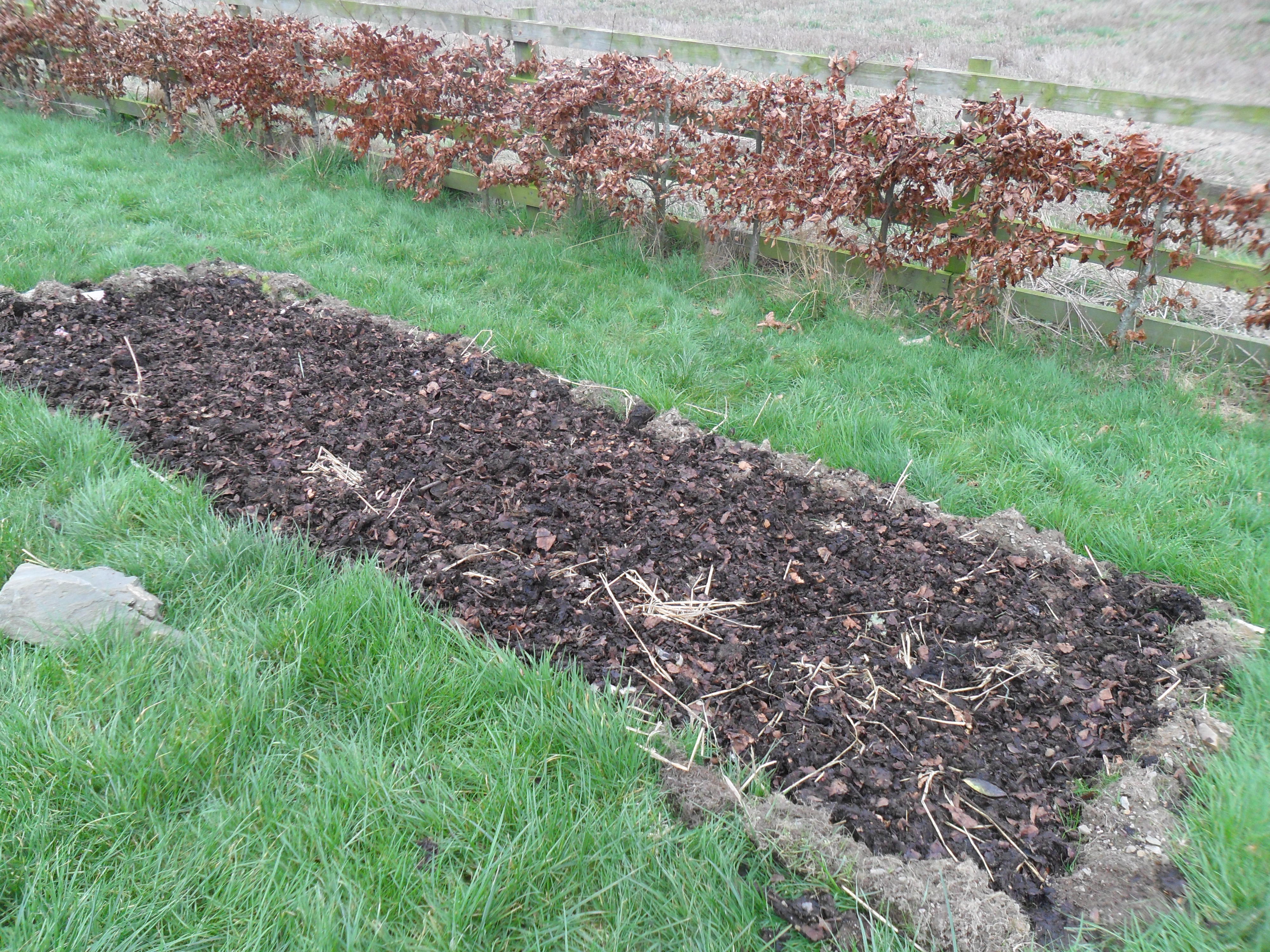
I am very excited to try planting potatoes this year!  Last week  I ordered my organic “Colleen” early seed potatoes, and some “Sarpo Mira” main crop seed potatoes from The Organic Center in County Leitrim.  They arrived in no time, and I  now have the early spuds sitting in egg cartons for about two weeks while they sprout.  In the meantime, I’ve prepped two areas for potatoes.  The first area I started about two months ago, by laying down newspapers and cardboard.  Just recently, I added compost on top.  (O.K., the “I” here is actually my husband!)   The next step is to throw some topsoil on.  I’m planning that will happen in the next two weeks when the early  potatoes will be ready to be planted.

The second plot is going to go through the same process, just at a quicker pace! I only put the papers and compost down today.  I’m so glad I had enough compost!  It’s really very basic planting – no fancy borders or anything like that.  We live in an area that grows potatoes in many of the surrounding fields, so I am hopeful that we’ll have a good experience with this.

Dinner … What’s cookin’? Lentils, vegetables & whole grain basmati rice.

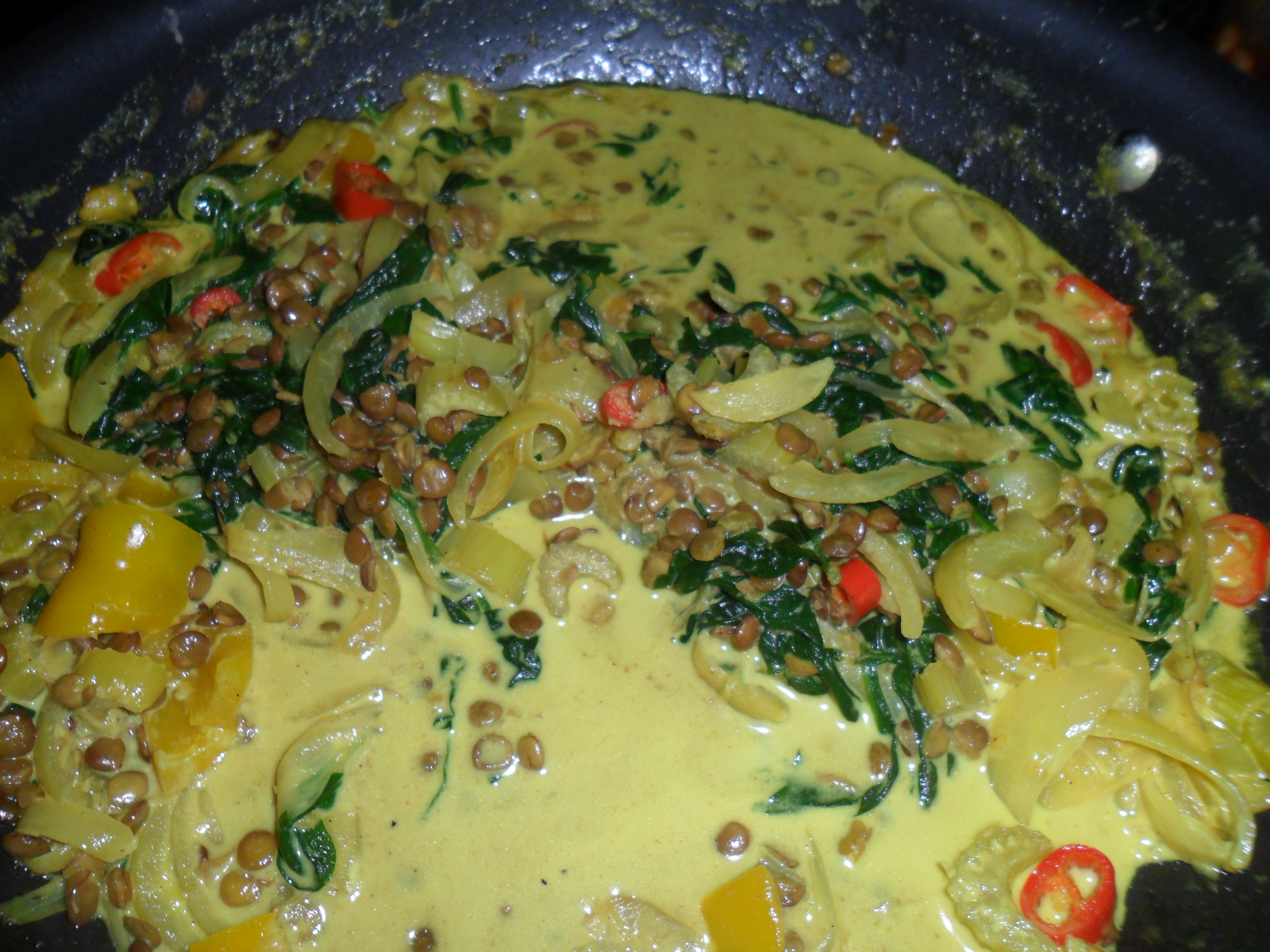
Dinner.  We eat  it every single day.  It’s not a surprise when the time for dinner rolls around again.  Kids, especially, want to eat.  Yet sometimes dinner time just seems to sneaks up on me and then I have no idea what we’ll be eating.  Yikes. This surprise feeling happens way more than I’d like to believe!  Today wasn’t so bad.  I had a general idea of what food I wanted to try and throw together. But honestly,  I do somewhat enjoy the  challenge of seeing  if I can come up with something interesting, healthy, and that the kids will eat – all  with no planning!  Sticking with my healthy theme, I wanted lentils and whole grain basmati rice.  To start things off with the vegetables, I used coconut oil and added  onions, celery, yellow peppers, one hot red chili pepper, and spinach.  Spices included a teaspoon each of turmeric, coriander & cumin, some cinnamon, and garlic.  Finally, I added full cream.  It smelled pretty good, so  I served  the vegetables on the rice with a dallup of whole fat Greek Style yogurt on top.   Phew! Finished just in time to eat and get the kids to their Irish dancing class!

Ordering vegetable seeds.

It’s February, and time to think about what I’m going to plant this spring.  Actually,  I started thinking about that before the summer was even over!  Last year was our first time planting vegetables, and we’re still experimenting with what works and doesn’t in our climate and soil.   Planting from seeds can be tricky if you’re not careful!   I spilled an entire packet of 100 very tiny turnip (swede) seeds into our raised bed last year.  And as luck would have it, every single seed took!  So we are going to skip  planting swede this year … and maybe next year, too.    The vegetables that didn’t fare well were broccoli (too many worms), cabbage, and tomatoes (you really need cover here for tomatoes).    What I am excited to plant again this year are zucchini (courgette), beets (beetroot), carrots, garlic, onions, rainbow chard, and squash.  They all thrived in our little garden and were delicious!  I am guilty of probably buying more seeds than I can handle.  I’ve added a few more vegetables that I’m going to try growing: peas, pumpkins, parsnips, and potatoes.  It really is just a coincidence that they all start with “p”!   I ordered my organic seeds today from The Organic Centre, which is in Rossinver, Co. Leitrim.  Their web site is theorganiccentre.ie.  I used their seeds last year and were very happy with them.  I am doing my best to keep our life as chemical free as possible.  The down side of being completely surrounded by fields is that they are sprayed a few times during the year.  I try to cover my plants when that happens, but realistically, I can’t do that completely.  We do our best.

In looking at my pictures, I was reminded that we had two unusual varieties of vegetables. Our “Yellowstone” carrots were, well, yellow!  Tasted delicious, they just weren’t orange.  Our “Golden Detroit” beets were also delicious, tasting exactly like purple beets just without the mess.  I was very happy with both varieties, so I think I’ll stick with them.

Next I need to map out where everything is going.  It’s important to rotate what you plant in your beds every year.  But I’ll leave that for another day.

Valentine’s Day – love your family and your compost!


Valentine’s Day can be a fun day to do something special with/for the kids.  I like to make cookies, and sent some in to school this morning with my girls.  We even have some left over for us to have at home which is a nice bonus.  Other than that, it’s not a big deal in our house.  I was never one to give my kids candy for Valentine’s Day.  They just don’t need it.  I usually had small gifts for them as a surprise (to make up for the no candy!) and I always gave them a  handmade card with words of what makes them special to me.  It’s too soon to tell if they’ll appreciate that, or only remember the fact they didn’t get chocolate!

So moving on from cookies … I’m going to jump to compost!  I love that we are composting.  It’s really not hard, and the result is fantastic feed for your soil!  I have a small container in the kitchen that I fill with raw vegetable scraps.  My 7 year old’s job is to empty that into a container we have right outside our back door.  When that fills it goes into the compost unit.  We’re pretty frugal when we can be.  You can buy fancy plastic containers for composting, or you can make a compost “unit”.   We found a helpful video on YouTube, and used wooden pallets to make a box like structure. When I say “we” I really mean my husband. I have to sing praises of him because he has done a lot of gardening work for me!  He built our compost unit.  We’ve modified the original one by taking off the bottom pallet.  This helps the flow of worms from the ground up.  I’ve also roughly started a second pile – to let the original one breakdown (I call it cooking).  With the new unit,  we are going to dig into the ground a foot deep and add the compost to that.  Again, this is to facilitate the movement of worms, and speed the breaking down process.

What do I compost?  The toilet rolls, our cardboard egg cartons, egg shells, tea bags, coffee grounds, all raw vegetables, grass cuttings, leaves.  I don’t compost cooked food, or meat or fish, or cat litter (gross!).  It’s important to bread down what you are composting.  The egg shells need to be crushed completely, egg cartons & toilet rolls need to be ripped into tiny pieces.  Vegetables need to be cut up.

Items can be categorized by being “green” “intermediate” or “brown”.  Here’s some examples:

GREENS – quick to rot

  • grass cuttings
  • poultry manure (without bedding)
  • young weeds & plants, nettles any age

INTERMEDIATE

  • fruit & vegetable scraps
  • rhubarb leaves (poisonous)
  • teabags, tea-leaves, coffee grounds
  • remains of veg plants
  • straw animal manures
  • cut flowers (cut smaller)
  • soft hedge clippings
  • bedding from herbivorous pets – rabbits, hamsters, etc.
  • perennial weeds (large quantities should be in their own pile)

BROWNS – slow to rot

  • old straw
  • tough plant and veg stems (broccoli)
  • old bedding plants
  • Autumn leaves
  • Woody prunings, evergreen hedge clippings (large quantities should be in their own pile)
  • cardboard tubes, egg cartons
  • crumpled paper and newspaper

Technically, the layering of your compost should be brown material, green material, light sprinkling of lime, then repeat.  There should be approximately 15 cm depth per green/brown layer.

Having said that… I heap mine on!  We keep an eye on whether it gets slimy.  That means it needs more browns.  We occasionally put lime on.  My husband rotates it with a pitchfork (he calls it a grape).  We keep it covered with plastic (and then wood on top of that to keep it from blowing away).    You just know by looking when it’s perfect for spreading – should be a nice dark brown soil/near soil texture.   Oh, and there should be LOTS of worms!

Compost – it’s an easy way to recycle what you have to make something great!  I hope you’ll try it, too.

Discovering what I was supposed to do … and Lavender Sachets, too.

It’s one of those things that I rarely do; sit down and concentrate on one thing.  I have three kids, a husband, and a cat.   I am being pulled in different directions 24/7.  So it was a nice change to have a quiet evening to myself where I could read through my gardening journal uninterrupted.  Yep, I was able to read about all of the great things I could have done in my garden this past fall… Ah well, this is a learning process.

I might not have been in the garden, but I was using plant material from my garden.  I was lucky enough to have English Lavender (Hidcote) already flourishing in our yard when we moved here.  Six plants of it. Six huge, gorgeous deep purple, super fragrant plants.  Prompted by my one sister-in-law, I decided to try drying them.  I cut as much as I could in July, and hung them upside down in dark places where ever I could manage in my house.  I liked having it in my closet as it smelled great!  By winter, the plants were plenty dry and ready to have the lavender pulled off of the stems.  Tedious, and way too boring an activity for the kids, it was just me left to do this task.  Boy did I smell fragrant doing this!  I filled a large air-tight container (a few times).  What to do with an abundance of lavender?  Make Sachets!  For all of the aunties, sisters-in-law, teachers, and to my neighbor who gave me the horse manure.  My husband has his sachet hanging in his car. My daughter has hers next to her pillow. I recently gave one to new parents as an accessory for their diaper (nappy) bag.  Everyone gets Lavender Sachets! 🙂

Mom in the Kitchen. Making Granola.

It’s my favorite room in the house: my kitchen.  I really enjoy cooking, and baking, and eating!  I try to maintain a healthy balance with what we eat.  Really, I do try.  Sometimes my kids like it, and sometimes they wish I’d be more like their friends’ moms and not care so much!  Like I said, I’m trying to get that balance right.

I think granola is a nice healthy snack food.  There is a wonderful restaurant in Ithaca, NY called the Moosewood.  The last time I was there, a few years ago, I was so taken aback by our experience that  I bought their “New Classics” cookbook (and even had it signed!).  They have a Maple Nut Granola recipe that is just too easy not to make.  Variations are a snap, too.   I really like to eat this granola with Organic Greek Style Yogurt from Glenisk.  I have to write a small note about Glenisk.  They are a company that I love to support by eating their products!  An Irish, family run, all organic company in County Offaly.  You just feel good eating their food!  I buy their organic yogurts – Greek Style for me, and fruit for the kids.  There, that’s the end of my plug for Organic!   I hope you enjoy this recipe!

Maple Nut Granola from Moosewood Restaurant’s New Classics cookbook:

4 & 1/2 cups medium-cut organic rolled oats
1/4 cup oat bran
1/2 cup sunflower seed
1/4 cup hulled sesame seeds
2 teaspoons ground cinnamon
1/2 cup blanched and sliced almonds
1/4 cup whole toasted cashews*
1/4 cup coarsely chopped Brazil nuts
1/4 cup coarsely chopped walnuts
1/3 cup vegetable oil
1/2 cup pure maple syrup
2 tablespoons barley malt or unsulphured molasses
*toast cashews in a single layer on an unoiled baking tray at 350 degrees F for 5 to 10 minues until fragrant and golden brown.

I made mine using cashews, pecans, and coconut – in exchange of the nuts listed above.

Preheat the oven to 350 degrees F or 177 degrees C. Lightly oil a baking pan.

In a large bowl, mix together the oats, oat bran, sunflower seeds, sesame seeds, cinnamon, and the nuts. In a small bowl, combine the vegetable oil, maple syrup, and barley malt or molasses (I used molasses). Stir the maple mixture into the oat mixture and toss well to coat thoroughly. Spread the granola evenly on the prepared baking pan.

Bake for 15 to 20 minutes; stir at 5 minute intervals to ensure uniform baking, until golden brown.

Remove the pan from the oven and place on a cooling rack. When completely cool, place in an airtight container for storage. Will keep for 7 to 10 days.

Pruning the apple & pear trees.

I took an organic gardening course before we bought our house.  I had big plans even back then!  I put all of my notes and the handouts  in a folder with the hopes that one day I’d get to use them.   I guess the expression “good things come to those who wait” keeps me going!  We were given two apple trees as a house warming present (what an awesome gift!) and we added a pear tree ourselves.  So it was time to do the year 2 pruning according to my notes.  Per my class:

From November through February Select 4 primary branches with good spacing and balance.  Cut back by half.  Remove any unwanted branches.  At end of season (Oct), strong secondary branches will have formed.

There, that’s done!  You can see the nice apples we had last season!

Time to trim the hedges.

It’s February, and a perfect time to get the hedges neat and tidy. The weather is somewhat mild and you’ll find some sunny days too.  In Ireland, it is illegal to cut hedges  between March 1st and August 31st as it’s contrary to the Wildlife act.  So this gives us a window of about a month to get all along the property line trimmed.   I have beech hedges (Fagus Sylvatica) which are slow growing.  I like them as the leaves turn brown in the fall, yet stay on the branches until the new leaves appear.  This gives some color (albeit brown!) all through the winter.   I am cutting them down fairly low to get them to spread out sideways.  I’m keeping them below the top of the fence until they are really full.  This is my second year cutting them – they are about 4 years planted (the owners before us planted them, but only lived here for about 2 years).  The 2nd picture is a shot of  what I still have to do.  It’s a work in progress!

Spreading out horse manure.

We had a glorious day of sunshine today, with temperatures around 9 degrees Celsius.  This was perfect for spreading some horse manure my neighbor had given me just yesterday.  I wouldn’t be an expert on manure, but it was somewhat “aged” and full of wonderful worms for the soil.    We have been working on this one (new) garden for about a year.  It started as all grass, like the rest of the yard.  So I first  put down a load of newspapers to kill the grass. Then I added seaweed on top.  To keep it from blowing away, I added some heavy compost.  In the meantime, boxwood plants went on sale so we bought a bunch of them and planted them around the border.  I am hoping the horse manure will be the final stage before planting.  We did plant some tulip bulbs in here this past fall, but the main intention for this garden is for roses.  I’m hoping to get them this summer.  One step at a time.

Getting Started.

It’s February, and in Ireland we thankfully have mild enough weather to get out into the garden (yay!). We moved into our home almost two years ago and we see the garden as a lifetime project. We live in the country with fields all around us, and pretty much love it! Every season is a new adventure as we learn about planting a vegetable garden, starting a compost area, growing fruit trees & plants, and simply creating our garden! I hope you enjoy seeing how things progress!