An abundance of pickling cukes … and a dill pickle recipe!

Deciding what to grow in the garden is usually a fun discussion with the family.  I like including them, hoping they’ll make healthy eating choices later on.  Our  littlest one would love if we only grew potatoes and carrots!  I still have a lot of work to do with her taste buds…  My son suggested growing cucumbers this year – so we could pickle them.  We love dill pickles on our burgers and they are impossible to find in the grocery store!  Must be an American thing 🙂

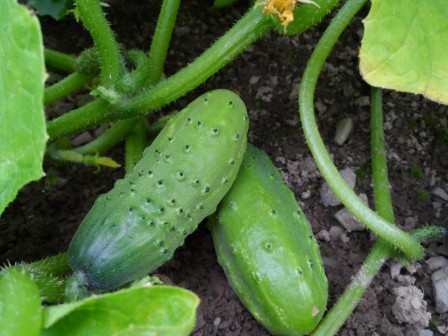
We figured, why not give pickling cukes a try?  So that is what we did.   Our summer was rather cool, and wet, so it was slow growing.  I planted them next to the zucchini which didn’t mind the odd summer weather, and I really had given up hope that they’d grow at all.  But by mid-August, the cucumbers were a nice size (between 4 and 6 inches long and getting fat!).  We’ve done two batches of pickling so far, and I have enough in the garden still  for one more batch.  We’ve already eaten some, and they were delicious!

Confession time: my husband and daughter have been doing the pickling!  All of it; from finding the recipe, then pickling, and finally to taking the pictures!  It’s good to share the fun, right?

It was neat growing something new. I really enjoy going into the garden and seeing how things are growing.  It’s so nice to see all of those flowers on zucchini, pickles, and pumpkins, too!  I’ve included the recipe my husband used.  I know it had quite a strong garlic flavor the first time, so they cut back on garlic for the second batch.

Happy pickling!
Dana

Boston Pickling Cucumbers.
Boston Pickling Cucumbers.

Boston Pickling Cucumbers.

Boston Pickling Cucumbers.

Boston Pickling Cucumbers.

Look how they grow! Boston Pickling Cucumbers.
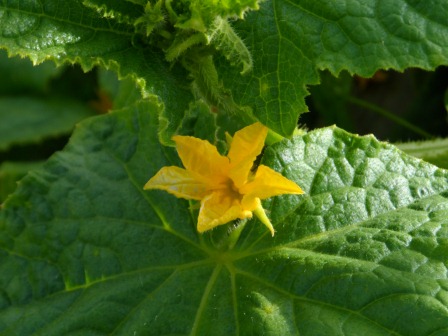
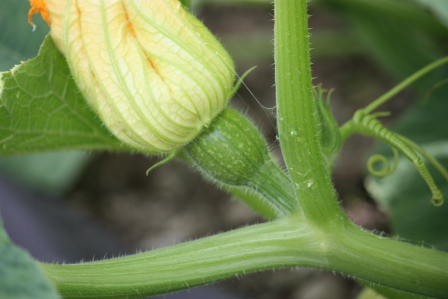
A cucumber flower.
A cucumber flower.

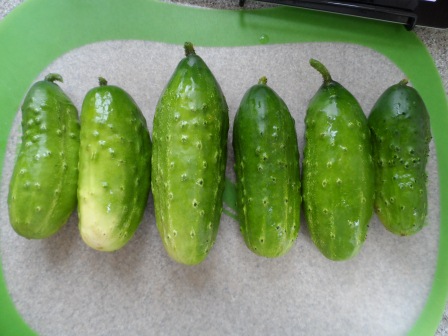
All lined up and ready to be pickled!

Pickling the cukes.

Pickling the cukes.

Now we wait!

Now we wait!

Kosher Garlic and Dill Pickled Cucumbers (Parve)
From , former About.com Guide

Ingredients:

  • 3-4 pounds (1 1/2-2 kilo) young and small cucumbers (dark green, firm, warty skin)
  • 2-4 sprigs of fresh dill
  • 6-8 cloves fresh garlic, peeled and cut in half
  • water
  • kosher salt
  • white vinegar

Preparation:

1. In a large jar, place 2 sprigs of dill and 3-4 cloves of garlic.
2. Wash and snip off ends of cucumbers. Put cucumbers in the jar until it is full.
3. Add water to the jar, one cup at a time. Then add 1 tablespoon of kosher salt and 2 tablespoons of white vinegar for every 3 cups of water added.
4. Top with 2 more sprigs of dill and 3-4 more cloves of garlic.
5. Once the jar is filled to the top, seal jar. Gently shake to mix.
6. Set in window or outside where it will get some sun. Allow approximately 4 days for fermenting. If you like more sour pickles, can can let them stay in the jar for an extra day or two.
7. Refrigerate.TIPS:1. Use cucumbers that are small, young, dark green, firm, and have warty skin.
2. The jar should be filled to the top with the cucumbers and water (see photo).
3. The vinegar ensures the pickles will be crunchy and not soft. So if you like a hard pickle, add a bit more vinegar.
4. If you want your pickles to be ready in less than 4 days, you can boil the water with the salt and vinegar. Let it stand so it gets to room temperature. And then add it to the cucumbers. This speeds the fermenting time.
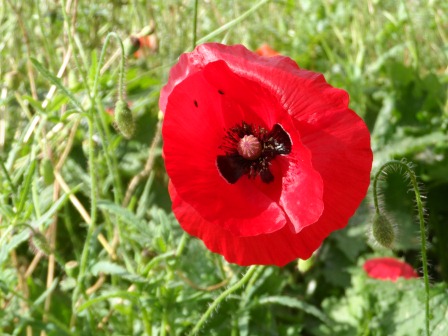
September 11th, 2001 … Red, White and Blue flowers to remember.

Today is a notable day to remember 11 years ago.  As an American, I can remember vividly what I was doing and where I was on the morning of September 11th, 2001.  My little post today is just to remember all of the special people who were affected by that day.  Because you know, we are all special in our own way.

God Bless,
Dana

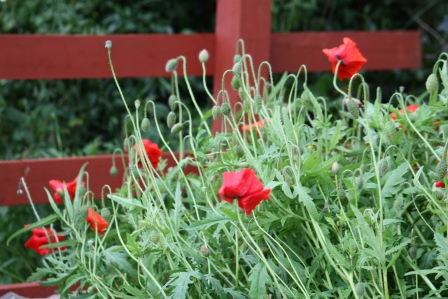
Red poppy.

Red poppy.

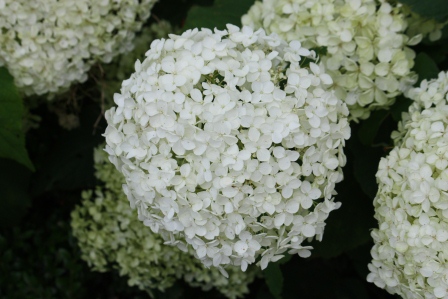
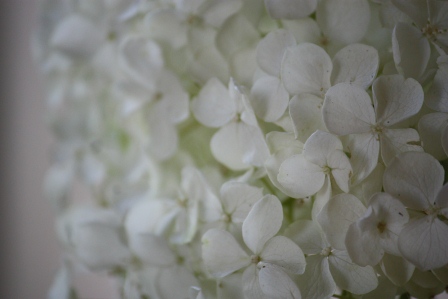
White Annabelle Hydrangea.

White Annabelle Hydrangea.

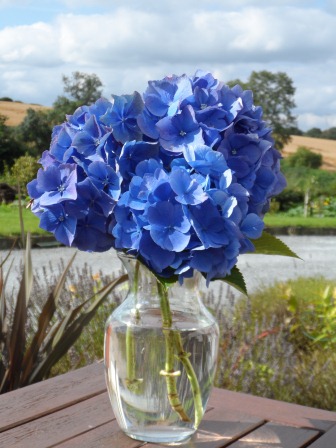
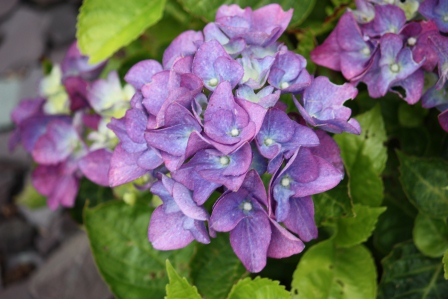
Blue Hydrangea.

Blue Hydrangea.

Time for a cuppa? Zucchini bread with crumb topping is perfect for your break!

Zucchini bread tea break.

Zucchini bread with crumb topping on Vinegar Hill pottery.

Zucchini (courgette) are fairly easy to grow, even in Irish weather.  Just a couple of plants will yield plenty of zucchini in one season.  I have to check on them daily as they grow, because they can get quite large rather quickly.  It is better to not let them get “out of control huge” as then they lose their tastiness.

There are so many different ways to use zucchini.  We often just slice them up,  lightly coat in olive oil, add some Cajun spices,  and throw them on the outside grill.  It’s too easy!  I think our  favorite thing to do with zucchini though, as rated by family and friends, is making zucchini bread.  Only after moving to Ireland did I start to think that the name is a bit off: it should be called cake!  It’s perfect to have with your cuppa of choice, whether coffee or tea.  It isn’t a common dessert here, so I like giving it to friends and family as a way of sharing something different.

A friend from Syracuse, New York, Charlotte, shared her recipe with me last year.  I hadn’t seen crumb topping in a zucchini bread recipe before.  What a hit!  I do realize this is not a health food. 🙂  But I did make a couple of changes to the recipe to make it more healthful in my eyes:  I added some whole wheat flour,  increased the amount of zucchini, decreased the amount of sugar, and changed the sugar from white to Demerara (unrefined cane sugar), and I added nutmeg.  Yeah, I know, it still has oil in it, but ya gotta live a little!

There wasn’t any sun shining when I took my pictures (have I mentioned the weather we’ve been having this summer???).  I have my plate and cup as close to the window as possible, which isn’t a very nice set up (sorry).  The pottery is my newest addition from County Wexford. It is called Vinegar Hill, and I absolutely love it.  We met the artist and it was so nice to get the story of the historical meaning of the pattern.  But that is for another post!

I hope you get to enjoy a lovely cuppa with some zucchini bread sometime soon!
Dana

Zucchini Bread

Dana’s adaptation
of Charlotte Santella’s recipe:

Ingredients

  • 2 cups whole wheat flour & 1 cup white flour
  • 1 teaspoon salt
  • 1 teaspoon baking soda
  • 1 teaspoon baking powder
  • 3 teaspoons ground cinnamon
  • 1/8 teaspoon of nutmeg
  • 3 eggs
  • 1 cup vegetable oil (can substitute ½ cup apple sauce & ½ cup oil)
  • 2  cups Demerara sugar (unrefined cane sugar)
  • 3 teaspoons vanilla extract
  • 2 ½ cups grated zucchini (usually takes 2 large zucchini to get this)
  • 1 cup chopped walnuts (optional)

Crumb Topping:

  • Crumb Topping: 1/2 cup regular oats, 1/2 cup packed brown sugar, 1/4 cup flour, 1/4 tsp cinnamon, 1/4 cup cold butter (2 oz) cut into small cubes.  Combine dry crumb topping ingredients, add cold butter and mix (I use my hands) until combined.  Add this to pan 5 minutes into baking.

Directions

  1. Grease & flour two 8 x 4 inch pans. Preheat oven to 325 degrees F (165 degrees C).
  2. Sift flour, salt, baking powder, soda, and cinnamon & nutmeg together in a bowl.
  3. Beat eggs, oil, vanilla, and sugar together in a large bowl. Stir in dry  ingredients to the wet  mixture, along with zucchini (and nuts if using) until well combined. Pour batter into prepared pans. 5 minutes into baking sprinkle crumb topping over top of  loaf pans.
  4. Bake for 40 to 60 minutes, or until tester inserted in the center comes out clean. Cool in pan on rack for 20 minutes. Remove bread from pan, and completely cool.   (mine are rarely finished before 60 minutes – I think because I heap those measuring cups with zucchini!).

Enjoy!

Zucchini bread with crumb topping on Vinegar Hill pottery.

Zucchini bread with crumb topping on Vinegar Hill pottery.

Zucchini bread with crumb topping on Vinegar Hill pottery.

Zucchini bread with crumb topping on Vinegar Hill pottery.

Vinegar Hill pottery.

Vinegar Hill pottery from County Wexford.

Zucchini (courgette).

My Zucchini (courgette).

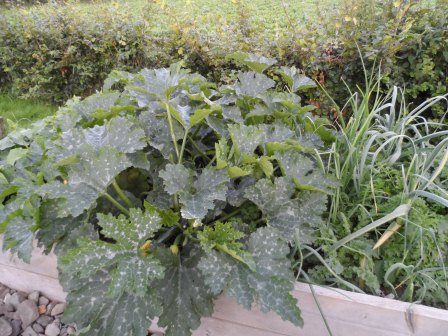
Zucchini (courgette) growing great in the raised bed.

Zucchini (courgette) growing great in the raised bed.

Zucchini (courgette) growing really well in the raised bed.

Zucchini (courgette) growing really well in the raised bed.

Wild flowers.

I couldn’t have a post without any flowers in it! 😉

An August garden tour – Potatoes, Blueberries, Pumpkins, and Apples!

I love having a vegetable garden.  It is really cool going out into the yard and picking something for dinner.  Yeah, and at the produce shop, I have a little conversation with myself that goes something like this: “No, I don’t need to buy potatoes ’cause we have lots of them. Nope, I don’t need any zucchini cause we have too many of them! And no, no peas for us this week because we have them, too!”  And I smile to myself 🙂

I like it.  We’re still learning. And growing. And changing.  But I think it is all good.  I tend to only put “pretty” pictures in the blog.  I’ll change that this week.  One picture shows what should be the pretty pumpkin flower, but this one is eaten by slugs.  We have had so many, many, many slug this year!  It’s amazing we have an abundant harvest given how much was sacrificed to slugs.   We’ll be changing the layout of the fruit orchard this winter.  The strawberries needed more space than we planned so we’ll be spreading them out.  Now about the pumpkins: they take up a lot of space!  But I love seeing their flowers so late in the summer.  We’re hoping for some pumpkins this year – if they survive the slugs!  Luckily, our potatoes haven’t been affected by the slugs.  Our main crop variety of Organic Sarpo Mira are delicious.  The soil is excellent after the compost worked through it.  It’s quite easy to fork up the spuds, wipe off the dirt, and boil them up!  I think they just might be our favorites of the garden (for the moment, anyway).

I hope you have access to fresh garden vegetables this summer!

Dana
P.S. I changed my blog around a little bit. I hope you like it!

A view of the fruit orchard. The rhubarb has been cut, strawberries are overgrown, and the pumpkins are taking over! Apple trees are happy.

Another view of the fruit orchard. The blueberry plants on the right aren’t very big, but we were surprised by all of the yummy fruit!

Our eating apples coloring nicely.

The pumpkins growing like crazy.

Pumpkin flowers.

O.K., here is the ugly picture: the flower on the right has been eaten. I decided not to show you the picture of the slugs 🙂

I have a bunch of these tiny little pumpkins … I’m not sure if they are too late to develop fully. We’ll have to wait and see.

My “Before” picture of some of our blueberries.

The “After” picture of some of our blueberries! They were sweet and delicious!

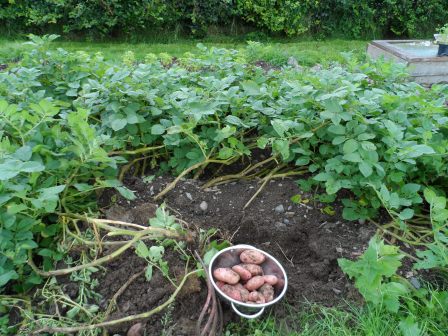
The bed of Organic Sarpo Mira potatoes, our dinner’s worth, and the fork to lift them out with!

They really are a great size! We’re delighted with their taste, too.

I have to have a picture of flowers in my post! This was about 6 PM this evening. After yet another very wet day, the evening was simply beautiful. And for that I am very, very thankful.

From sharing flowers … to growing a Hydrangea from a cutting.

Having friends who like to share their flowers is such a great thing.   A lot of my garden (flowers and fruits) are from friends and family.  My friend Susan has such a beautiful and well loved garden.  After one visit to her last year, I left  with a gorgeous bouquet of blue hydrangea.  I had the arrangement up high in my kitchen, and well,  just left it there.  Some of the blooms actually dried,  which I think is also very pretty.  One bloom had just enough water to grow roots.   Roots!  O.K., for those with Green Thumbs this would be no big deal, but for me it was huge!  I put the cutting in a small pot, out of the sun, in our laundry room.  I watched it die down, and then miraculously start to grow again.  I waited until I had transplanted it into a bigger pot before even telling Susan. I didn’t want to take any chances that it might not make it!  Now it is in a bigger pot, with a big flower and seeming to be very happy.  The color has changed; it’s now pink.  I only have it in a peat/compost mixture though.  I’ll have to wait until I plant it in the soil to see what color it will be in my garden.

Are you sharing your flowers with a friend?  Or if not,  I hope you have a friend who likes to share with you!  🙂

Dana

A beautiful blue hydrangea. from Susan’s garden.

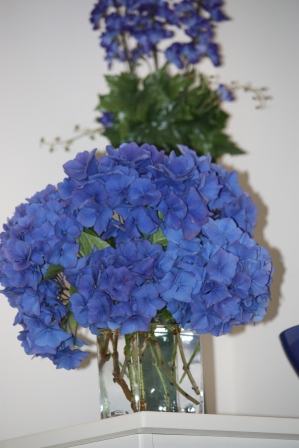
Cut flowers of  hydrangea, sitting up high in my kitchen.

“Susan’s hydrangea” growing bigger.

Side view of more growth.

Buds appearing!

A flower! It’s not blue, but it’s only in a pot of compost/peat. We’ll see what color it turns after it’s eventually planted in my garden.

Still growing and getting more pink in color.

Even more pink!

Just a pretty view.

This is officially known at my house as “Susan’s Hydrangea”!

Some fabulous scents are in the garden now, which is perfect timing since the lavender is finished.

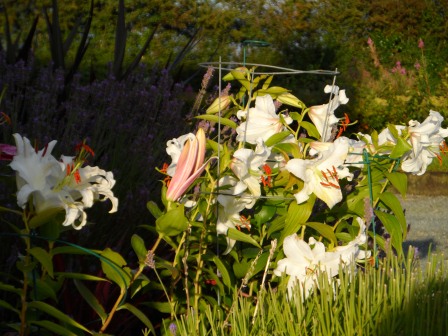
This is my flower of the moment! I love how it smells just walking past the garden!

The lilies are in among my lavender plants. We get so much wind that I have to stake them (ok, it’s not very pretty – I’ll have to seek out a prettier system next year!). You can see in the front I’ve trimmed the lavender plant, and I still have to trim the one in the left background.

Roses, Hydrangeas and Poppies for some summertime beauty.

Mom in the garden. That’s me.  Except I haven’t been able to get into my garden very much the past few weeks. This, unfortunately,  is making me quite grumpy!  So I’m simply going to post a bunch of pictures that make me feel like I’m in my garden.  🙂

I hope you like them. And that they make you feel happy too!

Dana

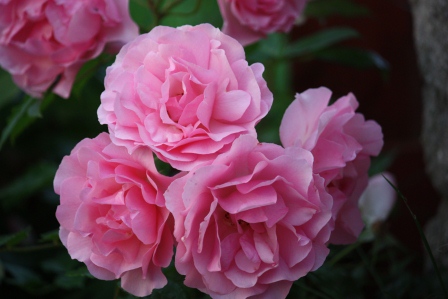
A cluster of my climbing roses (Zephirine Drouhin). I’m so happy with their brightness factor on our fence!

I really liked the lighting on this Zephirine Drouhin Climbing rose.
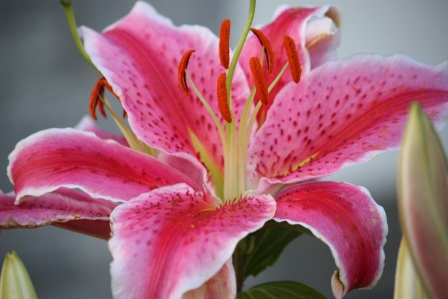
This is my sister-in-law’s Tiger Rose. I think it is amazing! (and I really *need* to get one!)

What a splash of color this beautiful Tiger Rose adds to a garden!

Evening sunlight softens the color tone of my Burgundy Ice Floribunda Rose.

Evening sunlight on my Iceberg Floribunda Rose. I can’t resist taking pictures in the evening!

Fuchsia is a very popular plant in Ireland. It’s not uncommon to find it growing in hedges in the West. It was introduced to Ireland in the mid-19th century from Chile & Argentina. (This picture was taken in County Mayo).

Is it any surprise that I have a picture of a Hydrangea? I love their high cheerfulness factor!

Yep, another Hydrangea picture…

My Clematis ‘Bagatelle’ (Dorothy Walton). This picture is for my husband 🙂

My poppies on a glorious morning!

A different view of the poppies.

Marigolds to finish the post with.

A beautiful visit to Kylemore Abbey & Victorian Walled Gardens, Connemara Ireland.

Kylemore Castle.

The first full sunny day of our holidays beckoned us to visit Kylemore Abbey &  Victorian Walled Gardens.  It  is simply beautiful, and if you are  in Connemara it is well worth the visit. www.kylemoreabbeytourism.ie  Admission for our family of five was 33 euros (about $40).  The first worker we came across was a lovely Irish girl who informed us that midgets (very annoying, small mosquito like bugs) love the Connemara area, and that the best defense for them was spraying on Skin So Soft (an Avon product)!  She kindly handed us her bottle and said “here, you can spray your family”.  So then we were armed to enjoy our day at the Gardens.

Kylemore Abbey sits on 1000 acres with woodland, lakeshore, and the largest Victorian walled garden in Ireland. The castle was built in 1867 by Mitchell Henry (as a romantic gift!) for his wife Margaret. Tragically, Margaret died in 1874.  In 1877 a Gothic Church was built on the property as a memorial to her. It is often described as a cathedral in miniature due to its proportions.   It is beautiful, with pillars of stone from the 4 provinces of Ireland: red Cork marble from Munster, black Kilkenny marble from Leinster, green Connemara marble from Connaught, grey Armagh marble from Ulster.

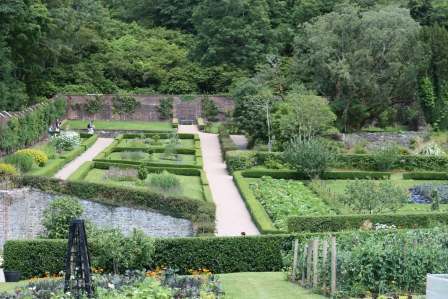
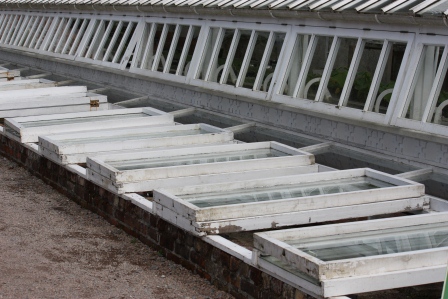
The 6 acre walled gardens have been restored to some of their 1870s majestic splendor.  They only have plants and vegetables which grew in Victorian times, growing them all from seed on the grounds.  So far, two of the original 21 glass houses have been restored.  I was surprised to learn of the exotic fruits they used to grow in them. Fruits such as bananas, melons, grapes, and figs were grown and sometimes shipped to England.  The garden is divided into two areas; a kitchen garden and a flower garden, with trees and a stream dividing the two.

Since 1920 Kylemore has been home to a community of nuns of the Benedictine Order.  They are the directors of the Kylemore Trust, keeping a close eye on how the Kylemore estate is run today. In addition to their spiritual daily routine, they run their farm and make handcrafted products such as soaps, sweets, and jams.

This is just a small glimpse! There really is so much more to this beautiful gem of an estate.  It is well worth a visit. We were very lucky to have a lovely sunny day to explore the grounds, and some Skin So Soft to protect us from the bugs 🙂

I must get back to my garden plans … they need some adjusting after this visit!
Dana

View of Kylemore Castle from the far side of the lake. In order to preserve the family’s privacy, Mr. Henry had the main road re-routed to the far side of the lake, and used the original road, which runs in front of the castle, as his personal access road around the estate.

The Gothic Church. Note the stone which comes from around Ireland.

The Gothic church is often described as a cathedral in miniature.

View around the lake at Kylemore Abbey.

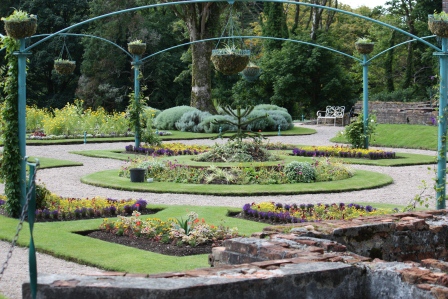
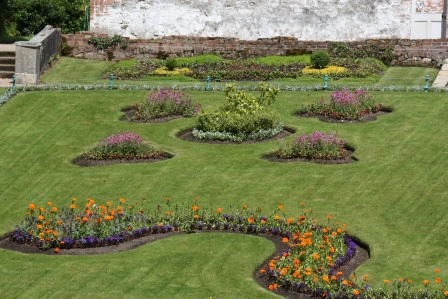
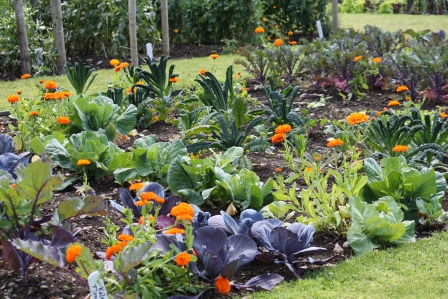
The gardens captivated me!  They were incredibly neat and tidy, with so many different sections!  I’ve tried to give a glimpse of as much as I could.  We were lucky to  manage some photos with very few people – it’s just how the flow of people moved.  I hope you like the little virtual tour!

The flower garden side of the walled gardens.

Flower garden side of walled gardens. The designs are exactly as they were in the original gardens.

The kitchen garden side of the walled gardens.

View of the mountains from the kitchen garden side of walled gardens.

Some of the cold frames. All of the plants at Kylemore are started from seed on the grounds.

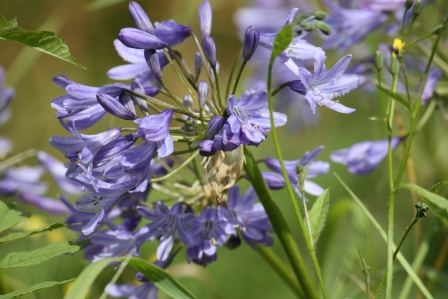
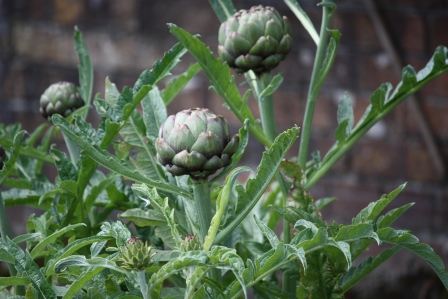
Artichokes.

A splash of color.

Couldn’t resist a picture of a purple flower…

Beaches in Connemara, County Galway, Ireland.

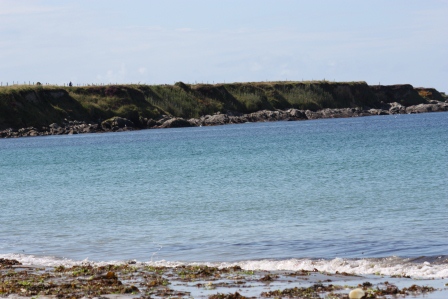
It’s summer vacation time and we had the opportunity to explore a bit of Ireland as a family.   We decided to head to the West, choosing to explore around  Connemara, County Galway.  The landscape in Connemara is so beautiful and unusual.  The surrounding mountains frame it perfectly.  There are rocks everywhere: making up the landscape, walls, houses, even the beaches! And of course there is the sea, which is beautiful from any angle.  At 14, 12, and 8 years old, my kids still love playing in the sand & water at the beach.  Thankfully, it doesn’t matter to them whether it is cold or not, or even if it is raining,  because Ireland is not known for its heat (or sunny weather)!  Some of the beaches in Connemara are incredibly pristine, and the water, I kid you not, was turquois.   They had a ball… while I was wrapped in a blanket. 🙂

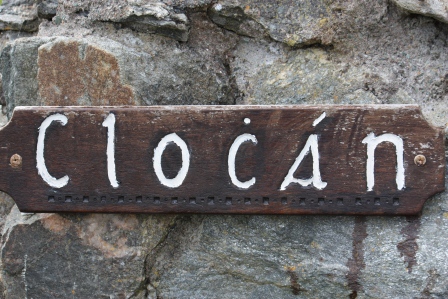
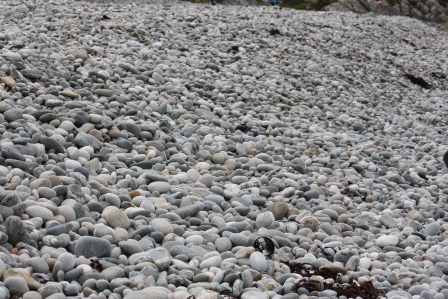
One beach we visited was completely covered in stones, with no sand at all. We had to drive through a pillared gate to get to the beach and the sign appropriately read “stones” in Irish  (clocán). It was a short visit, but so neat to see.  Here are pictures from some of the beaches, and some wildflowers. I just bought a fantastic handbook of Ireland’s wild flowers. It is great to be able to put a name on all of the flowers we so often see!

Will you be visiting Ireland any time soon?  What are you hoping to see?

Happy Summer!
Dana

Errislannan, Connemara.

Irish sign on the stone beach in Errislannan.

A beach of stones in Errislannan, Connemara.

Stone wall with bell heather in Errislannan, Connemara.

Ballyconneely, Connemara.

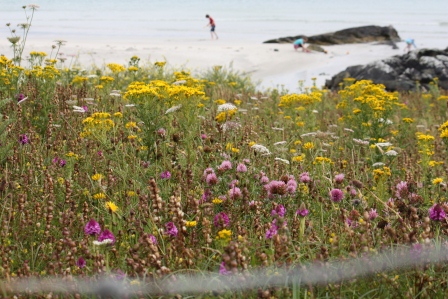
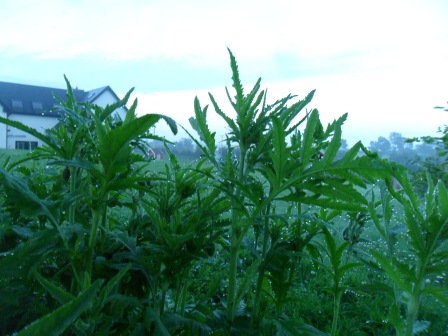
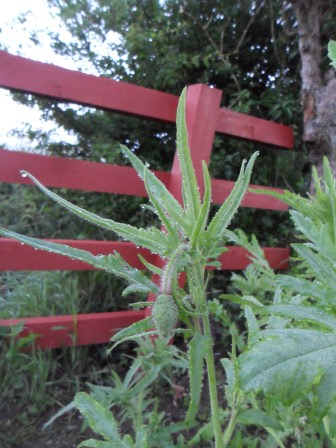
Wild flowers of ragwort, pyramidal orchid and wild carrot, and my kids playing on the beach in Ballyconneely.

A pristine beach in Ballyconneely, Connemara.

Kids work.

A pristine beach all to ourselves in Ballyconneely, Connemara.

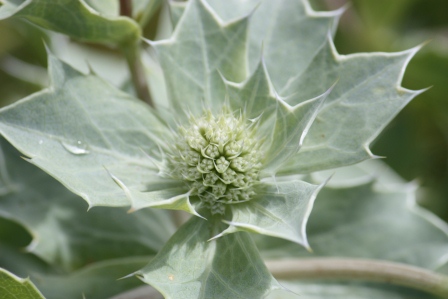
Sea Holly blooms in June, July & August. Only found by the sea, sandy strands and on the front of sand-dunes.

Sea Holly – an Irish wild flower.

The Pyramidal Orchid, an Irish wild flower, flowers from June through August, and can be found in dry grassland and sand-dunes.

On another day, on another beach in Ballyconneally (in the rain). Connemara.

Three happy kids on a sunny day in Cleggan, Connemara.

Stones in Cleggan, Connemara.

Poppies and other flowers from the garden.

My poppies have bloomed!  Just like a child, I’ve been checking on them every day, wondering when they’d finally bloom.  The wonders of gardening for me is not knowing if the seeds you planted will take!  They are planted by my ditch rock wall.  I planted way too many seeds!  The upside of that is it crowded out weeds.  The area right next to the poppies is in need of some serious work.  The weeds are super strong. It’s going to be quite the battle!  But for now I can enjoy the bright blooms of the poppies, and worry about the weeds another day.

I hope your garden is full of wonderful blooms!
Dana

Early morning fog in Sheepwalk.

I woke up very early one morning and couldn’t sleep.  A peek out the window enticed me to take a walk around our garden.  It was so beautiful! These four pictures were taken around 4:00 A.M.

Early morning pre-bloom poppies.

And here come the blooms!

Poppies!

Poppies.

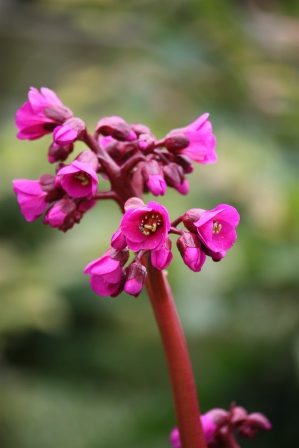
Some other plants have been flowering too.  This Bergenia is so pretty!  The leaves are somewhat large and hardy, and turn a burgundy color after their green start.

Bergenia flowers.

Bergenia plant & flower.

This hydrangea was given to me at the end of last season. It’s so pretty in with my lavender.

Hydrangea.

We’ve had some really windy days recently. The poor roses!  I’ve been cutting some to save them from being battered!

Hybrid Tea Rose Pink Peace.

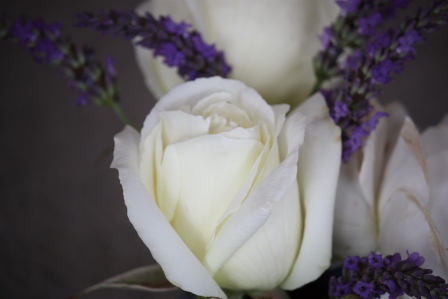
Hybrid Tea Rose Silver Anniversary with lavender.

This climbing rose is at our front gate and seems to be quite happy.

These are some pictures I took of blooms in the garden.  My camera is broken (two cameras, actually!) so I’m using a  zoom lens that I wouldn’t normally use.  It was challenging, but I think I captured some color, which was my goal!

Summer flowers with lavender.

Summer flowers.

Summer flowers.

Marigolds.

I love Marigolds. They are so bright and cheerful! They remind me of my childhood when my mom would save their seeds and use them the following year.  I did that with these, too.  🙂

English Lavender in full bloom = Lavender Wands!

Lavender Wands.

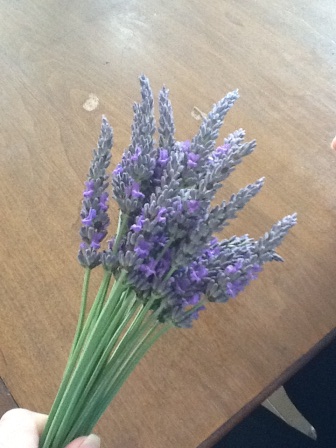
It’s July and my lavender is in full bloom.  Just brushing past it gives off a wonderful scent. This usually happens in the evening as I’m pulling off slugs from the neighboring hosta and lilies, so it’s a welcome reprieve from such yucky work!  I came across lavender wands a couple of years ago, and have decided I really like making them.  It’s fun to work with my hands, and it smells so lovely during the weaving process.  It’s not difficult to do, either.    I gather a handful of stems, tie them together, fold the stems over the blooms, weave the ribbon, and finish with a little bow!  🙂  Here are a couple of pictures of the process:

I like my wands nice and full, so I usually collect between 19 and 23 stems. Look for stems that have some flowers open.   Inevitably, one stem will break in the folding-over process, so I’ll end up with 22 which works well for the weaving since I work with them in twos.

Tie a ribbon at the base of the flowers (not too tight or you’ll break the stems).

After you gather your stems and peel off any greens, line up the blooms and tie a ribbon at their base.  You can use 3mm, 5mm, or 6mm size ribbon. The wider the ribbon the less weaving you’ll have to do.  I think 5 mm is perfect. I figured this out after making lots of wands with 3mm!

Folding stems over the flowers.

Next, hold the flowers in your hand and fold two stems down (gently, so they don’t break), put ribbon either over or under these two, and bring two more stems down. I use two stems, but you can use one or three. I found one to be too much work. Then repeat the process, bringing the ribbon over and under the stems.

I had a lot of fun making these, and putting together a rainbow of colors.  You could hang these in your closet, or put them in your dresser drawers, or leave them on the window sill of the bathroom!  Because I have so many, I have mine in a vase in my family room.  They will last for years.   I am going to try and sell them at a fair coming up in a few weeks. We’ll see if there is any interest for Lavender Wands!

English Lavender in full bloom.

I can’t be 100% sure of the type of lavender I have since I didn’t plant it. But I believe it is an English hybrid (Lavandins), probably Abrialii.  This variety blooms after English lavenders finish their blooming and it lasts to mid summer.   They really have a strong fragrance, and are great for drying too, since the flowers are easily removed from the stems.  After the blooms are finished the stems should be cut by about a third to promote fullness for next season.

I really appreciate having such a lovely and fragrant plant thriving so easily. What a bonus to be able to bring some of it inside and enjoy it all year long!   What do you think, would you use a Lavender Wand?

Dana