A surprise in the garden: A Malva plant!

Malva Sylvestris Mauritanicus "Windsor Castle"

Malva Sylvestris Mauritanicus “Windsor Castle”

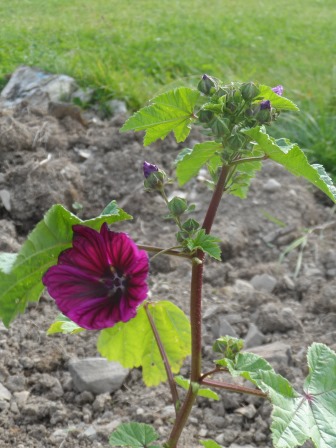
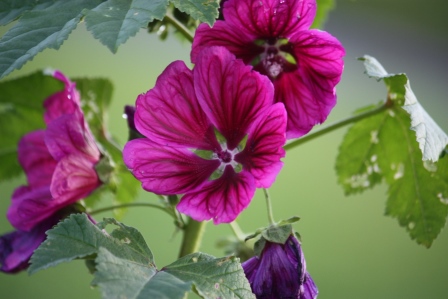
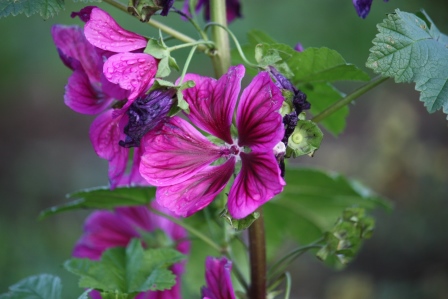
A surprise in the garden?  Well, it was a surprise to me since I hadn’t planted it.  This lovely little plant appeared late this summer.  With some help from my on-line gardening community friends from The Irish Garden (http://www.garden.ie) it was identified as a malva plant.  I believe it is Sylvestris Mauritanicus “Windsor Castle”.   It is also known as Common Mallow, and is a leafy biennial-perennial.  It will (hopefullly!) re-seed itself, and will grow to 3 or 4 feet in height.

Malva in the early days

Malva in the early days

Of course I took pictures as it grew.  In the early days I was thinking it was a pretty weed!  The new buds are a dark purple, yet the flowers are a wine color.

Malva in the early days

Malva in the early days

Malva Sylvestris Mauritanicus "Windsor Castle"

Malva Sylvestris Mauritanicus “Windsor Castle”

Malva

Malva

The only down side of this story is that it is in my white and yellow garden!  Given how lovely this color is, I think I can live with one more addition to the color scheme of my center garden.

Malva & Potentilla

Malva in front of my yellow Potentilla

I have to say I’m really happy about this plant growing in my garden!  Such a lovely surprise. 🙂

Malva

Malva

Have you had any nice surprises lately?

Happy fall!
Dana

The vegetable garden’s summertime review

Organic Pea Karina

Organic Pea Karina with a sweet pea flower

Life has seriously gotten busy recently, so I do apologize for having neglected my blogging, and for not having visited your blogs as well.  I am very much looking forward to sitting down and reading what all of my gardening and cooking blogger friends have been up to!  When exactly that is going to happen is another story…

My last post was about my summertime flowers.  I feel I have split loyalties, between my flowers and my vegetables.  I do love having both of them, but when it comes to taking pictures the flowers are just a wee bit more glamorous.  And I love taking pictures!  I’ll do my best to show off my vegetables looking fab (which might just be covered in muck!).

Red Robejla organic onions

Red Robejla organic onions

My red onions did very well this season.  That picture above is of them before I dug them out.  They were very nearly out of the soil already.

Red Robelja organic onions

Red Robelja organic onions

I think I will try and grow more next year.  There doesn’t seem to be a lot there!
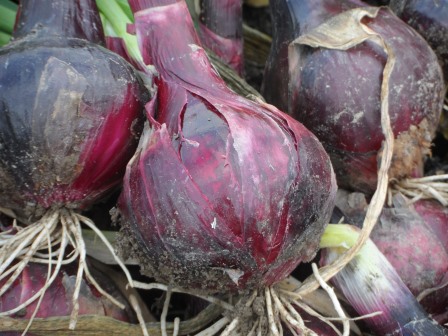
A nice size Robelja onion.

A nice size Robelja onion

Red Robejla organic onion

Red Robejla organic onion

After the stems started to dye down, I dug them out and placed them atop of my garlic bed which had already been cleared.  We were lucky enough to have some dry weather so I left them there for a week or so.  They are now finishing their drying in my back room.

My onions drying out

My onions drying out

I’ll throw in a picture of my potatoes for good measure. They are not glamorous, but they did taste good!  Sarpo Mira is the variety, which is blight resistant. I’ve grown them for 2 years now.  I think next year I will be adventurous and try a different variety.

Peeled spuds

Peeled spuds (Sarpo Mira)

I have only one picture of my carrots and it is not pretty!  They are good large, sturdy carrots ( organic yellowstone), not like the orange ones you typically see.  But they taste good!

Organic Yellowstone carrots.

Organic Yellowstone carrots.

Organic Brussels Sprouts Rubine Red

Organic Brussels Sprouts Rubine Red

Talk about winning the prize for the least glamorous vegetable!  My Brussels Sprouts were completely covered with caterpillars on a regular basis.  What I’m sure would be beautiful leaves if left uneaten by those critters, is simply ugly after all of that destruction.

Organic Brussels Sprouts Rubine Red

Organic Brussels Sprouts Rubine Red

We do have sprouts!  I’m really not sure if they will be worth it though. That process of picking off caterpillars is really for the birds.
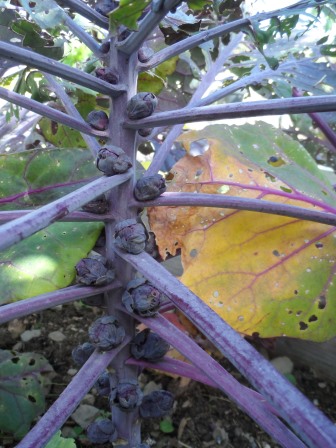
Organic Brussels Sprouts Rubine Red

Organic Brussels Sprouts Rubine Red

Did the critters leave anything for us?
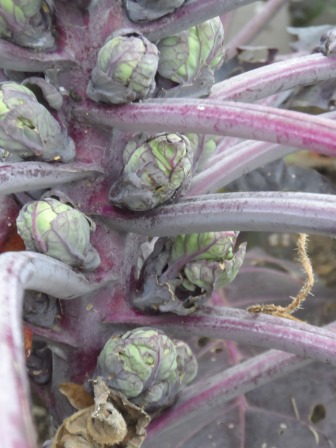
Organic Brussels Sprouts Rubine Red
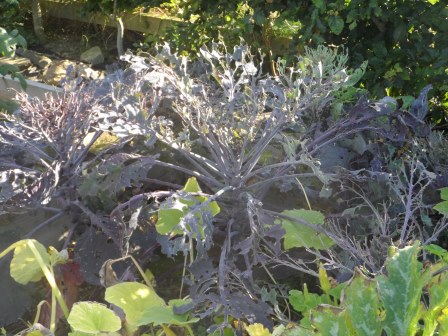
Organic Brussels Sprouts Rubine Red

Another view of the least glamorous vegetable in the garden.

Another view of the least glamorous vegetable in the garden.

Let’s talk pumpkins!  We planted pumpkins in a few different spots, but they thrived in one bed in particular.  Guess I know which bed had the best soil! Pumpkins like a lot of food.  Also, to get bigger pumpkins, you can cut the vine after the pumpkins are formed which will force all of the energy to go into growing the pumpkin and not on growing the vine and further pumpkins on the vine.  The problem is, I really like the flowers!  🙂

IMG_0701Not to worry, I did get some pumpkins and their size will do just fine for me.  They are baking pumpkins, actually, so would be on the smaller size anyway. I have quite a few photos because I thought it was neat to see how the color changes.  I only have a couple that are orange, but the rest are on their way.
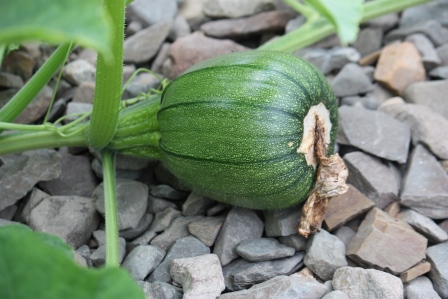
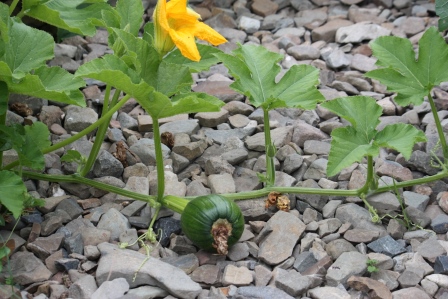
In the beginning...

In the beginning…

A long, long time ago...

A long, long time ago…

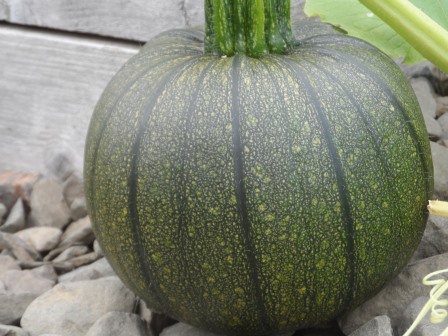
My favorite pumpkin with a perfect shape!

Phew!  Finally a size that is respectable!  My favorite pumpkin with a nice round shape.
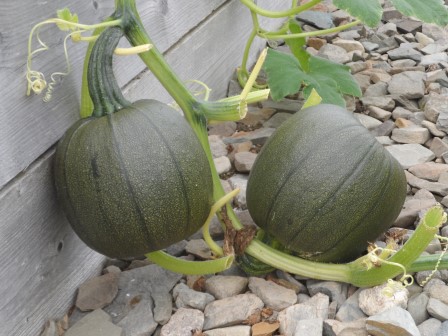
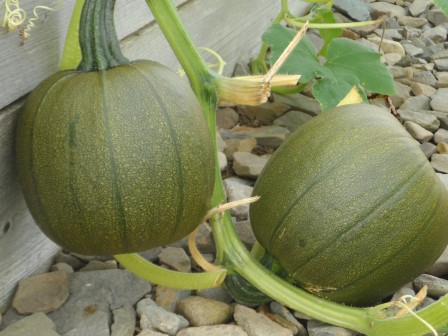
Two hangin' together.

Two hangin’ together.

The two hangin' changing color!

The two hangin’ and changing color!

Love the speckled look.

Love the speckled look.

One orange pumpkin!

One orange pumpkin!

This is the same orange pumpkin, but with my foot in the picture which shows you how small it is! (the pumpkin, not my foot)
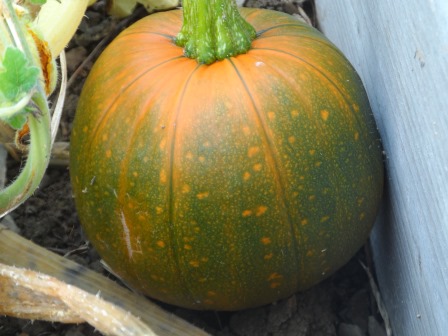
This is the same orange pumpkin, but with my foot in the picture which shows you how small it is! (the pumpkin, not my foot)

Can you believe how many photos of pumpkins I've taken?

Can you believe how many photos of pumpkins I’ve taken?

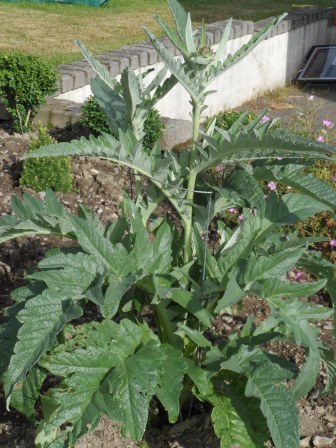
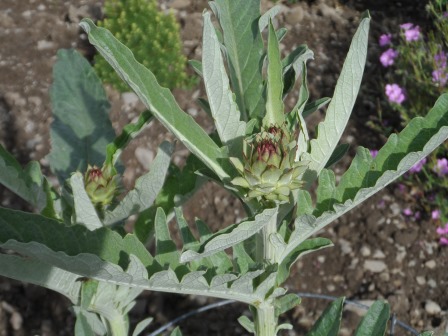
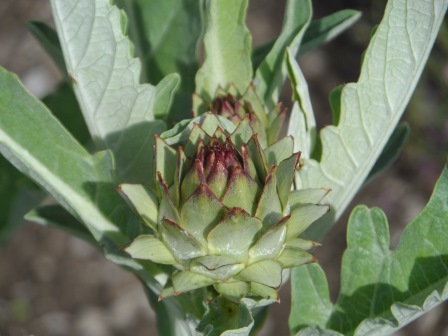
I’m moving on from pumpkins. I have a feeling you’ll be seeing more of them in my blog throughout the fall.  I bought a globe artichoke plant in May and I am so glad I did.  I didn’t manage to eat any of the artichokes, but the benefit of that is that they form really interesting flowers!
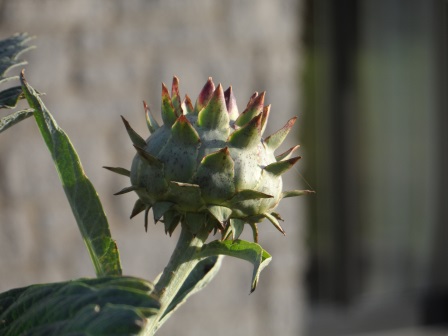
Globe artichoke Cynara Scolymus

Globe artichoke Cynara Scolymus before blooming.

Oh but wait, it gets much better!
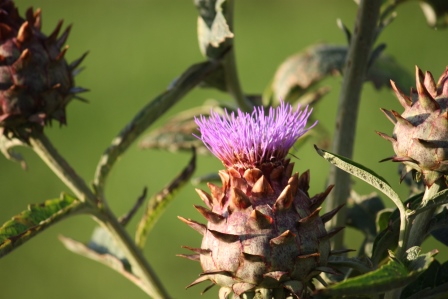
Globe artichoke Cynara Scolymus

Globe artichoke Cynara Scolymus in bloom.

Globe artichoke Synara Scolymus
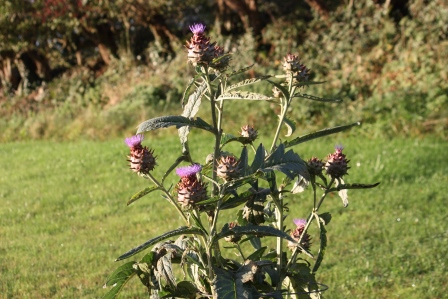
Globe artichoke Synara Scolymus

The entire plant is coming into bloom!

The entire plant is coming into bloom!

Globe artichoke Cynara Scolymus. Something interesting to look at.

Globe artichoke Cynara Scolymus. Something interesting to look at!

The globe artichoke plant is so different from anything else in the garden, and I love that.  I must show you how that particular garden has really shaped up this past year.  That will be for my next post!

But before I go, I’ll leave you with some more flower pictures.

I hope your schedule is less hectic than mine has been!

Dana
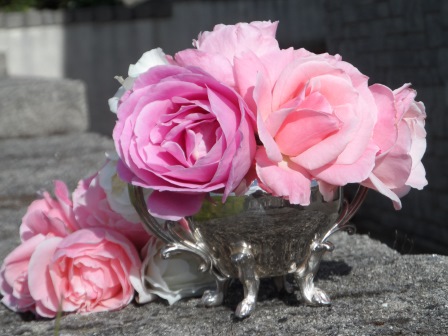
Fall roses in my silver sugar bowl.  Just because.

Fall roses in my silver sugar bowl. Just because.

Fall roses tumbling down!

Fall roses tumbling down!

Fall flowers from the garden in my Polish Pottery vase.

Fall flowers from the garden in my Polish Pottery vase.

Fall flowers in the evening sunlight.

Fall flowers in the evening sunlight.

Oh yes, I definitely favor flowers to veggies for pictures! 😉

Barley Harvest on a Sunny Day

Time for the farmer to harvest the barley.

Time for the farmer to harvest the barley.

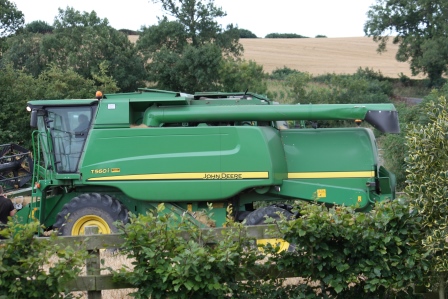
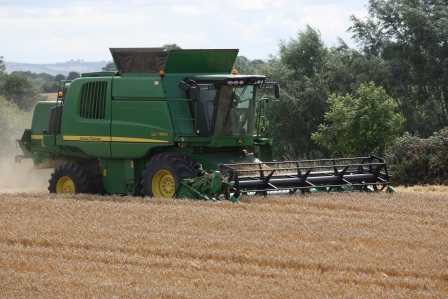
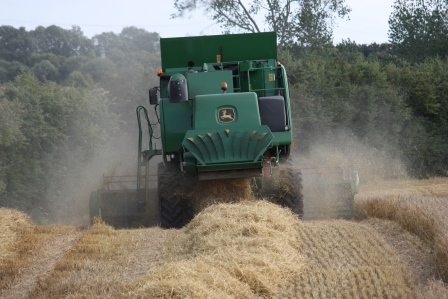
You could say that we live in the country.  I think that being completely surrounded by fields qualifies us for that description.  This season there was barley growing in the field behind our house.  What an amazing summer season for the farmer: dry, warm, and sunny!  We enjoyed watching the combine harvester last weekend as it harvested the barley.  We had great front row seats!

Combine Harvester.

Combine Harvester.

I can only imagine what the workers thought as I took their photo (all afternoon).  It was just so neat to watch!

Harvesting the barley and leaving the straw.

Harvesting the barley and leaving the straw.

As the barley is harvested, the straw is left behind.  The straw is then later gathered up into bales.

Neat rows of straw are left behind after harvesting the barley.

Neat rows of straw are left behind after harvesting the barley.

O.K., now having kids makes this next part quite a laugh (ya gotta humor them).  The straw is gathered up and formed into bales (in our case round ones) and then rolled out of the baling machine.

Tractor and baling machine.

Tractor and baling machine.

Bale of straw being rolled out.

Bale of straw being rolled out.

And there you have it! A bale of straw.

And there you have it! A bale of straw.

Yeah, I know, but they are kids and this is kinda new to us still. 🙂

Tractor & baling machine.

Tractor & baling machine.

Those guys worked really quickly!  They had the field done in no time.

The field with bales of straw.

The field with bales of straw.

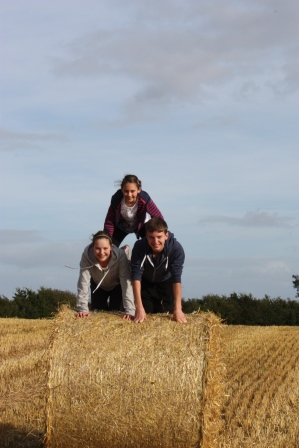
And what are kids to do with a field behind their home filled with bales of straw???

Surf on the bale!

Surf on the bale!

or pose for mom.

or pose for mom.

It was such a beautiful day which rolled into a perfect evening.  The kids had a ball playing in the field.

A perfect evening.

A perfect day.

The field on the other side of our house being harvested.

The field on the other side of our house being harvested.

I love taking photos in the evening.

I love taking photos in the evening.

A perfect day.

A perfect evening.

The color of fall.

The color of fall.

I really enjoyed putting this post together.  We all had such fun that day!  I hope you are enjoying good weather where you are, too!

Dana

Harvesting Garlic & a Clematis’ improved health

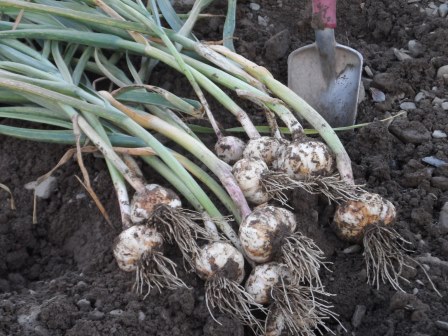
Freshly dug garlic.

Freshly dug garlic (Cristo).

Some things in the garden seem to grow fairly easily.  Garlic is one of those things!  We’ve grown garlic the past two years and have been very happy to have done so.

Garlic in June.

Garlic (Cristo) in June.

They don’t require special attention, really, and like well drained, fertile soil.  I watered them when we had quite dry weather so the soil wouldn’t dry out, but that was it.  They are ready for harvest when the greens die back.  Then I hang them in our back room to dry out completely.  This year I am planning on planting some in the winter, too.  I think it is more typical to grow it then.  That will be my first attempt at winter gardening!

Freshly dug garlic.

Freshly dug garlic.

I was pretty happy with the quality of the soil as I was digging up the garlic.  We’ll be adding our compost to the beds as we continue to harvest the different vegetables, and fruit. It really does help the soil!  As for quality of soil, I have another story to tell.

Garlic & Geraniums

Garlic & Geraniums

Cristo garlic.

Cristo garlic.

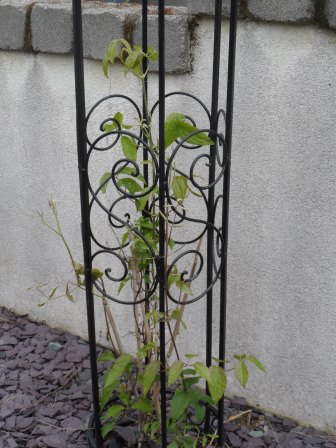
My obelisk a few months ago.

My clematis starting to climb the obelisk a few months ago.

Back in March I posted about an obelisk which I set up for my clematis.  (You can read about it here: https://mominthegarden.wordpress.com/2013/03/06/my-showy-hellebores-an-obelisk-and-a-chocolate-pudding-recipe/ ) My clematis, ‘Bagatelle’ (Dorothy Walton), had one single flower last year!  We had moved it the year before as it was in a terrible position.  Fearing wilt after all of the rain we had last year, we needed to do something.  The soil in which it was planted really needed some extra attention. We dug it up and added compost, aerated the soil, fed it, and hoped for the best.  The difference in the plant this year is amazing.

Late blooming clematis early in the season.

My clematis early in the season.

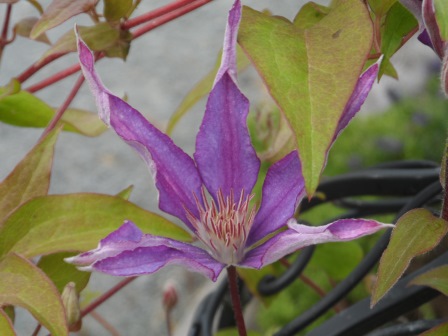
This was the first flower this season. It has really thin petals (they get bigger as it develops).

Clematis after some rain.

Clematis (‘Bagatelle’ Dorothy Walton) after some rain.

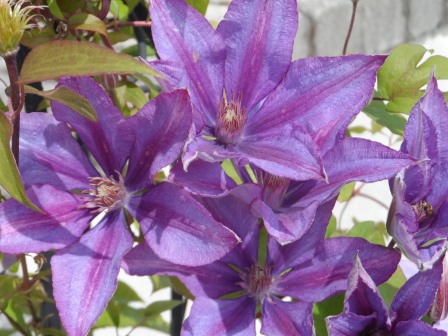
Clematis in full glory!

Clematis in full glory!

There are a few different types of clematis. Mine is a late season variety.  So in February I will be pruning it back to about 12 inches from the ground, just above an old leaf joint.  That way I will continue to have flowers all along the plant, and not just at the top.

The obelisk is getting covered!

The obelisk is getting covered!

The plant climbed up the obelisk, and then right back down again! I’ve seen plenty of clematis that would have taken over this little obelisk!  But for now, this one will work for us.

'Bagatelle' Dorothy Walton Clematis

The flowers of the ‘Bagatelle’ Dorothy Walton Clematis face the morning sun.

I took this picture yesterday. There are still new blooms!

I took this picture yesterday. There are still new blooms!

Now that the clematis is doing so well, I’m thinking of getting another one. 🙂

Which is your favorite variety of clematis?
Dana

Strawberry Bed Clean-up

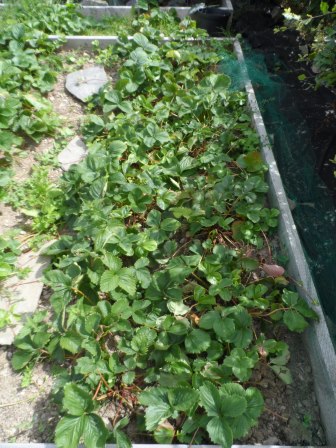
Strawberry bed at the end of the season.

Strawberry bed at the end of the season (with a hanging cow windsock/scarecrow).

The strawberries were my favorite item in the garden this summer.  They were so sweet, and there were so many of them.  Everything went really well; No mold, no birds eating them before us, no problems!  But strawberries spread like crazy and get really messy rather quickly (that was our problem last year).  They have a rather short life, too.  Three years. That’s it. Then it’s time for new ones. Given that they produce tons of “runners” every season, it is cost free to replace them.   My blogging friend Claire of Promenade Plantings http://promenadeplantings.com/ mentioned that the first plant on a runner is the best to use.  I like getting tips like that!

Super fresh!

Super fresh from the garden!

My husband took full ownership of strawberry care this season.  Well, except for the weeding, that is always my job!  This week he and my daughter did a lot of work preparing them for next year.  They dug up the entire bed, removed the oldest plants, potted up the healthy runner plants, and replanted the one year old plants.  It is so cool having their help!

After digging up the old plants, the newer ones are replanted.

After digging up the old plants, the newer ones are replanted.

Potting up the runner plants.

Potting up the runner plants.

I'll admit it was a bit of work (for my husband!) tidying up this bed!

I’ll admit it was a bit of work (for my husband and daughter!) tidying up this bed!

A neat and tidy new strawberry bed.

A neat and tidy new strawberry bed.

You can see the difference in the two beds in the photo above!  The second bed in the back still needs to be done.  This month is really the ideal time to do it. Thankfully, there are still a few weeks left to get that finished!

‘Cause we want to be able to make more strawberry ice cream like we did this year!

Homemade strawberry ice cream!

Homemade strawberry ice cream!

In case you missed it, here’s a link to my post from earlier this summer on strawberries: https://mominthegarden.wordpress.com/2013/07/15/bumper-crop-of-strawberries-an-angel-food-cake-recipe-with-strawberries/

View of the garden in August.

View of the garden in August (after clearing up one strawberry bed).

A geranium plant grown from seed.

A geranium plant grown from seed.

I had to have a flower photo to finish this post!  My father-in-law grew a bunch of geranium plants from seed for me.  I was rather late in asking him to grow them, so they are only now blooming!  But I’m enjoying them very much. 🙂

I hope I’ve maybe inspired you to try growing strawberries!  Feel free to ask a friend if they have extra plants as they really do grow like crazy.

Happy Planting!
Dana

Sweet Peas in the Summer Time

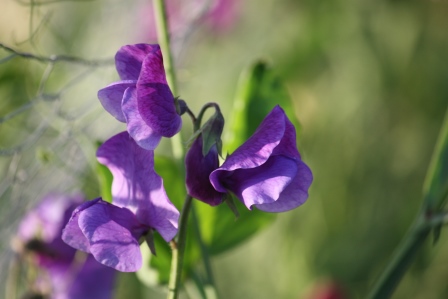
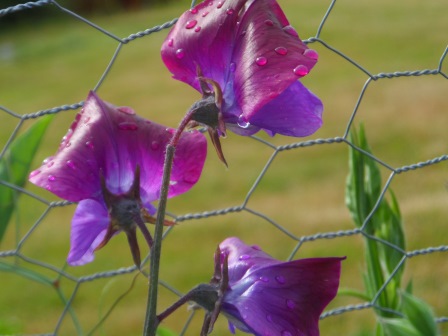
Purple sweet pea.

Purple sweet pea.

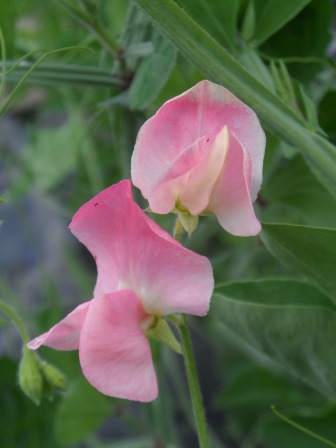
They really do live up to their name!  Sweet pea.  They have a lovely sweet fragrance, which matches their very pretty flower.  I mentioned in an earlier post that I planted some at the front of my fruit garden in the hopes that they would help beautify it.  I’m not sure if that is exactly what you’d say they are doing, but I think they are lovely!

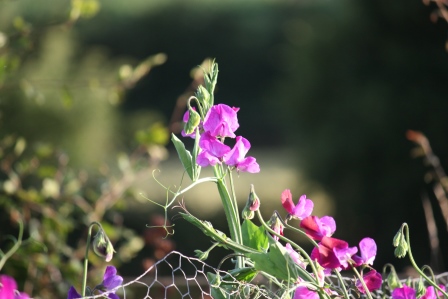
One way to add a little splash to the edible garden!

One way to add a little splash of color to the edible garden!

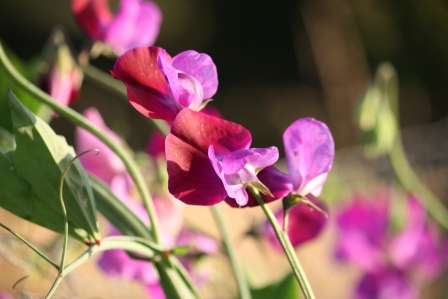
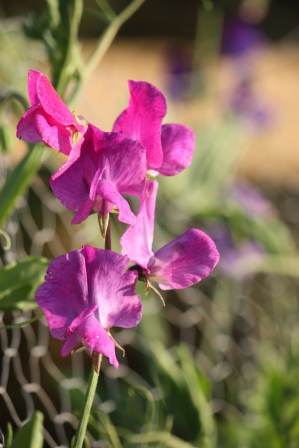
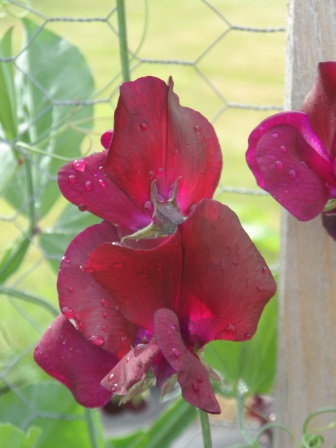
They are a somewhat delicate flower, showing off different shades of pinks and purples with a few white ones thrown in for good measure.

A little sun light goes a long way to showcase the flowers.

A little sun light goes a long way to showcase the flowers.

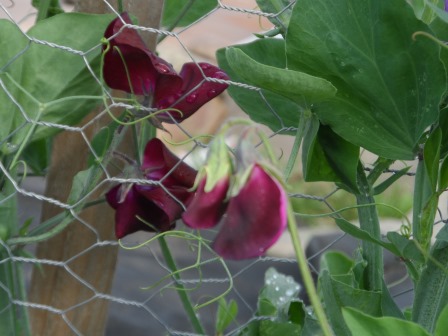
It is seriously difficult to make the darn chicken wire look attractive. I was going for the “curtain of flowers” look!  I am considering other options for the future though.  I’d love to source some sort of wooden tee-pee type structure.  I’ll let you know if (I mean when) I find them!

A light shade of pink sweet pea.

A light shade of pink sweet pea.

It rained today.  It felt like today was the day we’d make-up for all of the rain we didn’t get this summer! Lashing rain all day.  Yuck.  So I felt the need to post my pictures of sun kissed sweet peas.  Lots of ’em.

Multicolored sweet pea.

Multicolored sweet pea.

There’s no point in wasting perfectly happy pictures, right?  I do realize that the content for sweet peas is quite light, but I think that is O.K. now and again.

Climbing upwards.

Climbing upwards.

One sweet pea  in full bloom and one starting to open.

One sweet pea in full bloom and one starting to open.

Purple. What's not to like?

Purple. What’s not to like?

Sweet pea.

Sweet pea.

A peachy/pinky colored sweet pea (captured when the sun was behind a cloud!)

A peachy/pinky colored sweet pea.

And here's a picture of that cloud!

I love this picture because all I can see is a heart!

Sweet pea.

Sweet pea.

They are such a sweet, simple flower.  And so easy to grow!  I’m glad I planted them this year.  I hope they brightened your day like they did mine! 🙂

Dana

Sunshine on a wild-flower garden.

Wild flower garden.

Wild-flower garden.

I have a wild-flower garden.  It certainly isn’t a typical wild-flower garden.  Mainly that’s because its location is in the middle of my front yard.  Yeah, I know, that is weird.  I really enjoyed the flowers, but not the wild garden look!  I had just prepared this center bed and was still figuring out what to plant in it when a friend asked me if I’d like some wild-flower seeds.   It was as simple as that!  I thought I’d give it a go for a season and see how it looked.

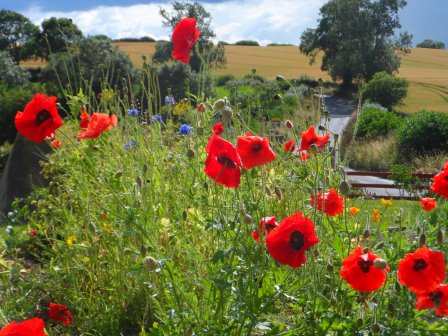
Lots of poppies in my wild-flower garden.

Lots of poppies in my wild-flower garden.

Irish Wild-flowers.

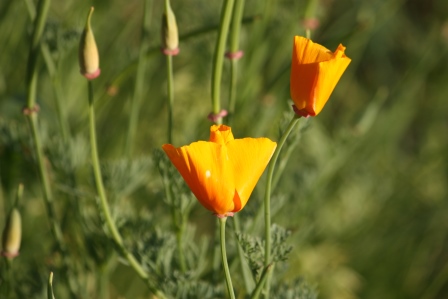
Orange wild poppy.

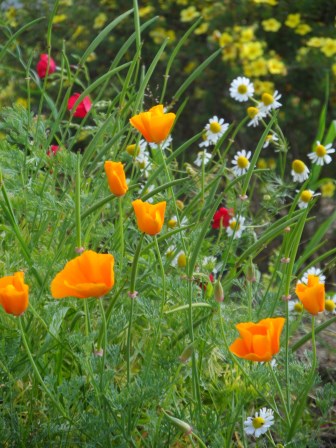
Some of the flowers have been so pretty!  I love the orange wild poppies.

Orange wild poppies.

Orange wild poppies.

For a season it has been fun seeing what would grow and bloom.  There were a couple of cute surprises!

A single red flower.

A single red flower.

Beautiful blue.

Beautiful blue cornflower.

Lovely yellow.

Lovely yellow.

A bit of a mess!

A bit of a mess!

So the above photo is really what the wild-flower garden tends to look like: A mess!  I do like my poppies and daisies by the back of my wall. They certainly are anything but neat and tidy. But they are at the back!  I’m afraid this garden is too central to be so messy for me.

Wild orange poppies.

Wild orange poppies looking quite wild.
Wild orange poppies.

Wild orange poppies.

Well it definitely was fun having such lovely flowers, especially to photograph!

Just a bit of blue ...

Just a bit of blue (blue cornflower) …

Yet another poppy!

I love poppies in the evening sunlight!

Poppies before the storm.

Poppies before the storm.

Too many pictures of poppies?

Too many pictures of poppies?

The skies cleared again.

The skies cleared again.

Another learning experience for me!  But I am delighted to have had the chance to photograph such beauties.  I hope you’ve enjoyed them too.

Dana

More beautiful blue.

Blue cornflower.

End of July Garden Tour featuring Brussels Sprouts and Globe Artichokes

Brussels Sprouts & Pumpkins.

Brussels Sprouts & Pumpkins.

The garden is really looking full!  The Brussels sprouts plants are getting huge! The stalks are just starting to produce itty bitty teeny weeny little sprouts!

Brussels Sprouts (teeny weeny ones!)

Brussels Sprouts (teeny weeny ones!)

Yeah, well, maybe you can’t see them on a compressed picture.  You might just have to take my word that they are actually there!  Every day there seems to be just a bit more growth.

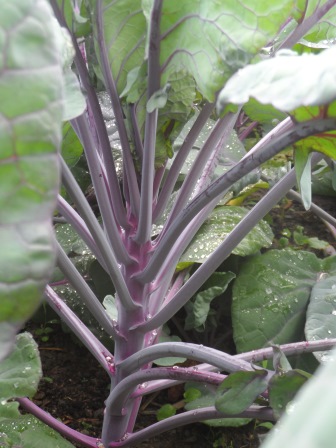
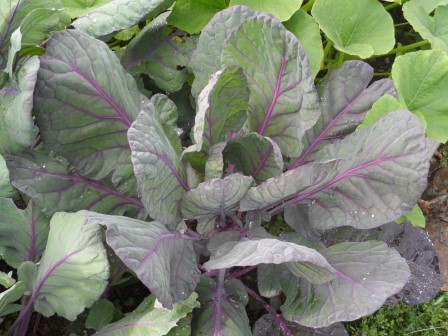
Brussels Sprouts' large purplish colored leaves.

Brussels Sprouts’ large purplish colored leaves.

Brussels Sprouts are a new adventure for us.  We started our garden three seasons ago, and every year we have expanded and tried something new.  I love that!  But I really think we need to add another bed for next year.  My pumpkin plants are squished!  I think I want a nice big bed just for pumpkins. 🙂

The veggie beds.

The veggie beds.

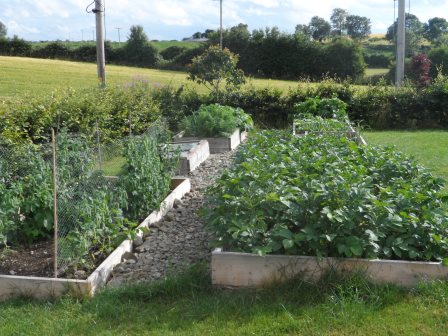
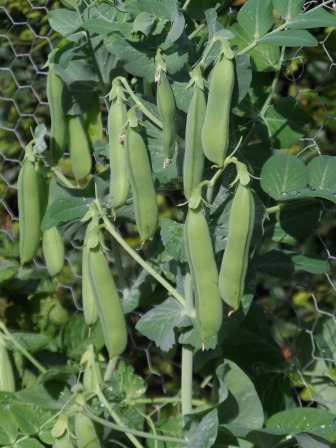
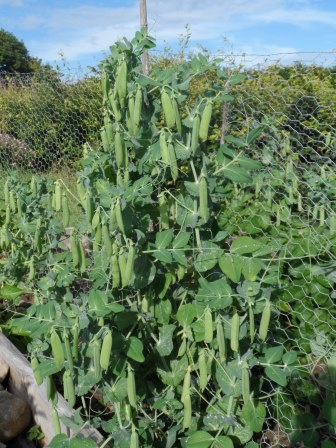
Here is a look at the other side of the garden.  The potatoes are doing well.  We’re still eating “last year’s” potatoes!  The peas are almost ready for picking.

Peas.

Peas.

Peas.

Peas.

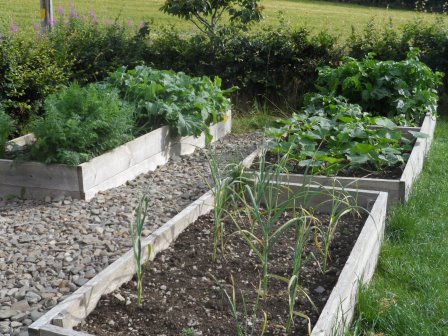
Garlic, carrots, swede (turnip), parsnips, beets, rainbow chard, and more pumpkins.

Garlic, carrots, swede (turnip), parsnips, beets, rainbow chard, and more pumpkins.

Here’s what I’ve learned this season: Swede need their own bed since their leaves will cover up everything around them!  Carrots need to go in the higher beds to avoid carrot fly. We could never plant too much beet root (not enough of them germinated this year).  Planting onions from seed is easy.  That sticking extra pumpkin plants into one half of a tiny little veggie beds was a crazy idea.  I think a big bed right next to those veggie beds is just the thing!  Now to convince my husband 😉

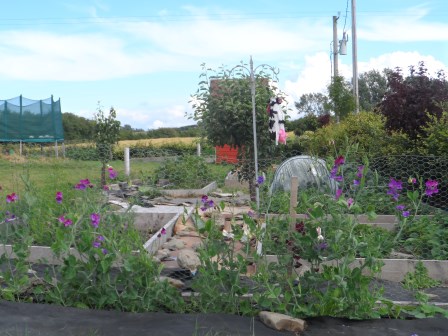
View of garden with Sweet Pea.

A very busy picture! My focus was on the Sweet Pea at the front of the garden.

We planted some sweet pea at the top of our fruit garden (well, it is mostly fruit).  I wanted something fun to brighten it up.  I think they’ve done a good job.  We were quite late in planting them, so they aren’t in all of their glory just yet.

Sweet pea.

Sweet pea change color as they age.

Sweet pea.

Sweet pea.

Different shades of sweet pea.

Different shades of sweet pea.

It rather felt a bit like cheating when I bought a globe artichoke plant this year.  Isn’t that silly?  I have a few packets of seeds, but just never got around to planting them.  But in the end, I’m delighted that I did buy the plant because look what I have now:

Globe Artichoke plant.

Globe Artichoke plant.

This is one rather tall plant!  I have counted 5 baby artichokes on it!

A few of the artichokes.

A few of the artichokes.

Artichoke up close.

Artichoke up close.

When do I confess that I have never had a fresh artichoke???  I love canned ones though! Nothing ventured, nothing gained!  (Guess who will be searching the internet  looking up how to cook a fresh artichoke?)

The front garden with a globe artichoke plant.

The front garden with a globe artichoke plant.

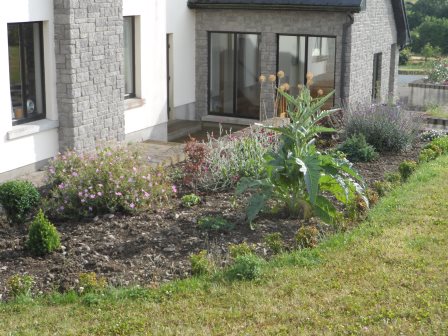
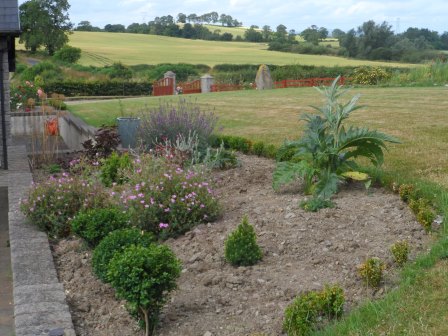
I have the globe artichoke in one of my flower beds.  I’ve seen them in gardens before and I found them to be a showy plant, and here is where I wanted mine to perform.

Flower garden with a globe artichoke plant and a view!

Flower garden with a globe artichoke plant and a view.

What simple pleasures!  How lovely to be able to plant food and flowers and enjoy their beauty and their taste!  Have you planted something new this year?

Dana

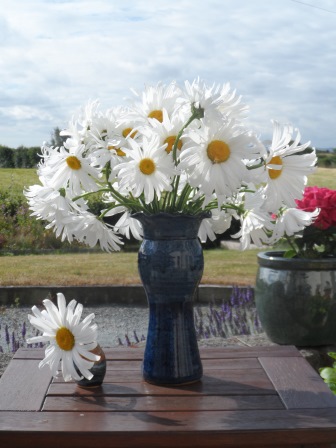
Some of my Shasta Daisy :-)

Some of my Shasta Daisy 🙂

Tastes of Summer

A cool drink of lemonade.

A refreshing drink of lemonade.

I’m sure I’ve mentioned that Ireland is having a most glorious summer.  Warm, sunny days with a slight breeze; it doesn’t get better than that!  With no hectic schedules like we have during the school year, we’ve been able to relax and enjoy the good weather.

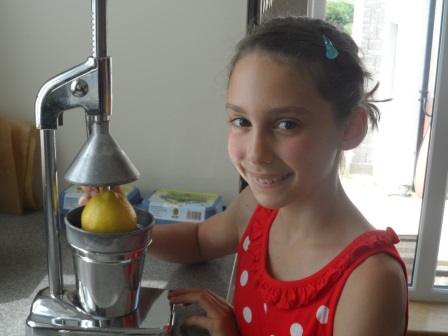
Making lemonade.

Our littlest one making lemonade.

Lemonade is really easy to make! We have a very basic juicer, which is perfect for squeezing lemons or oranges.  We used 3 & 1/2 lemons, a quarter cup of sugar, and then filled the jug with water (about 2 liters or 2 quarts).  Ours was tart!  You can of course make it sweeter. 🙂

It is lovely to be able to make simple dinners, too.  Wander about the garden, see what needs to be harvested and throw something together!

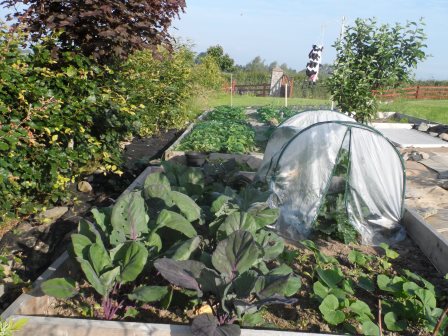
A look at the garden in July.

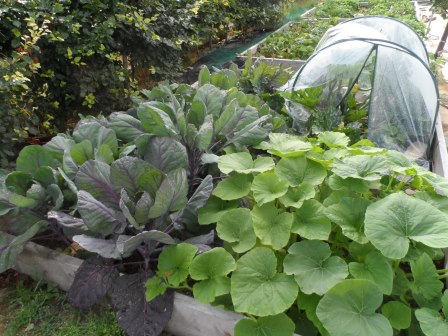
A look at the garden in July. The Brussels Sprouts are on the left, some very small pumpkin plants on the right, a mini-green house, and then the strawberry beds behind.

The miniature green house was an experiment.  I bought it for next to nothing at the end of last summer.  I originally wanted to try planting eggplant (aubergine) in it, but those seedling didn’t survive.  So in went a zucchini (courgette) plant to see how it would do.  It is doing amazingly well!

A very happy zucchini plant.

A very happy zucchini plant.

O.K., I’ll admit that zucchini plants are really easy to grow!  But last year many of my fruit would start to grow and then drop off.  I’m not sure what happened. Despite losing so many of the fruit, since we had a bunch of plants last year my children grew quite sick of zucchini.  I made about a dozen loaves of zucchini bread (read “cake”), too, so we really did have quite a lot.  This year I took a chance and only have one plant.

Our happy zucchini plant in its own mini-green house!

Our happy zucchini plant in its own mini-green house!

The fruit are growing at a fast pace in the heat of the green house, providing us with just the right amount of zucchini!

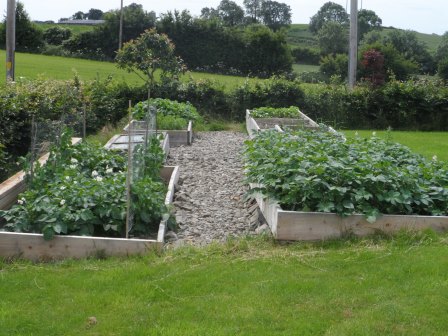
Our vegetable beds. Potatoes in the right front bed.

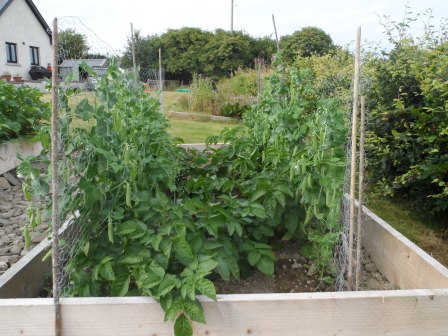
Our vegetable beds. Potatoes in the right front bed.  Last year’s potatoes and our pea plants on the left.

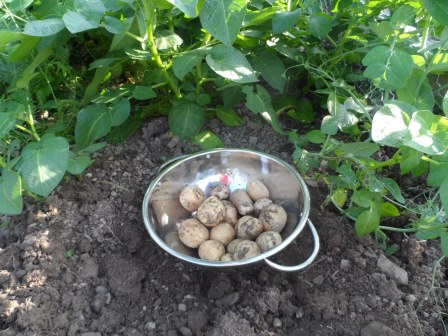
What to go with zucchini for dinner?  Some spuds!  So here is my potato story:  We planted two types of potatoes last year; an early crop and a main crop. They both were fantastic, and we were very happy with our first year of potato planting.   This year, we were moving things around a bit, and decided to just have one bed of main crop (Sarpo Mira) potatoes.  The second bed we planted with peas.  So I was a bit befuddled when potato plants started appearing in the pea bed (talk about a novice gardener!).  Turns out I didn’t dig out all of the potatoes last year, and even better still, those potatoes from last year are delicious!  Woohoo!

Last year's early crop of potatoes!

Last year’s early crop of potatoes!

A two for one deal on potatoes!

A two for one deal on potatoes!

I’m especially pleased because as we eat those potatoes, I can finally weed around the pea plants.  It was a huge mess!

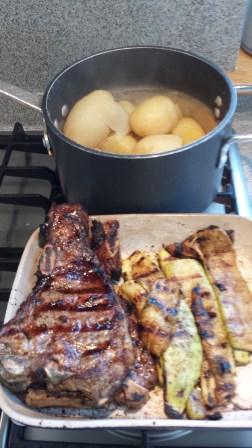
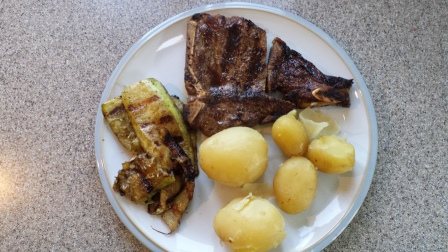
This whole post came about mainly from our dinner the other night.  Really, it was superb, if I do say so myself!  My sister-in-law’s husband is a farmer.  I’m trying to figure out how to politely write that we ate some steaks from one of their cows.  I’m not sure there is a polite way to say it!  I have never had anything like it.  It was amazing.  Kinda like eating your own veggies, and you’re sitting there eating and wondering how the supermarket food tastes so much different…  It was just like that! 🙂

The fixings!

The fixings! We love grilling!  Even the zucchini goes great on the grill outside.

Home grown dinner!

Home grown dinner. (photos courtesy of my husband who did an awesome job of cooking dinner!)

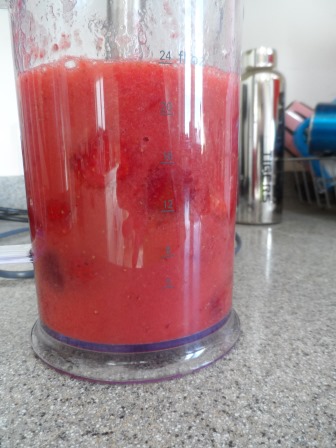
We’re not done yet.  Those strawberries I posted about on my blog?  Yep, we used them to make strawberry ice cream.  This was our first time making ice cream with egg yolks.  We don’t have an ice cream maker, so after putting it in the freezer we had to take it out every 30 minutes or so and whisk it up.  I have to say that it was definitely worth the effort!

Strawberry Puree.

Strawberry Puree.

Yum!

Yum!

Mixing the strawberries with the cream & egg mixture.

Mixing the strawberries with the cream & egg mixture.

Two containers for the freezer.

Two containers for the freezer.

Should I apologize for the lighting on the ice cream photos?  I know it’s too dark.  Just one of those things where the lighting was not going to work with me!  I just thought I’d give you a little glimpse of how we made it.  A few blogs helped me out with this recipe!  The recipe is from Ree, of The Pioneer Woman  http://thepioneerwoman.com/cooking/2013/07/strawberry-ice-cream/ .  She is beyond amazing.  The Gourmand Mom http://thegourmandmom.com/  helped me out by connecting me with David Lebovitz, of Living the Sweet Life in Paris, who let me know to keep whisking the ice cream or I’d have icy custard!  http://www.davidlebovitz.com/2007/07/making-ice-crea-1/

Homemade strawberry ice cream!

Homemade strawberry ice cream!

My 13 year old daughter was a huge help in making the ice cream, I have to say. Having her help allows me to get so much more done!   She reads my blog, too… and lets me know what she thinks!  🙂

Those are some of our tastes of summer!  I hope you have been enjoying some wonderful tastes of summer, too!

Dana

Happy summer flowers!

Happy summer flowers!

Bumper crop of Strawberries & an Angel food Cake recipe (with Strawberries)!

Bumper crop of Strawberries!

Bumper crop of Strawberries!

What a glorious summer we have had!  Sunny, warm days (maybe even described as hot?!), with just a hint of a breeze. We love it!  In the five years we’ve lived in Ireland, this is definitely the best stretch of weather we’ve experienced.  Our strawberries seem to be quite happy in the heat.   W.O.W.!  We have had tons of them! (only slight exaggeration)

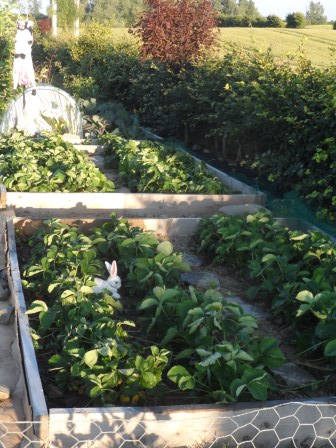
Our two strawberry beds.

Our two strawberry beds.

Last year was our first year growing strawberries and it didn’t go well.  We had too many plants, too close together, and the netting was impossible to get on and off easily.  It didn’t help that it was a horrible year for slugs, and a very wet season!  So we made some changes this year, and we even got lucky with the weather.  We have less plants and more space to get in and around to pick berries and to weed.  The netting is easier to manage this year too, so even the kids can take it off and cover it up again without hassle.  It is just so lovely to have fresh berries!  For us, this is definitely becoming one of our “tastes of summer”!

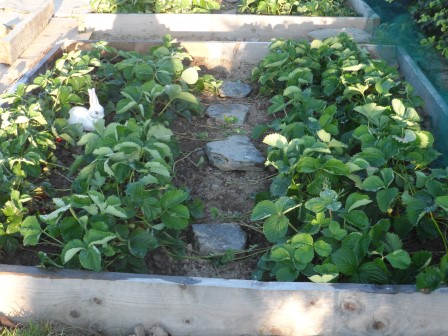
A ceramic bunny helping to keep the birds away ;-)

A ceramic bunny helping to keep the birds away 😉

Seeing red.

Seeing red.

It really is great to be able to go into the garden and pick your own strawberries.  In America, we used to enjoy going to farms to pick strawberries.  But I have to say that this is something else.  What I’ve learned this year is that the older plants should be replaced with the newer ones.  So later in the season we’ll be planting and replacing and hoping for the best for next year!

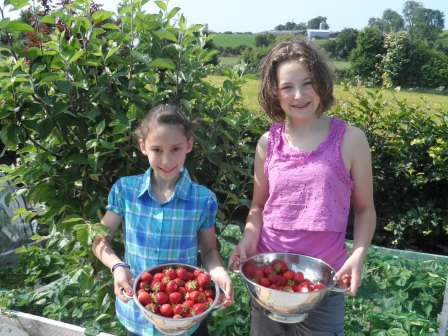
My two girls with their haul of strawberries one sunny morning.

My two girls with their haul of strawberries one sunny morning.

Super fresh!

Super fresh!

Given the nice weather, and the abundance of strawberries, I decided to make some Angel food cake.  I have a recipe that I love that calls for raspberries, so it was an easy switch for the strawberries.  We actually made the cake twice in the last week; once using the Amaretto, which is an Italian almond liqueur for the sauce, and once without.  Either way is delicious!

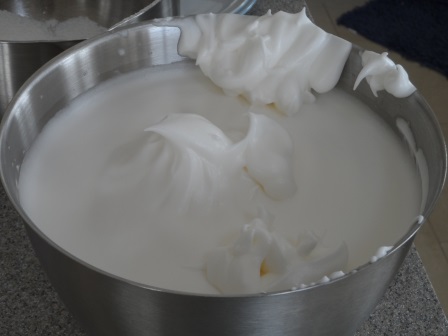
10 egg whites...

10 egg whites…

Given the warm days, I was glad for a rather quick and simple recipe.  It gets even easier for me since my daughter is a super help in the kitchen.  We’re about at the stage where I’m just the “helper”!

Cut up strawberries for inside the angel food cake.

Cut up strawberries for inside the angel food cake.

Pure fluffiness!

Pure fluffiness!

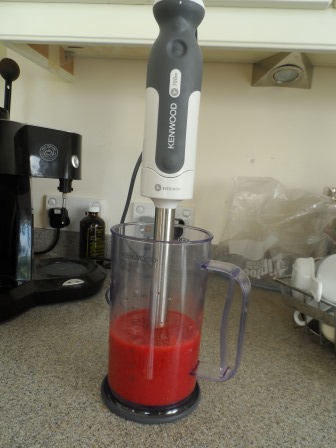
The strawberry sauce.

The strawberry sauce was so easy to make!

This isn't a proper tall angel food cake pan, but it did the trick.

This isn’t a proper tall angel food cake pan, but it did the trick.

Yum!  I have a couple of recipes that I use this with.

Yum! I have a couple of recipes that I use this with.  I just realized that the bottle doesn’t actually say “Amaretto” on it!  But the box does…

Yeah, I snuck  some flowers into the pic! (I had to look up "snuck"!  It is actually used in the US & Canada, but not here.

Yeah, I snuck some flowers into the pic! (I had to look up the term “snuck”! It is actually used in the US & Canada, but not here.)

We were quite happy with the results!

We were quite happy with the results!

I hope you are enjoying some lovely weather where ever you are, and with something tasty to eat too!

Dana

Angel food cake with raspberry Amaretto sauce

The New Basics Cookbook
Julee Rosso & Sheila Lukins

10 egg whites at room temp
1 ¼ tsp cream of tartar
¼ tsp salt
1 tsp vanilla extract
½ tsp almond extract
1 ¼ cups sugar
1 cup cake flour (2 tblsp corn starch in 1 cup plain flour measure)
1 cup fresh raspberries
Raspberry Amaretto Sauce (recipe below)

Preheat oven 350 degrees. (176 C)

  1. Beat the egg whites, cream of tartar, and salt in a large glass bowl (not metal) with an electric mixer until they form soft peaks. Add the vanilla and almond extracts.  Then gradually add the sugar, beating until the whites are stiff, but not dry, and shiny.
  2. Sift the flour onto the egg whites and sprinkle the raspberries over the top. Using a rubber spatula, gently fold in the flour and raspberries.
  3. Spoon the mixture into an ungreased 10 inch nonstick tube pan, and bake until a toothpick inserted in the cake comes out clean, 40 minutes.
  4. Invert the pan onto a cake rack and let it cool completely without removing the cake from the pan.
  5. When the cake is cool, invert the pan onto a serving platter.  Remove the pan carefully, loosening the cake slightly around the edges if necessary, and serve with raspberry sauce.

 Raspberry Amaretto Sauce

 2 cups fresh or frozen raspberries, thawed if frozen
½ cup confectioners’ sugar
1 tblsp fresh lemon juice
¼ cup amaretto liqueur

  1. Puree the raspberries in a blender or food processor. Add the confectioners’ sugar, lemon juice, and amaretto, and continue to process until smooth.
  2. Strain the sauce to remove the seeds, and serve.