A look back on the garden, The Final Chapter (part IV)

Hello! What a fun time I’ve had, going through photos of the garden from the past year. For the past 11 years, I’ve continually added to the nearly blank slate of a garden that was here when we moved in. I’ve learned a lot, I’ve done a lot, and I continue to learn and do! It’s my happy place, and I don’t need the proof from the studies that show ‘gardening is good for you’, I already know it. This last chapter is mostly about fall vibes and a tiny bit of winter. Enjoy!

September collage with sunflowers, butterfly bush, apples, pumpkins and delphinium but

This first collage starts in September. Look at all of our red eating apples! I don’t actually ‘pick’ them to eat, but instead I use the ones that have dropped to the ground. We didn’t have any major wind storms this fall (rather unusual) so I was able to gather apples at a reasonable pace. It’s harder when they all are knocked off at once!

The Buddleis Buzz ‘dark pink’ butterfly bush is covered with Tortoiseshell butterflies. We might also get Peacock butterflies, or Red Admiral butterflies, or Painted Lady butterflies. The butterfly bush is a dwarf variety, so it is quite a manageable size, and with lots of vibrant color. This one has quite a sweet scent as well.

The Monarda Fireball (red Bee balm) is new for me and was planted in a container. I really want to get it somewhere in the garden, but I’m not sure where just yet.

The top left picture is just to show you the contrast of the yellow dwarf sunflowers with the tall Claret F1 burgundy sunflowers. I loved the look of this flower bed! And just a few steps away is the pumpkin arch, which still had mostly green pumpkins in September. The blue Delphinium was quite a treat for me as I grew it from seed. That was a new flower for me to grow from seed, and I’m glad it not only survived but it thrived. Fingers crossed that it will survive the winter and we can enjoy it again in 2022!

I added the picture of the Russian sage (Perovskia atriplicifolia ‘Little Spire’) as it looks really nice with the roses. The birch tree bed now has Rudbeckia goldstrum (Black-eyed-Susan) and Persicaria Blackfield just starting to bloom.
September collage of roses, pumpkins, ornamental grass, tulip bulbs

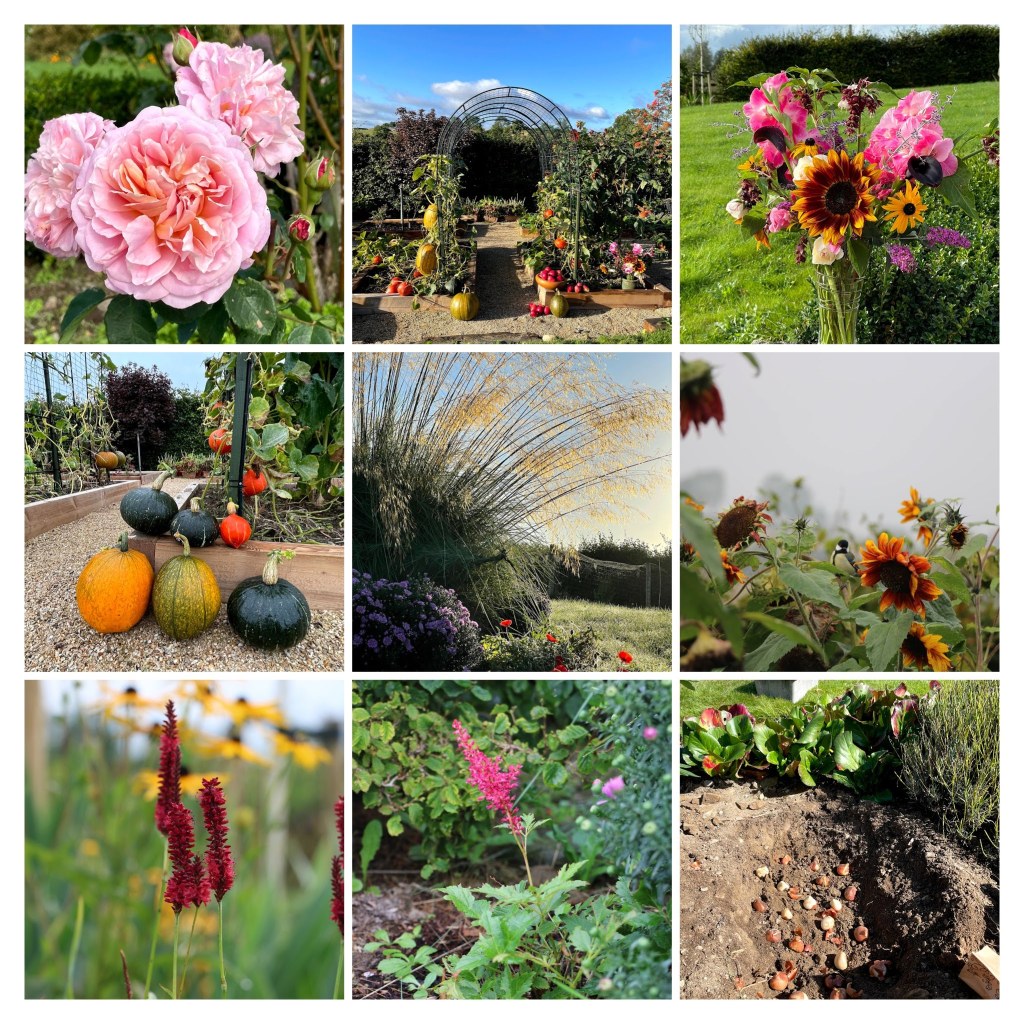
Staying in September, these David Austin ‘Eustacia Vye’ are relatively new to my garden. Not only are they beautiful, they have a delicious scent, too!

I made an outrageous flower arrangement with Pink Parrot gladiolas. While I do love the bright, shocking pink color, it is rather difficult to pair with in an arrangement. 🙂

The pumpkin arch update, at this stage, shows that the pumpkins are starting to turn orange, while the Red Kuri squash are turning their final color or burnt orange/red. The Green Hokkaido squash, which are more flat than the rounded pumpkins, remain a dark green color. The Claret F1 sunflowers always had a flurry of activity with birds. I was happy to capture this Great Tit (the largest of the Tit family) in this picture. The sunflowers have been enjoyed by the birds for most of the season. I did save a couple of flower heads for seeds for me, but the rest are there for the birds to eat.

The ornamental grass is the feature item in this bed. But the Asters put on quite a show in September. In the same bed, but in the bottom middle picture, is an Astilbe (marked pink, but it sure looks red to me). This is just a single plant that I think is still getting established. We’ll see how it does in 2022 and determine if it needs a new location.

The bottom left photo is of the Persicaria Blackfield, which pairs really well with the Rudbeckia, and birch trees. They also fill in quite nicely. Something I did this year that I probably shouldn’t do again, is that I bought my bulbs early in the season. So by the time my ‘normal’ time for ordering bulbs rolled around, I wanted to buy more (and did)! These are some of the early purchases of tulips being planted.
September collage of apples, pears, sunflowers, compost and chickens

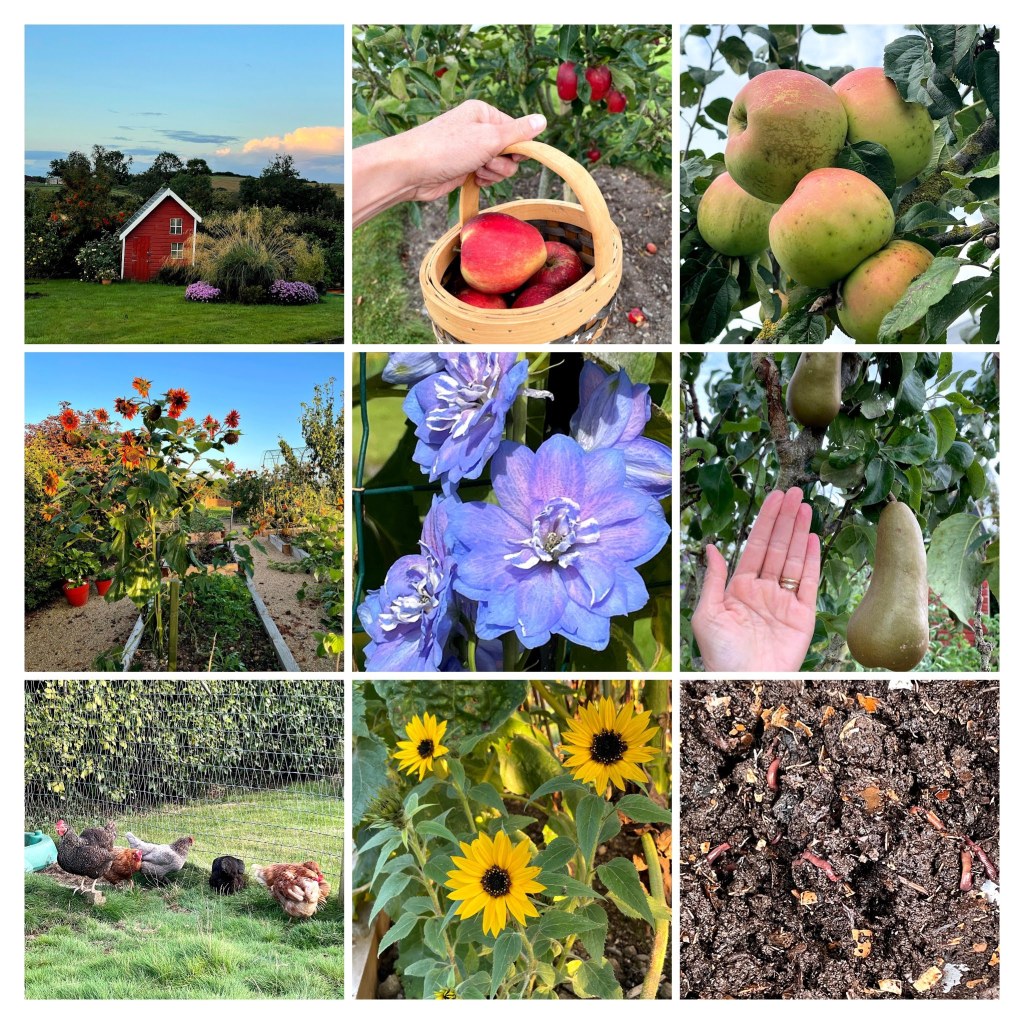
September still, and just an update on everyone’s growth: the apples, both eating and cooking, the pears, the new chickens, the delphinium, the sunflowers, they were all thriving at this stage! Those are pink Asters in the top left photo, with the ornamental grass. They really steal the show in September! One final picture of my compost in the tumbler, which you can see is filled with worms (and eggshells that probably should have been broken down more before being added). This is great stuff, and as it becomes ready – completely broken down – I add it to the garden.

October collage of pumpkins, roses, asters, raspberry, sunflower and sunsets

October is all about orange (including the sky)! We had a great haul of pumpkins and squash this year. If nothing else, I like growing pumpkins simply for their orange coloring (including their flowers). Of course we enjoy eating squash, too, but what a bonus for it to look pretty in the garden, too!

I’ve included a couple more pictures of the pink Aster because they really are fabulous, and require no maintenance. I love easy to grow plants and this is one of them! This is also a better picture of the Astilbe with the Aster. I think they will look pretty together when the Astilbe fills out more.

Another first for us this year was planting raspberry canes. While we only had a few raspberries – and they were really tasty – the canes have definitely established themselves in the bed. So fingers crossed that in 2022 we’ll not only have a nice crop, we’ll figure out the best way to cover them from the birds.

October collage of roses, pumpkins, marigolds, asters, roses, dogwood leaves, and garlic being planted

October is also when I planted our winter growing garlic. I’ve grown the same variety, ‘Vallelado’ Organic Garlic, for a number of years because it is really good for our Irish weather. The rule of thumb is to get it in the ground before Christmas. (I get mine at Fruit Hill Farm in Cork.)

I have two different color pink Asters in the yard. These fuchsia pink and are super vibrant! The roses are still going strong – this year was really super for roses. Also, I had some super big, late blooming marigold flowers. The top right picture is of my dogwood tree. Although it doesn’t flower – this variety needs hot weather (so why on earth it is sold in Ireland is beyond me) – but I find the leaves to be quite lovely, especially as they turn red.
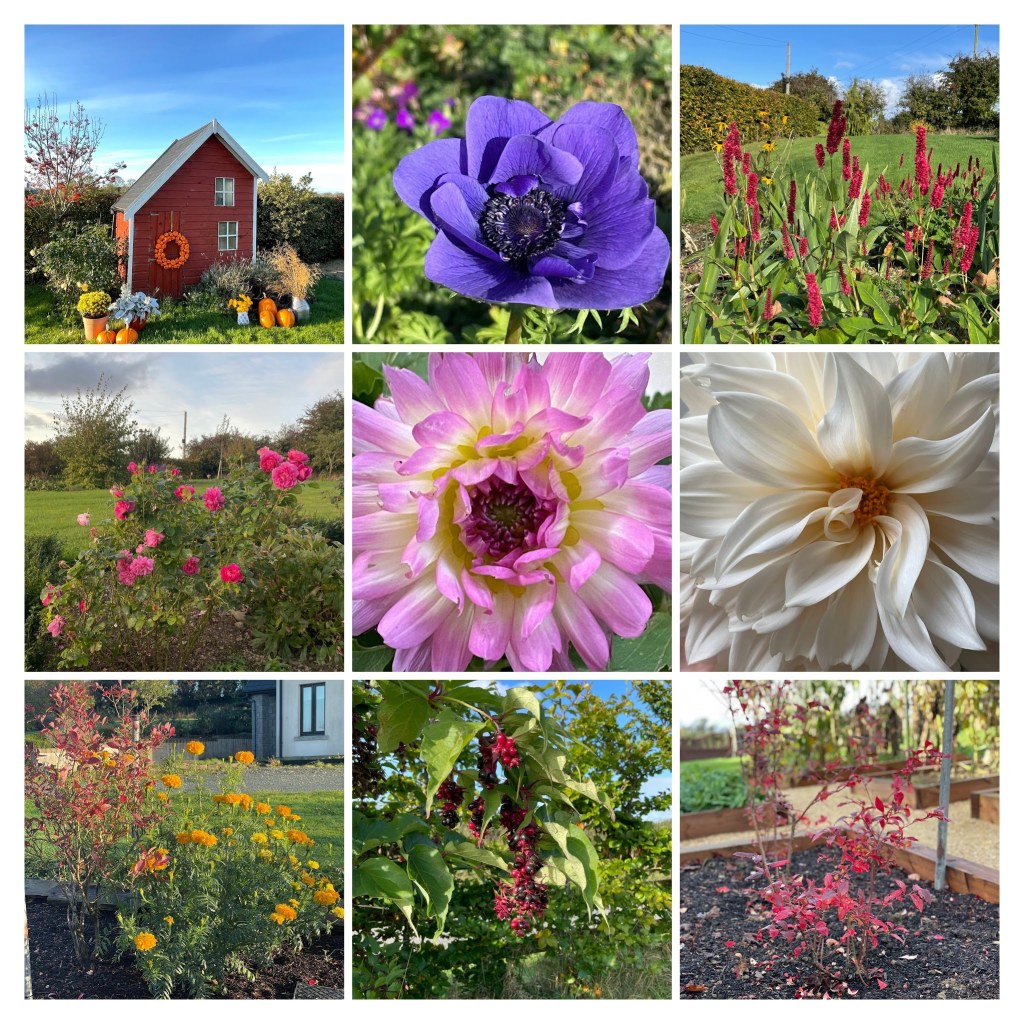
Collage from October & November of anemone, dahlia, roses, blueberry shrub, marigolds

Now we’re on the cusp of November with the Dahlias are finally blooming. Dahlias are relatively new for me, and I’m still learning. You’re supposed to cut their main stem a short time after it starts to grow, to prevent one big heavy stem from growing, and instead have multiple stems to balance out the weight. I did this quite late in the season which is why they bloomed so late for me. Lesson learned! These are in containers, as they need to be protected in the winter and that’s the easiest way for me to do that. Given how pretty they are, I’ve ordered some more for 2022. I have plans to plant them in the ground, which means I’ll have to dig them up next November. I’ll keep you posted.

The blueberry shrub has the pretties fire-red leaves in the fall. It is such an extra bonus after enjoying the yummy blueberries!

A shrub with berries for the birds is the Leycesteria formosa (Himalayan honeysuckle). These have long dangly flowers with berries. The main stems of this lovely plant look like bamboo, while the shorter stems with the flowers are great for using in flower arrangements.
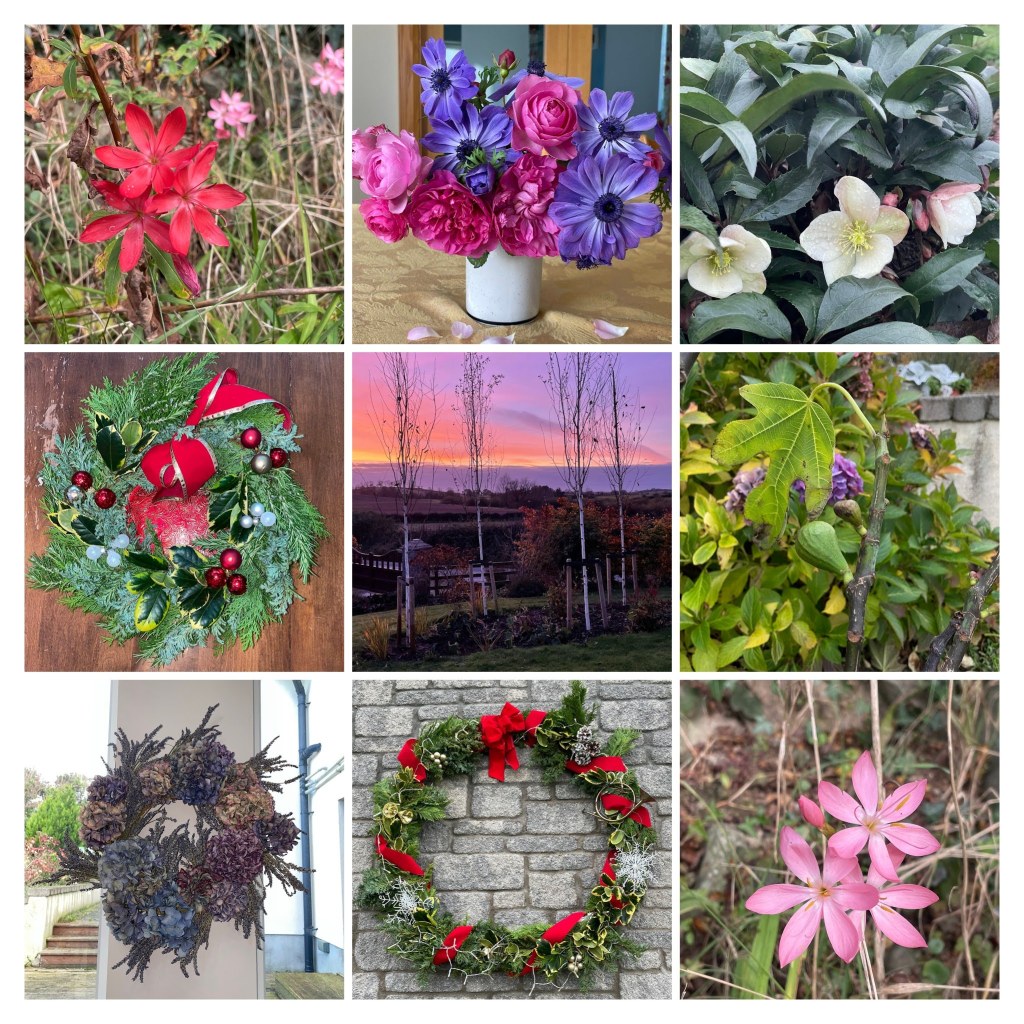
collage from November & December of wreaths, anemone, roses, hellebore and hesperanthus

Here we are in the last two months of the year. The pink and red Hesperanthus (formerly known as Schizostylis) is such a treat to have in November, when there aren’t many other flowers about. This year, though, I also had roses. The Anemone can often be found in the winter garden, as can the Hellebore ‘Winter Sunshine’.

I’ve been patiently waiting the past few years for my fig tree to produce fruit. While it did grow fruit this year, they didn’t properly ripen enough to eat. I’m really hoping that next year will be the year!

I made a few wreaths during this time, too. I just like using my hands, and not letting anything go to waste. All of the greenery and plant materials came from my garden.

And that is a look back on my garden for the year! I’ve really enjoyed reviewing everything, and reminding myself of all that we’ve done in the garden. Being and working in the garden is simply something that I love to do. I hope you’ve enjoyed the tour!

Take care, and stay safe 🙂

In Peace,
Dana
A look back on the garden, part III

Hi there! Don’t mind me, in this third part post, I’m just walking down memory lane where I look back on the garden from July and August, and boy was there a lot going on! Some plants, like my sweet pea, took a while to get started, but once they did, they really took off. I grew three different types of sunflowers this year. What was nice about the different varieties was 1. how completely different they looked and 2. how they all bloomed at different times. This meant that I was able to enjoy sunflowers from summer into fall. These two months saw a lot of growth in the pumpkin / squash category, too. And let’s not forget that July is notable for harvesting lavender and garlic. Let’s get started!

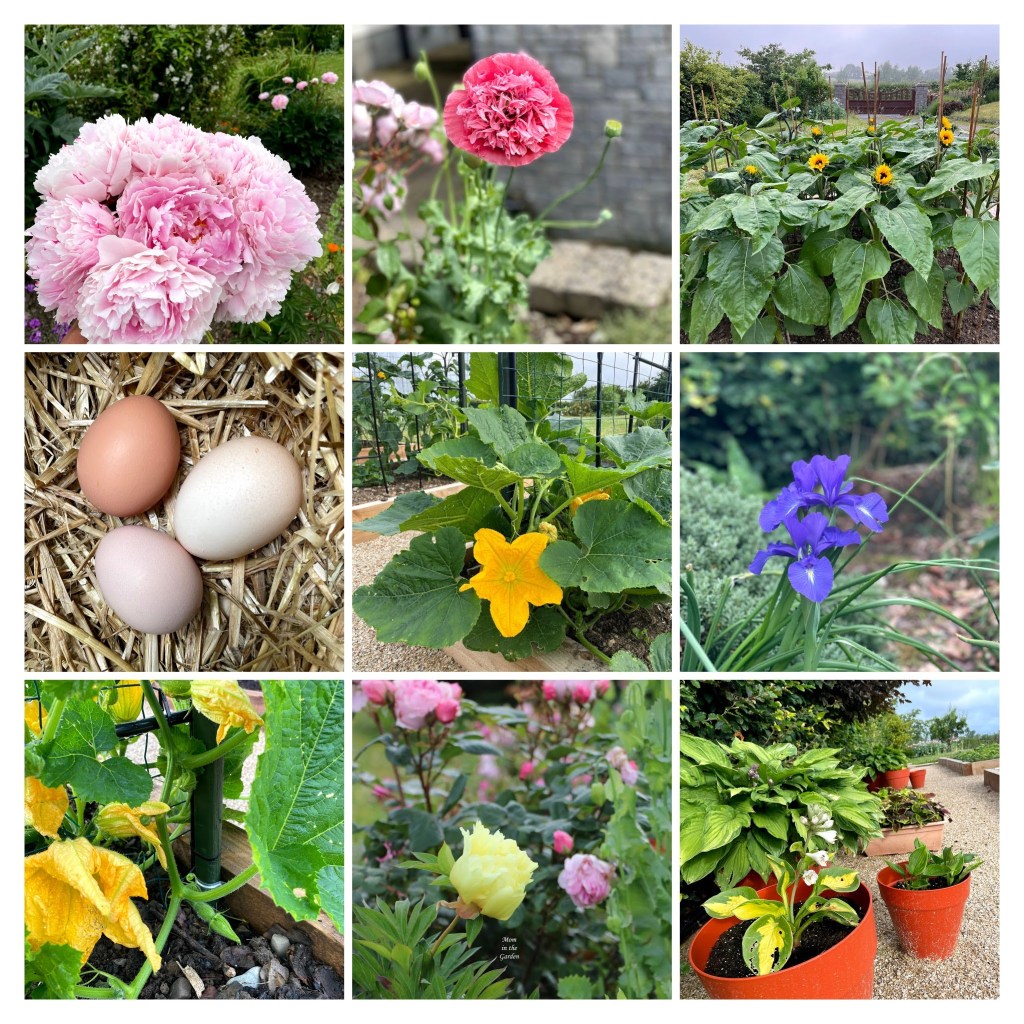
Collage of flowers from the garden in July: pumpkin flowers, peony, hosta, poppy, sunflowers, iris and eggs.

This first collage is from the beginning of July, and the yellow Itoh (hybrid) peony ‘Hillary’, on the bottom, just made the cutoff. I only had one delicate flower, and its color was quite lemony, a first for my garden. It was planted two years ago, so it should have more blooms in 2022. The other ‘end of the season’ peony was my Sarah Bernhardt variety. I’ve had this plant quite a few years so I get lots of big, beautiful, and scented, flowers. If you like peony, I’d definitely recommend this variety. Also during this time, the pumpkin and squash plants started to progress up the pumpkin arch. While they never made it all the way up, I did in fact, gets lots of pumpkins and squash – we’re still eating the squash!

To add some ‘interest’ along the hedge in the new garden, this year I added a bunch of planters filled with hosta. Most of the plants I’d had already, either in containers or in the ground. But I did purchase a couple of new ones as well, which are in the smaller pots, and they bloomed in July. The hosta flowers are not as nice as the leaves, if you ask me, as I think the leaves are the real attraction. These iris, as every year, were the very last of my four varieties to bloom.

While some flowers were finishing up for the season, it was at this stage that the first of the sunflowers started to bloom. They were mid-height – they were supposed to be 5 feet (1.5 meters) tall, but were more in the area of 3 feet (.9 meter) tall – and had only one flower per plant. This would be my least favorite sunflower because of the single flower. That doesn’t mean I didn’t like them, though. 🙂 At the top of the collage is a double poppy that thankfully shows up in the garden every year. And finally, I have a picture of three very different eggs, representing the 3 new variety of chickens that joined my hens this spring.

July collage of flowers: coleus, poppies, sweet pea, pumpkin flower, apples, Maple tree

Apple update: the pretty blossoms are now cute little apples! Another picture of the double poppies, because they are absolutely beautiful. I’ve also included a ‘yucky’ picture in here, too: it is my maple tree with a powdery mildew. We haven’t seen this before, and there isn’t really anything you can do for it, except at the end of the season to clear away the leaves (and not add them to the compost). Fingers crossed that it has a better season in 2022. The picture of the sweet pea is the first cutting of the season. I know this because it is such a small posy, and by the end of the season they were big bouquets.

The middle photo is of my ‘rainbow garden’. In the front, the cream colored David Austin Lichfield roses and yellow potentilla shrub are at their peak. I only learned this year that I could prune the potentilla, which I duly did at the end of the season. I can’t wait to see how it looks in 2022. I have helenium ‘Moerheim Beauty’ growing in a couple of places in the garden, as it’s a lovely splash of red and golden color (here it is along side my daisies).

I am all about having splashes of color in the garden, no matter if it’s from flower plants or veggie plants. It’s another reason I love to grow pumpkins and squash, I mean, what’s not to love about those big orange flowers? I picked the last photo for the pretty sunset, as the poppies under the birch trees are not quite at their peak.

July collage of flowers including garlic, freesia, peony, lilies, sunflowers, roses, poppies, and pumpkin arch

We’re in mid July here, and that’s when I harvested my garlic. The timing was perfect as we had some dry weather. There’s nothing worse than getting caught in a wet spell and not being able to harvest the garlic in time. I’ve planted about half of that amount for the 2022 season, which will still be more than enough for us. It keeps all winter, in a cool, dry location. Garlic is one of the easiest things to plant, and I highly recommend growing your own. It is so worth it in taste!

You will see through the different collages that I have a lot of containers. Part of that is me trying new flowers, part of it is that we have a deck that suits containers really well, and part of that is that I don’t have a more suitable place in the garden for those flowers. The pink, yellow and white freesia are a perfect example of looking lovely in a container but wouldn’t suit in the garden. So I’m glad for the containers! Funny enough, I filled both my garden and containers with lilies this year. Best decision ever as they are so easy to grow and are perfectly showy.

The birch tree bed was completely taken over by poppies in July. It was quite remarkable as they were 99% one variety (a single flower, lilac color) and I didn’t plant any of them. They come from my compost which apparently doesn’t get hot enough to kill seeds. So whatever I put in the compost, has the potential to come back!

I threw in another picture of the mid-height sunflowers as a progress report, as well as some roses just to remind me that the roses were still going strong. 🙂

End of July collage of flowers: sunflowers, lavender, daisies

We’re now at the end of July. The second variety of sunflowers have started to bloom – and this Claret F1 lasted well into fall, with so many flowers per stem. The colors were from chocolate to yellow and burnt orange / burnt red, with medium sized flowers, and they grew pretty tall (well over my head!).

I was a bit late in harvesting my lavender this year, but that didn’t stop me from making some fresh wreaths (pictures in the next picture). The clematis, ‘purpurea Plena Elegans’ is a pretty raspberry/wine color, but doesn’t really like the amount of wind that we have. It looks ok, but isn’t ideal in our yard, unfortunately.

The lychnis Coronaria rose campion has really pretty fuchsia pink flowers, although the evening sunlight in the picture doesn’t show that very well. Those flowers will actually spread like wildfire, so unless you want them everywhere, you have to pull them out as soon as they show up in their new spots (they are easy to pull out).

Of course I had to throw in another pumpkin arch update!

July collage of flowers: roses, sweet pea, lavender wreaths, blueberries

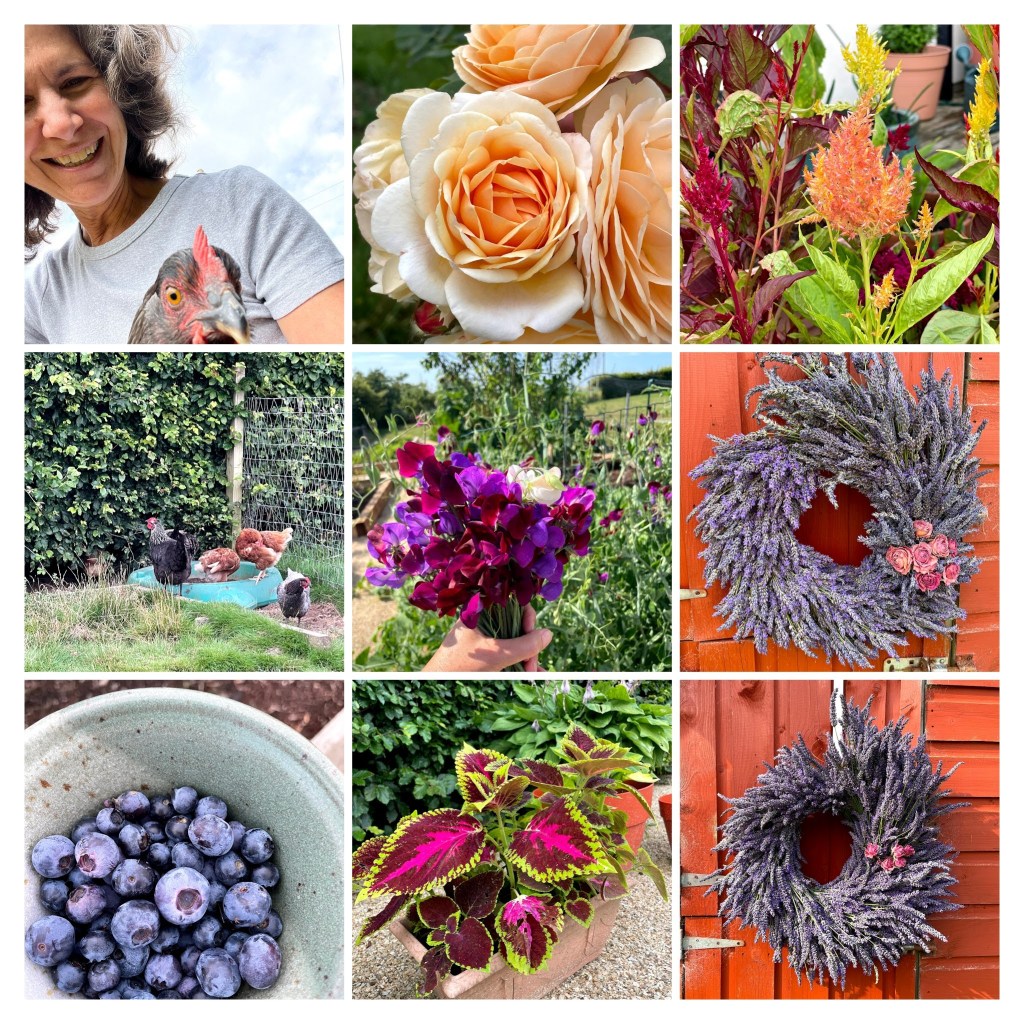
We’re finishing up July with blueberries! We had a great ‘little’ harvest this year, of several little bowls of blueberries. This was the first year that we covered the shrubs with netting and that worked great for keeping the birds away. I also spread out our plants that were crowded together previously, and fed them more than I typically would, which paid off. I’m excited for the 2022 season, as we learned a lot last season.

Finally, a picture of the chickens! We added three new varieties in March, but I only took video of them in the beginning, so I had no pictures to share earlier. We have a Bluebell (she’s gray), a Maran (with stripes), and a Daisy Belle (the largest of all of them and quite pretty with green shimmers in her black feathers). The Bluebell is quite friendly and likes to sit on my lap when I’m in the yard with them.

I made these two fresh lavender wreaths (as opposed to dried lavender). The bottom one I made first, and the one above was made second – I think I get better over the course of the season! The Celosia, the top right picture, I grew from seed. They were easy to grow, and dry really well, so I might grow them again.

More roses – of course!

August collage of flowers: helenium, pumpkins, hydrangea, gladiolas, lilies,

I told you it was a lot of flowers! These pictures are from August. This is another another batch of helenium flowers. These are next to my ‘Teasing Georgia’ yellow David Austin roses, as I think the colors go nicely together. The other flowers are: ‘Magic Star’ lilies, gladiolas ‘Pink Parrot’, hydrangea Selma, clematis ‘purpurea Plena Elegans’, and some more poppies. This sunflower is the first of the dwarf sunflowers to bloom. Next to the two small pumpkins is a picture of Liatris spictata Kobold, which is such an unusual flower for my garden – so I love it!

August collage of flowers: incrediball hydrangea, vanilla fraise hydrangea, coleus, lilies, agapanthus, calla lilies, sweet pea, Russian sage, pumpkin arch

So I found myself picking flowers for this collage that we’ve seen before. But it is interesting to me to see how much they grow and fill out and change colors during the season! The Incrediball hydrangea (bottom right) was moved in early spring 2021, but seems to have settled in well. This plant takes a lot of water, and I have still not figured out the perfect balance of getting that right. It doesn’t help that it is just out of reach of our hose, either. I’ll keep at it until we get it right! It’s not too far from the paniculata hydrangea Vanilla Fraise, actually – which is just starting to turn pink in this picture. The paniculata has not had any water issues, thankfully.

The coleus was my pride and joy this summer as I grew it from seed and it just looked so spectacular! Also, it was planted as a reminder of my dear former neighbor and friend Betty, who always grew them.

See the single, purple agapanthus flower? That didn’t do great in a container for me. Turns out the few that I had in the garden weren’t very happy either, but I had them in a somewhat shady area. So I’ve moved all of them into a new – sunny – spot in the garden and I can’t wait to see if that does the trick (along with extra feed).

Look at the Russian sage (Perovskia atriplicifolia ‘little spire’)! I had some growing in partial shade and it wasn’t very happy. This guy, in full sun, is just shouting out with joy! I’m glad the space is large enough for it. These potted pink Calla lilies looked really well and bloomed for weeks.

Of course I’ve included another update on the pumpkin arch!

end of August collage of flowers

We’re wrapping up August with this collage. I rarely mention the wild fennel that I grow, but it is very pretty. The flowers are yellow and dainty. I enjoy watching the birds as they try and balance on the stems while eating the seeds in the winter. The plant isn’t just for birds, as it is edible for our consumption, too. The other plant not mentioned often enough: globe artichokes. I’ve used some in this flower arrangement – they look like purple thistle. The globe artichokes were arranged with roses, sunflowers and helenium.

The paniculata ‘Vanille Fraise’ hydrangea has turned pink by this stage. It’s around this time that you can cut the flowers to easily dry them. The Red Kuri squash look orange at this point in their growth, but as they mature, they will turn a more burnt orange/red. This view of the pumpkin arch shows us two Red Kuri squash, which are still orange, growing up the fencing.

The red apple tree is an eating apple tree, while our second tree is a cooking apple tree. I know I’m biased but, the red apples are incredibly tasty! I enjoyed eating our supply of apples right up until Christmas. I should have cooked and frozen some, to keep them longer. That will be something I’ll try in 2022, if we get a good crop.

The top picture is of some of my lilies – both pink and white. The white ones are in the garden, while these pink ones are in a container. They’re just so easy to grow, why wouldn’t you want that beauty and fabulous scent?

And finally, the sunflowers: the neat line of dwarf sunflowers bloomed in a perfect line. Not only that, they also then continued to bloom multiple flowers on their stems. The burnt red and yellow sunflowers were tall and floppy, grew all over the place, and were absolutely lovely in their uniqueness.

Phew! Are you still reading? You’re amazing! That was a really long post. I’m kind of impressed (and surprised!) with all of the flowers that I grow. Although I of course know all that I grow, it is only looking at them in this monthly review format that I really appreciate all that I have. And I really do appreciate them! I appreciate them so much that I created a new bed, in order to plant more flowers! 🙂

Thanks so much for stopping by. Let me know what you think!
Part IV will finish out the year.

In Peace,
Dana

A look back on the garden – Part II

Hello! I’ve had quite a time going through my photos from 2021 – there are a lot! Every season brings something different and interesting, so I can’t even say which is my favorite season. They are all wonderful in their own way. But in this post, we’ll look at the garden from April through June. As you can imagine, that’s a pretty busy time in the garden. Some of what you’ll see: Tulips, Allium, Bluebells, Lily of the valley, apple and cherry blossoms, and Roses – lots and lots of Roses! I hope you enjoy the tour. 🙂

April collage of apple blossoms, cherry blossoms, anemone and magnolia

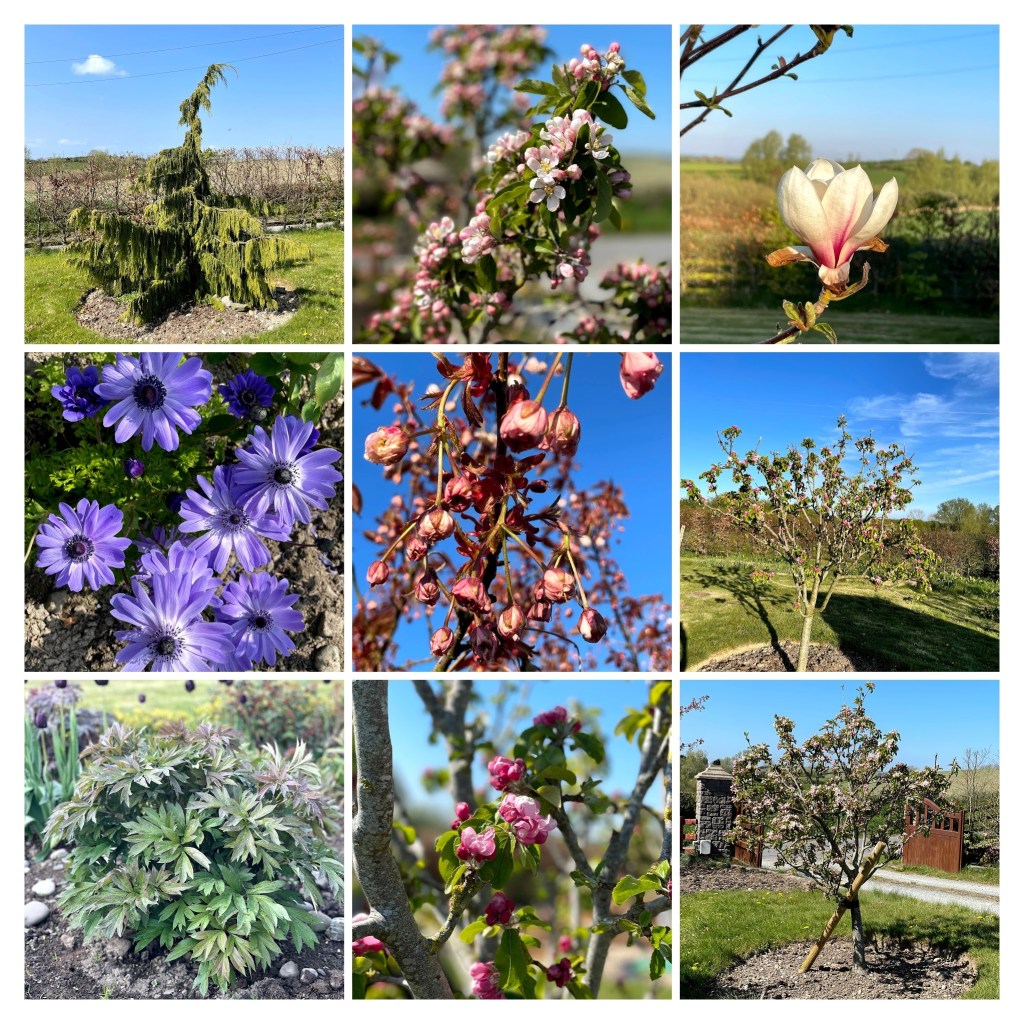
April is definitely a time when we start to see a lot more happening in the garden. We enjoy seeing the two varieties of apple tree blossoms – one has very light pink flowers, while the other has bright pink flowers. Our cherry tree blossoms are also light pink, and start to show at this time. The Anemones have been going all winter and continue to bring a pop of purple color to the garden. I have a picture of the green leaves from one of my peony plants here, too: Paeonia ‘Hillary’ is an Itoh (hybrid). I think the green leaves are lovely. I guess I have a thing for ‘greens’ because I also have a picture of my Nootka Cypress ‘Pendula’ simply because it is one of my favorite trees.

April collage of tulips

I had to have a tulip block! I love tulips, with a special fondness for pinks. These pictures are all from April. I have to say that I planted a bunch more this past fall, so we’ll see how they do in a few months!

April collage of frosty grass, bleeding heart, bergenia, hyacinth, magnolia, grape hyacinth and hellebores

We’re still in April! Just a reminder, as shown in the photo with the birch trees and the hen house, that we can still get a hard frost (in May, too, unfortunately). As for flowers, in April we have Bleeding Hearts, white and pink varieties of Bergenia, Grape Hyacinth, Hyacinth, and Hellebores. The ‘heaven scent’ Magnolia tree and the Birch trees were planted at the same time in November 2020. While I confess that I didn’t really notice a strong scent, I found the Magnolia flowers to be quite pretty.

May collage of hosta, tulips, lilacs, cherry blossoms

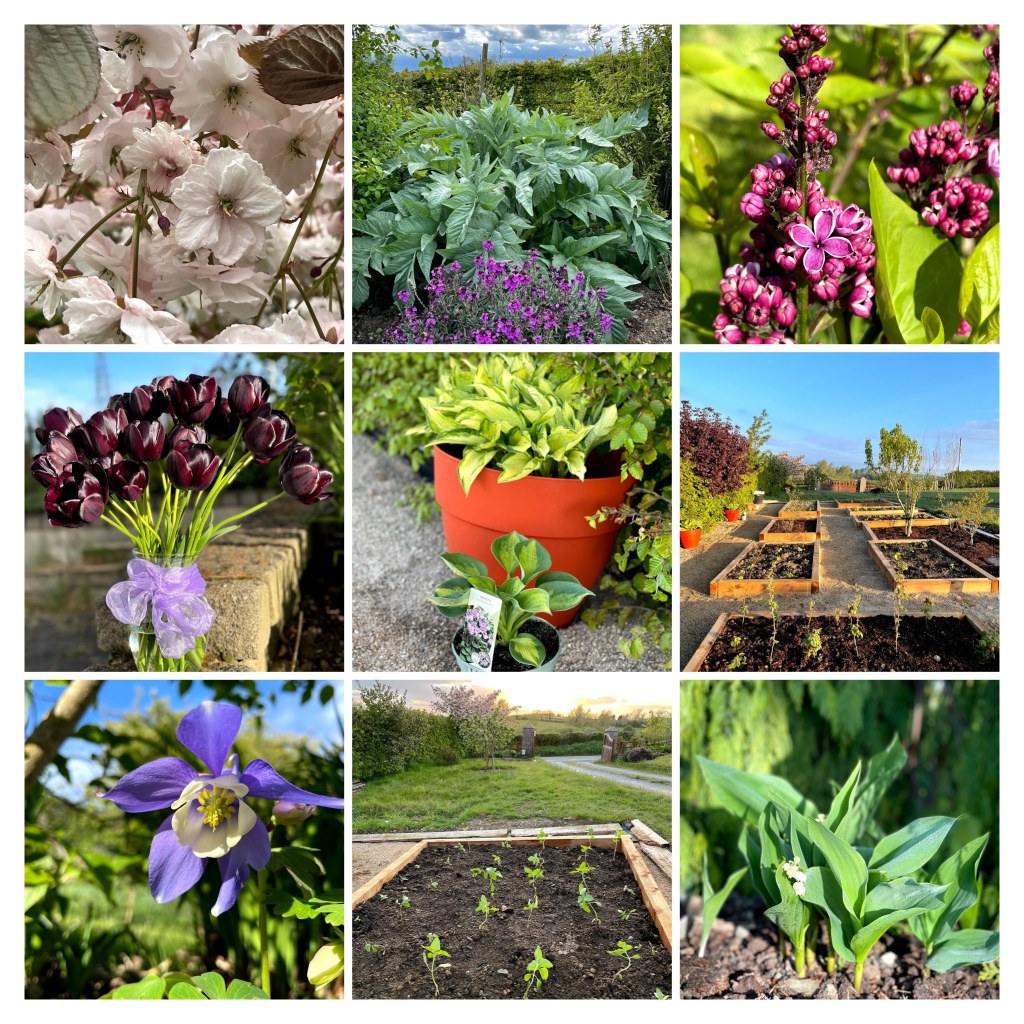
Moving along to May, we are still enjoying tulips. Other bloomers at this time: Lily of the valley, Columbine (or Aquilegia), lilacs, fully blooming cherry blossoms, and Erysimum ‘super bowl’ mauve. The Hosta were moved from the ground into planters this year, to decorate the new garden. They started to fill out in May. The plants in the veggie beds and the sunflower bed are all doing well and showing lots of growth. The Globe Artichoke plant, behind the mauve Erysimum plant, is one of my favorites for the unusual leaves and of course the artichokes, which flower purple when left to fully mature. I grow it because I think it is so interesting to look at!

May collage of blue bells, garlic, rosemary, lilacs and potted plants

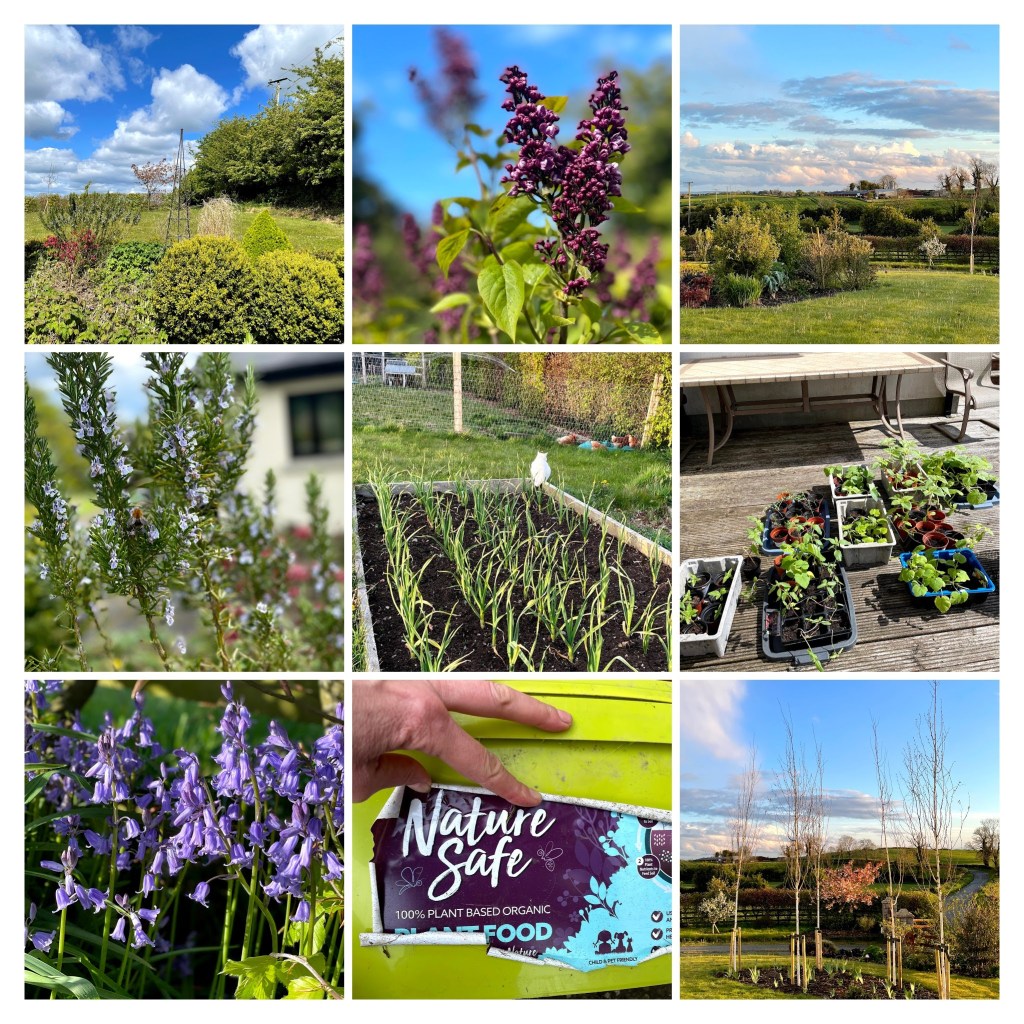
Although still in May, the organic plant based food ‘Nature Safe’, which I use throughout the garden, would have been taken out in March to start feeding my evergreens, and the lilac shrubs. I really like this product, plain and simple. It took me too long to learn that feeding your plants regularly is *really* important. Some more blooms in the garden: Bluebells, Rosemary (did you know it flowers?) and lilacs. At this time, everything I’ve grown from seed gets acclimated to get ready for the move to outdoors. Here’s a look at how the garlic is doing, too.

May collage of flowers with lilacs, lily of the valley, poppy, pumpkin, peony and allium

Still in May! The lilacs have finally opened completely, while the Viburnum Opulus ‘Roseum’ is just coming into bloom – it starts out green and will eventually turn white. The first of my peony, an old fashioned variety, also starts to bloom (it is a deep red) and looks quite nice among the Bluebells. Tis the season for Allium, and Poppies. These orange ones, like all of the Poppies in my yard, were not planted by me. They were either planted by a bird, or more likely, by my compost. The pumpkin plants are planted in the ground and showing signs of wind burn (but they mostly survived this). The Bearded Iris were planted in the bed of the Birch trees in November, and I just wasn’t sure if they would survive. But they sure did survive! Here one is getting ready to bloom.

May project of Pumpkin arch

Our ‘Pumpkin Arch’ project was done in June. My husband made it for me based on a few requirements I had. He really did a great job and it is my favorite feature in the garden. We planted pumpkins and squash at the base of it, and that worked out really well. They didn’t reach the top of the arch this year, though, so I’d like to plant them earlier in the season. I plan to also cover the young plants with fleece to protect them from windburn (our area is really windy) and from frost. Maybe then they’ll reach the top of the arch!

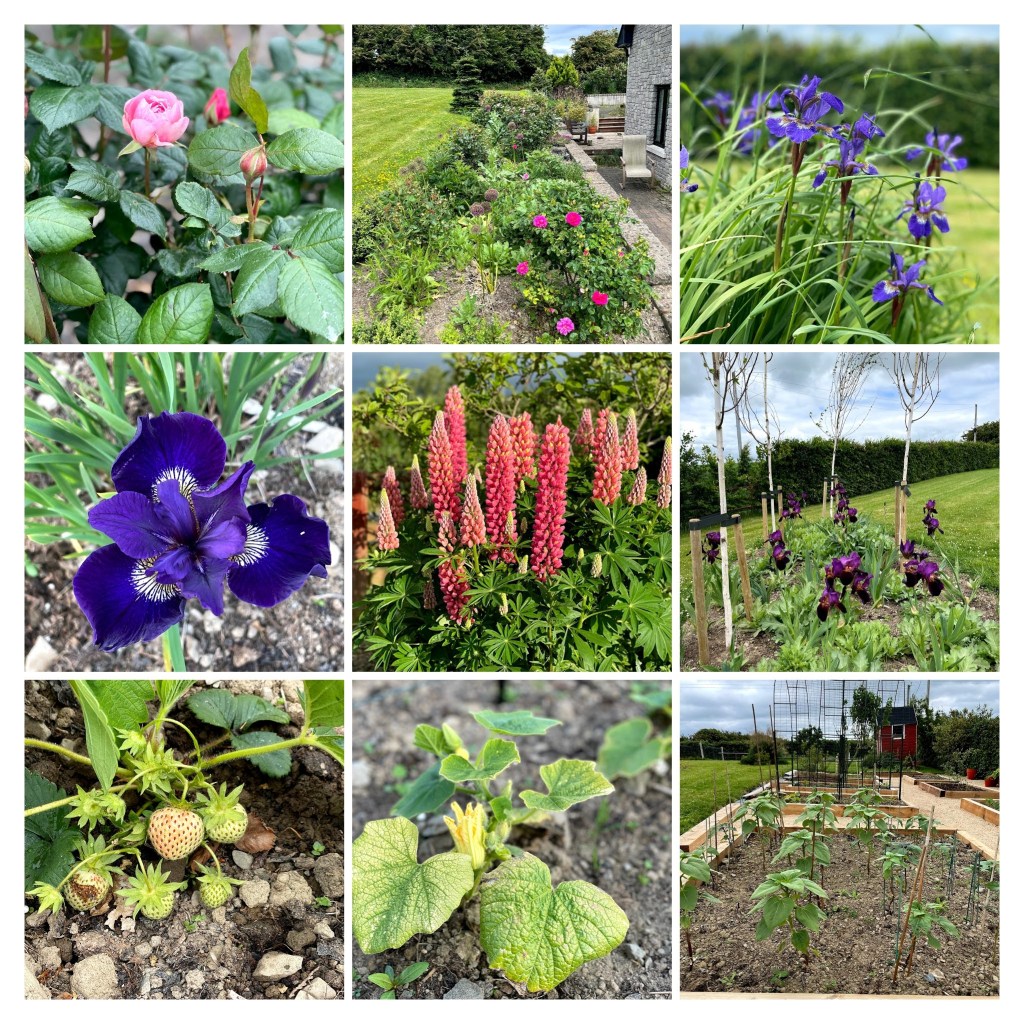
June collage of iris, roses, strawberries, pumpkins & lupin

June! The sunflowers are getting taller, the strawberries are ripening, the pumpkin plants are finally settling in to the soil and producing flowers. The lupins looked exceptionally fantastic this year. I didn’t do anything differently, so hopefully they’ll be as lovely again this year. I have three different varieties of iris in the collage above, but I only know the bearded iris name: Benton Storrington. And since this is early June, the black spot hasn’t gotten hold of the rose shrubs (yet).

June collage of roses and peony

The roses really take over the show in June, but they aren’t alone as also showing off in the best kind of way are the different varieties of peony plants that I have. Last year wasn’t the best year for my peony plants (some had been moved early in the season). I’m hoping they’ll be happier this year.

My oh my that’s a lot of flowers and plants in the garden! I made it a goal to work for a short time in the garden every morning before work. I have to say that doing that small bit (nearly) every morning made my life so much easier in the garden. I was able to stay on top of weeding – mostly – and I was able to enjoy working in the garden since it was just a short amount of time. I might not get out in the garden every day, but I do try and do small bits here and there to keep the weeds in check.

Thanks so much for stopping by! I hope you enjoyed the tour. Until next time, stay safe and healthy!

In Peace,
Dana

June 5, 2021 sunset in new garden
June 5, 2021 Sunset view from the garden

A look back on the garden, while planning ahead

Happy New Year! While life all around us is still rather unsettled with Covid-19 (the Omicron variant being the latest cause of widespread infection), there is one thing that, thankfully, remains a constant: the garden. January is the perfect time to look back over what we grew in the garden last year. I like to reflect on what did well, what didn’t, and think about what we want to add. I’ll do this in four parts, using a collage of pictures. Shall we get started? 🙂

January snow on snowdrops, chickens and the playhouse with a picture of the compost, too.

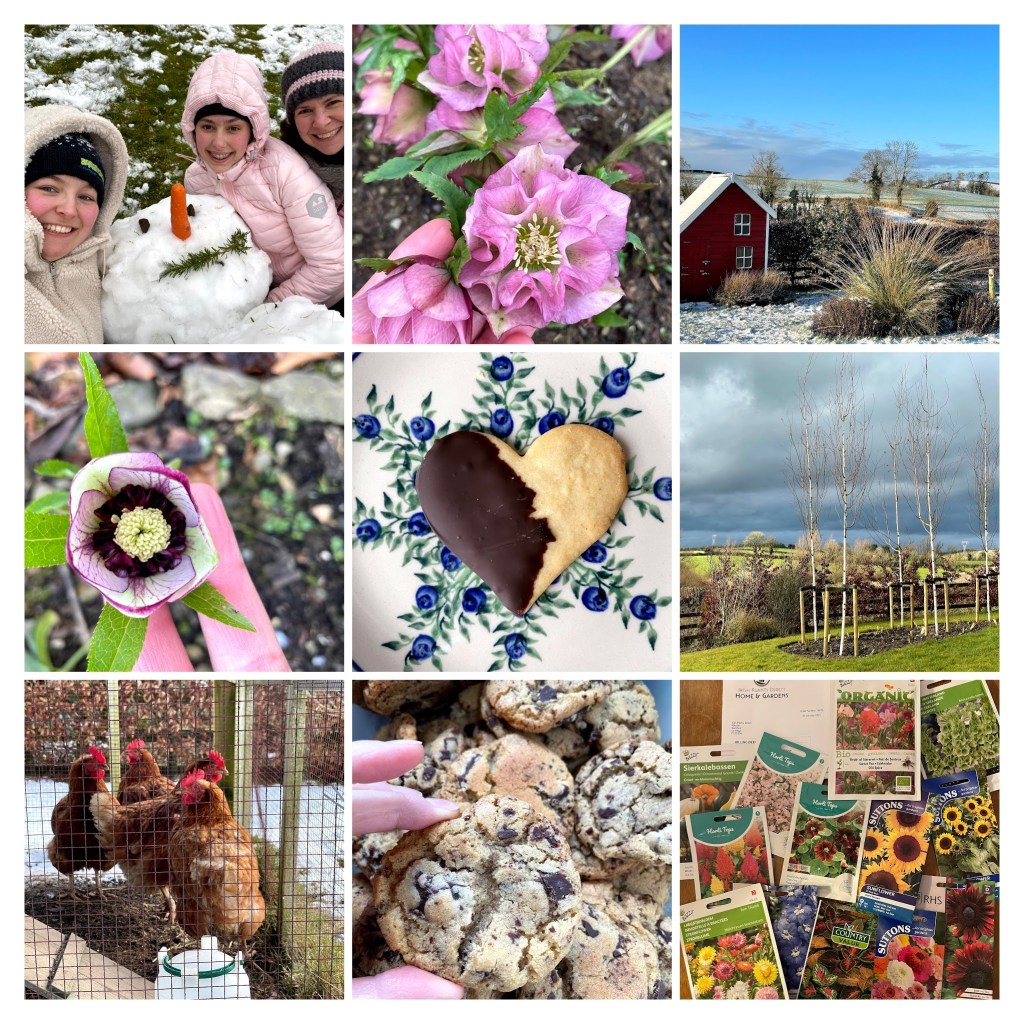
We had a light dusting of snow last January, which made everything quite pretty. The snowdrops are usually the first to flower. I’ve just checked today on the snowdrops and they have pushed through the soil, so it shouldn’t be long now before they bloom again! Also early to flower are these ‘Winter Sunshine’ hellebores. This plant in particular flowers profusely all winter long, and when the leaves aren’t suffering from black spot, the leaves are a very pretty blue-green (I cut them off if they have black spot, and the plant does fine). I took a picture of our compost heap because it really is amazing stuff, despite its messy look. As for my Rhode Island Red (hybrid) chickens, I can never resist taking pictures of the girls’ fluffy bums!

February collage of pictures, including a snowman, cookies, seed packets, a hellebore and chickens.

We had (just) enough snow in February to make a snowman! My daughters and I had a fun time in the snow. I’m so thankful that they have a silly side and that they want to include me in their fun! We also did some baking – dark chocolate is our favorite to bake with. As for the garden, a couple more of our hellebore plants started to flower. The single hellebore flower is Anemone Picotee, while the more showy hellebore is Frilly Isabelle. Funny enough, not all of my hellebores flowered last year. I know that last year I cut their leaves late in the season, so I didn’t do that this year. (I’m not sure that would do it, but worth a shot.) The birch trees were only planted in November of 2020, so I took a lot of pictures of them. You can just barely see the bearded iris stumps at the bottom of the trees, the first plants I added to the birch tree bed. The chickens weren’t sure what to make of the snow, but thankfully, it wasn’t around for long. This was also the time my seeds arrived, which is always a time of excitement. 🙂

February collage of pictures of hellebores, snow drops and cupcakes

A few more pictures from February, as I added a couple new hellebore plants underneath the birch trees: Harvington Double Apricots and Harvington Double Reds, both of which came from Altamont Gardens, in County Carlow. They are both very frilly and showy, making them just perfect. The snowdrops also opened up nicely, which can really be appreciated on a sunny day. I don’t have the name of my pink hellebore, but it is a ‘single’ and very pretty. We did some more baking in February, too!

March collage of pictures of anemone, hellebores, daffodils, and compost.

Moving right along to March, I’ve captured here the single pink anemone that I have. It is quite a bright pink color, while all of the rest of the anemone in my yard – and there are a lot – are purple. The end of February / beginning of March is when I gave my rose shrubs a hard prune. That worked out great this year, as the roses did really well. I am slowly learning that to prune more is better than to prune less with my roses. The Pulmonaria flower, in the middle, blooms along with the daffodils, and is a nice companion plant to them. This variety (whose name I don’t know) also has pretty spotted leaves. I so enjoy having chickens and getting fresh eggs every day! They are such a treat. Not to be outdone by the chickens, Kitty enjoys being in the garden with me. While I do take lots of pictures of her, you can also find her photobombing her share of pictures. And we have another picture of our compost! The compost benefits from being ‘turned’, the more the better. But even if it is just left over the winter (sorry to say that this happens a lot with us!), the bottom of the heap will be good to use by the summer.

March collage of pictures of tulips, daffodils, magnolia, hyacinth, ranunculus, and seed trays.

March (and creeping into the start of April) brings more color into the garden, with ranunculus, tulips, daffodils, hyacinth, anemone, bergenia (this one is a white variety) and our magnolia tree in bloom. The Aubrieta definitely steals the show in the rose bed at this time of year. That pink ‘pops’ from clear across the yard. My plan was for it to grow over and down the wall. Its plan is to grow into the garden! I’m hoping my plan wins. Last March is also when I started some flowers in seed trays. This was the first year I tried this, and overall it went well. The coleus and delphinium were the biggest successes, or at least my favorite.

collage of a baby blanket with farm animals

I was a little busy with this creative project, too, last March. It’s kind of fun to look back on what kept me busy! It actually took about 6 weeks to make this baby blanket. It was a fun project that I was very pleased with. But I haven’t really worked on any crocheting since, which means it’s about time to start again!

I skipped our biggest project which we started last March: the cleaning up of the veggie/fruit garden and the addition of the pumpkin arch. I will definitely cover that in my next post.

Meanwhile, I hope you are staying healthy, and are having a good start to the new year!

In Peace,
Dana

P.S. The feature photo is from last year, we have not had snow this year (yet?).