Life is … A Bed of Roses!

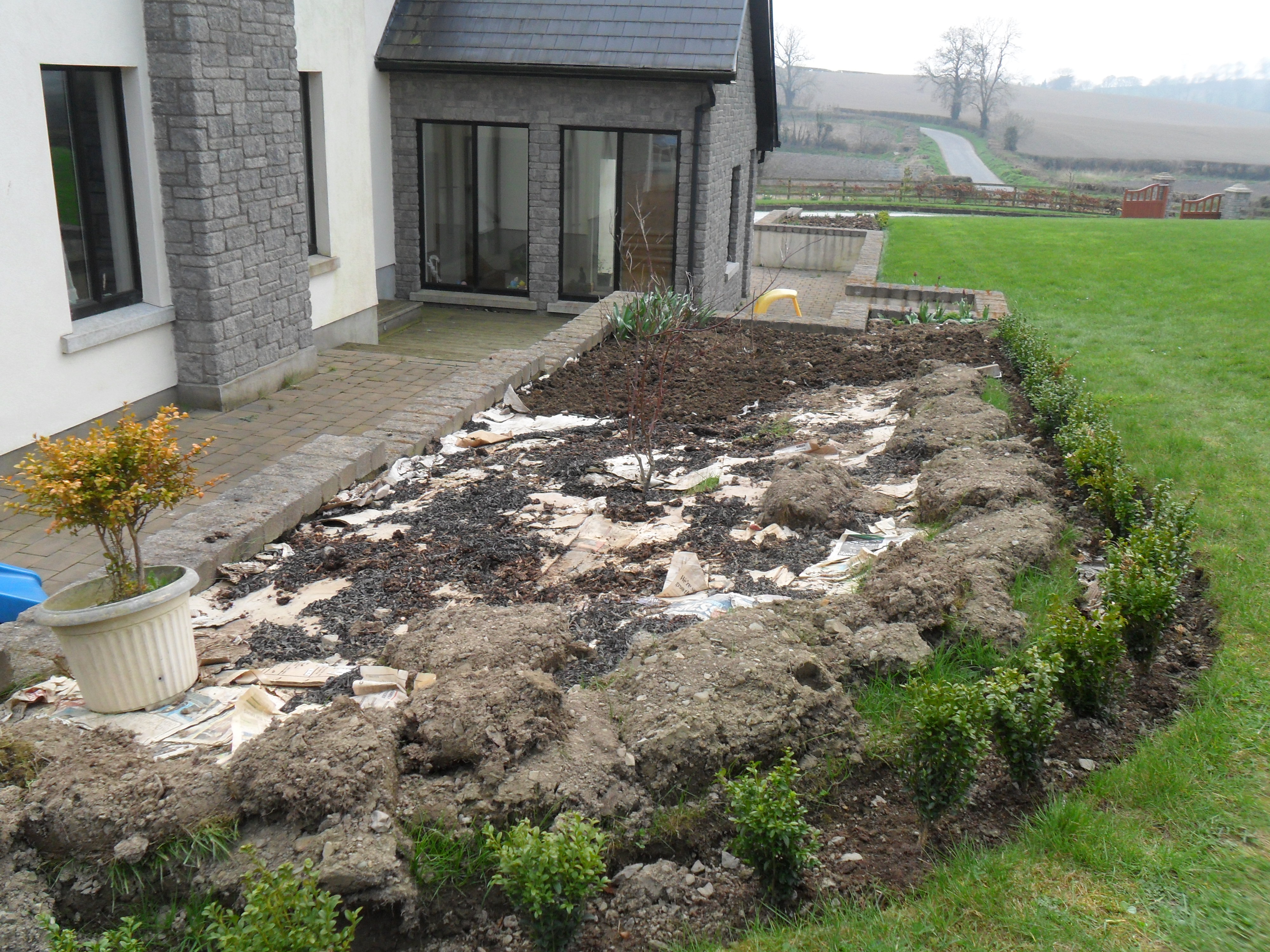
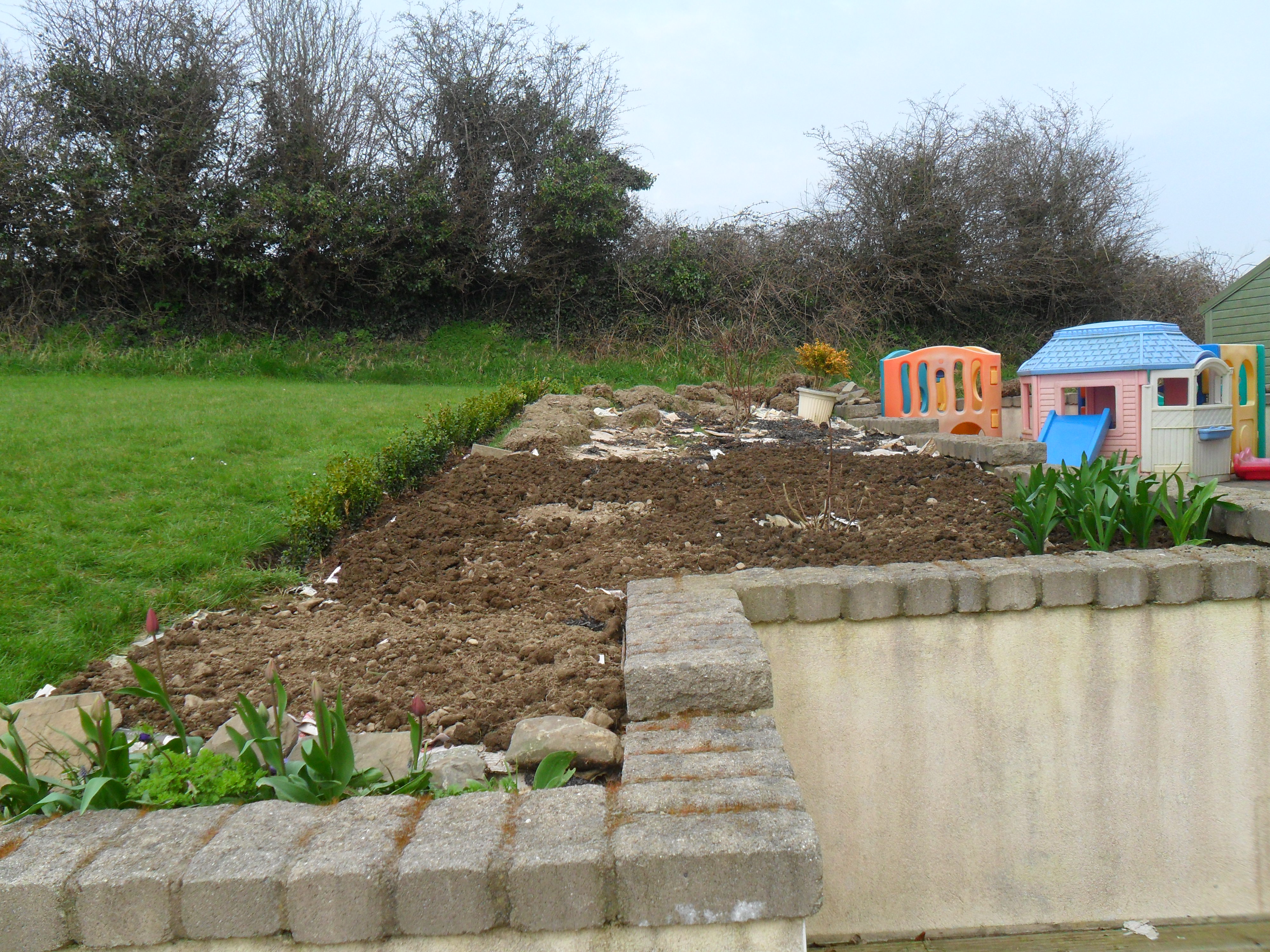
I love roses, especially fragrant ones.  So it was no surprise to my husband when I planned out a rose bed for one of my first gardening projects.   And plan I did!  The area that is our new Rose Garden was simply grass last year.  I marked out the area I wanted with layers of newspapers and added compost and seaweed on top, and a few stones to keep the papers in place.  I then left it alone for the grass to break down.  As for the next step of  picking a border, I have to say that there is something about boxwood plant borders that I really like.  I think it is the functionality of the plant!  So boxwood is what we went with (as soon as it went on sale locally).  The garden had quite a few months of really not looking all that pretty, I have to admit.  This doesn’t bother me as long as I have a clear vision of what it is going to look like in the long run!

Last fall I decided that tulips would be a nice flower to have in the rose garden.  I planted bulbs and then covered everything up with some local horse manure (see my previous post: https://mominthegarden.wordpress.com/2012/02/07/laying-down-manure/).  Some of the tulips are up now (Blueberry ripple & Innuendo). I’m still waiting on a few double late tulips.  I was all ready to plant some roses this weekend  so I gave the garden a really good digging through!  I used my hoe and mixed in/up/around everything! It’s a good thing I love gardening, because this was some seriously hard work!   This was it, I was finally ready to call it a garden bed.   We  planted 3 Rosa Jacques Cartier roses (what a fancy name!), and then 3 roses with names not nearly as exciting.    My husband and I have a little debate going on.  The debate is whether or not it is worth buying special (read “expensive”) roses via catalogue, or are the inexpensive “sale” ones just as good.   We’ll have to wait until this summer to find out which roses are the winners!

How about you, which do you prefer?  Buying through the catalogue or locally?  I’d love to know!

Dana

Future home of a rose garden (newspapers, compost, seaweed & rocks)!

Getting closer to being a rose garden (with horse manure).
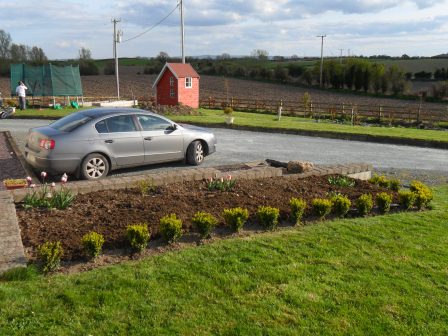
My new rose garden (with tulips)!

My new rose garden (with tulips, too)!
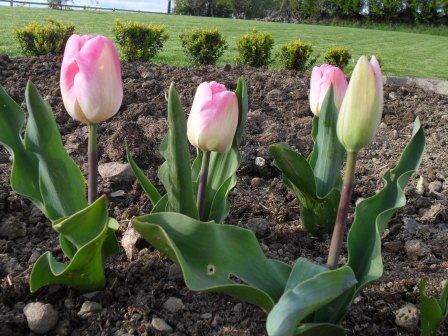
“Innuendo” tulips.

“Blueberry ripple” tulips.
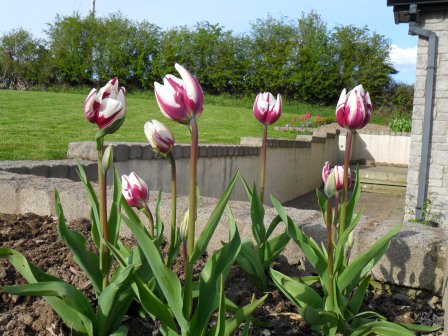
“Blueberry ripple” tulips in my new rose garden.

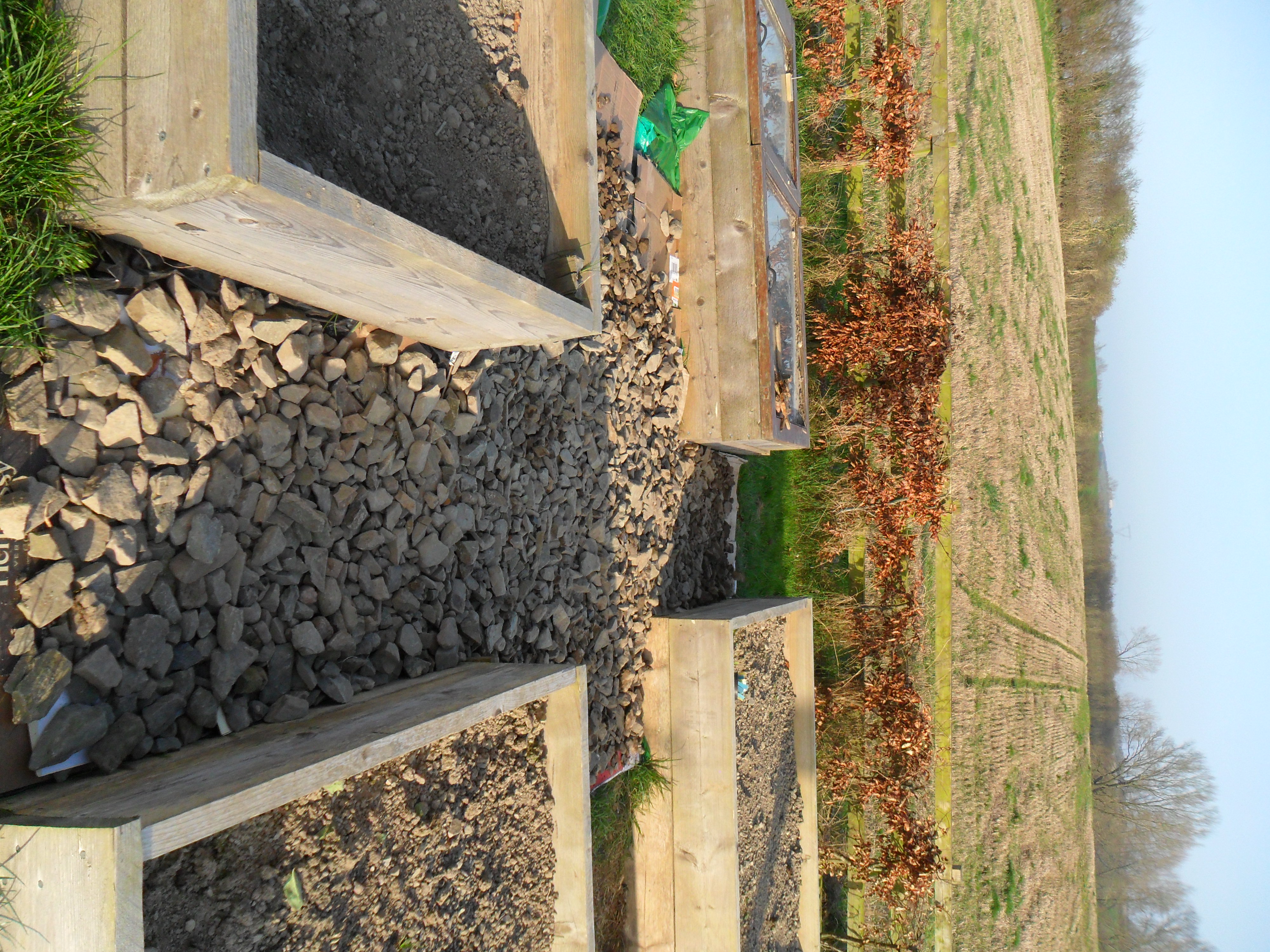
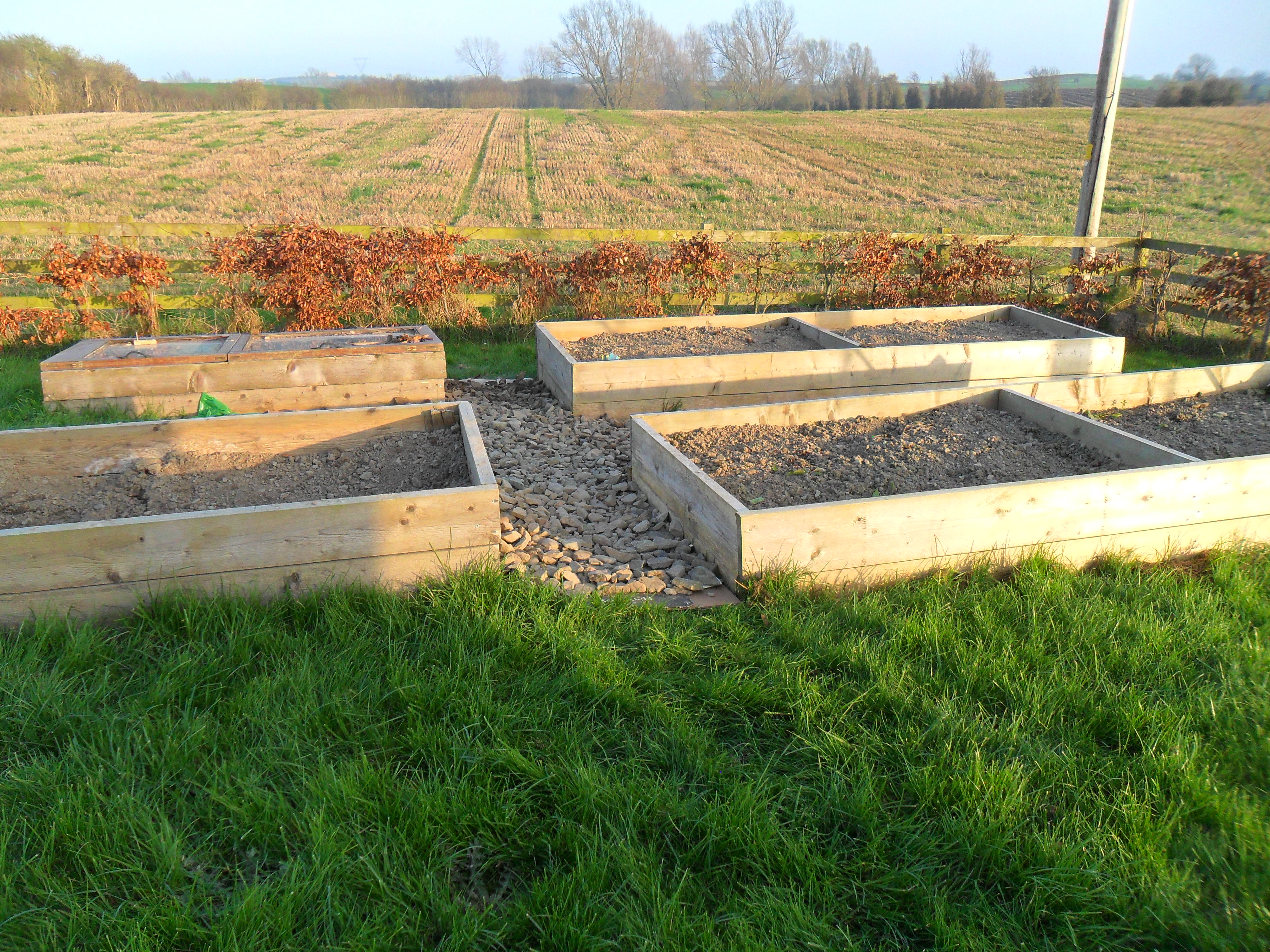
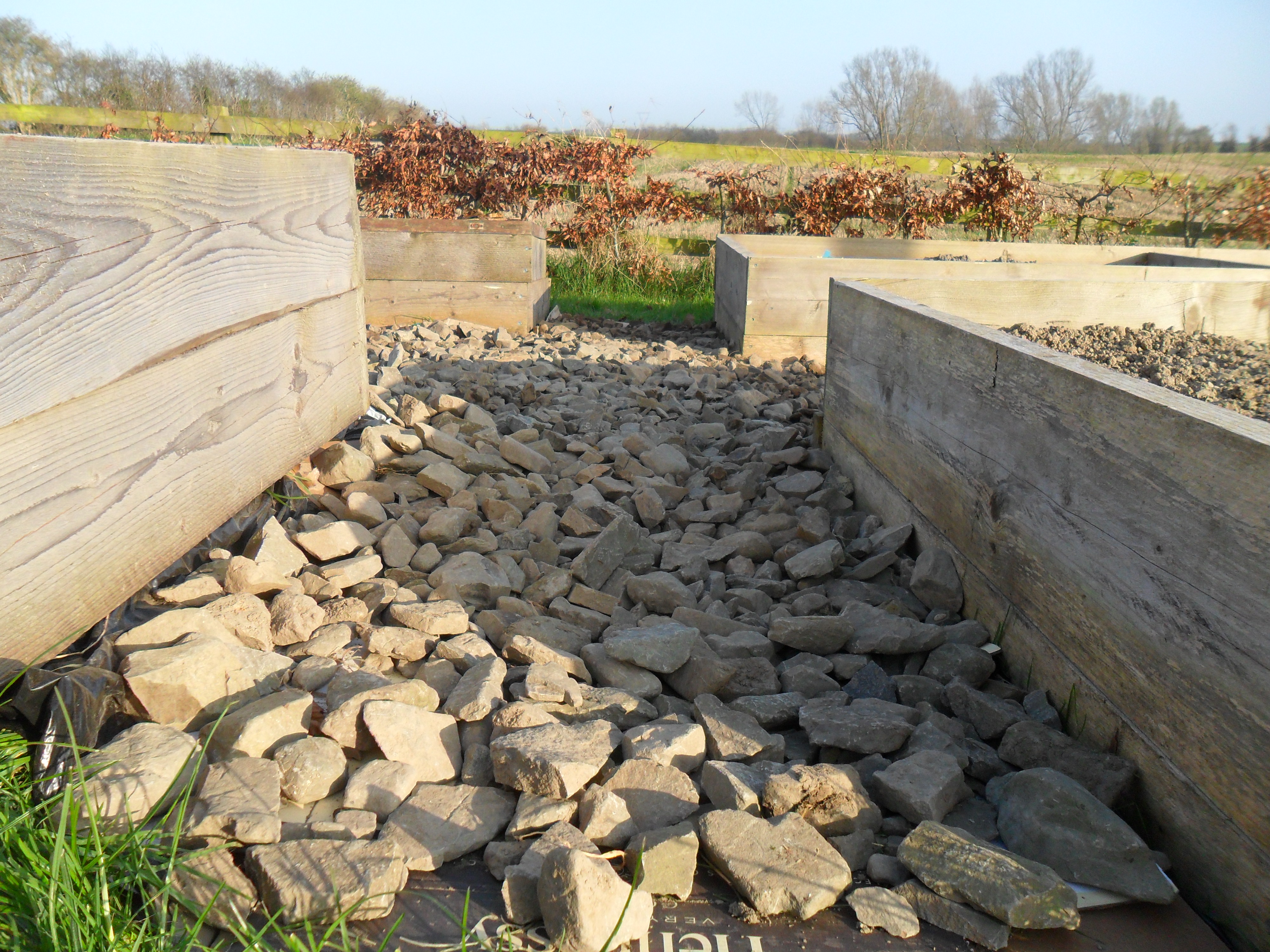
A stone pathway between raised vegetable beds.

Sometimes it takes doing things a few times to get it right, don’t you agree?  Last year, we put together  raised beds, threw in some soil, and off we went. “Learn as we go” mentality,  or maybe “fly by the seat of our pants” would better describe us.  As the soil settled in our  raised beds, we began to remove the stones.  We didn’t really think much of this process, and kind of just tossed them.  That’s right, anywhere.  Pretty quickly we realized that there were way more stones than we’d realized.  So we dropped them between the raised beds.  I thought there would be enough stones to  just lay in between the beds all nice and neat. I was hoping they’d kill the grass and look great as well.  I mean, there were a lot of stones!  But that’s not exactly how things worked out.  The pile ended up being a heap, and the grass managed to grow over the heap.  It wasn’t pretty, and it was rather awkward to walk on.  It was so bad, I didn’t even take a picture of it (and I photograph just about everything)!

You may notice a theme throughout my gardening.  Frugality. That’s right, I’m looking to save money where I can.  Why buy gravel when I’ve got three million stones right here in my soil? I needed to find a way to make this work.

For the past week I’ve made “the stones” a little project for my kids.  I threw down some cardboard and asked them to move the stones from the heap to the cardboard.  This was turning out to be a painstaking process of trying to cajole them into moving more than 10 stones in the five minutes that they’d dedicate to helping.   None of us were happy with the stones.   Today I made the time to really look at the project and see if this was going to work.  I decided that I wasn’t going to take any chances with grass coming through, and I put down plastic under the cardboard.  Oh boy, this meant moving the stones that were moved this past week!  I guess it was good that the kids hadn’t gotten too much done!  I had the help of my two girls today, and I have to say they really did a great job.  They alternated between shifts of moving stones and jumping on the trampoline. I’ve never seen them keep such precise track of time before!   This  worked well for us.  We managed to clear all of the “heap”!  My daughter exclaimed “Daddy is going to be so impressed!”.  Funny, she must have been reading my mind.    The project isn’t completely finished.  I need more plastic and cardboard, and actually more stones, too!  But with all of the new soil I have, I know I have more than enough stones to fill the gaps.

Happy homemade & frugal gardening,

Dana

One of the paths between the beds is tidy now.

This is where we had the “heap” of stones.

It looks nice when you can’t see the plastic and cardboard. Great motivation to get the job finished!

There are a lot of stones.

I love the sunsets.

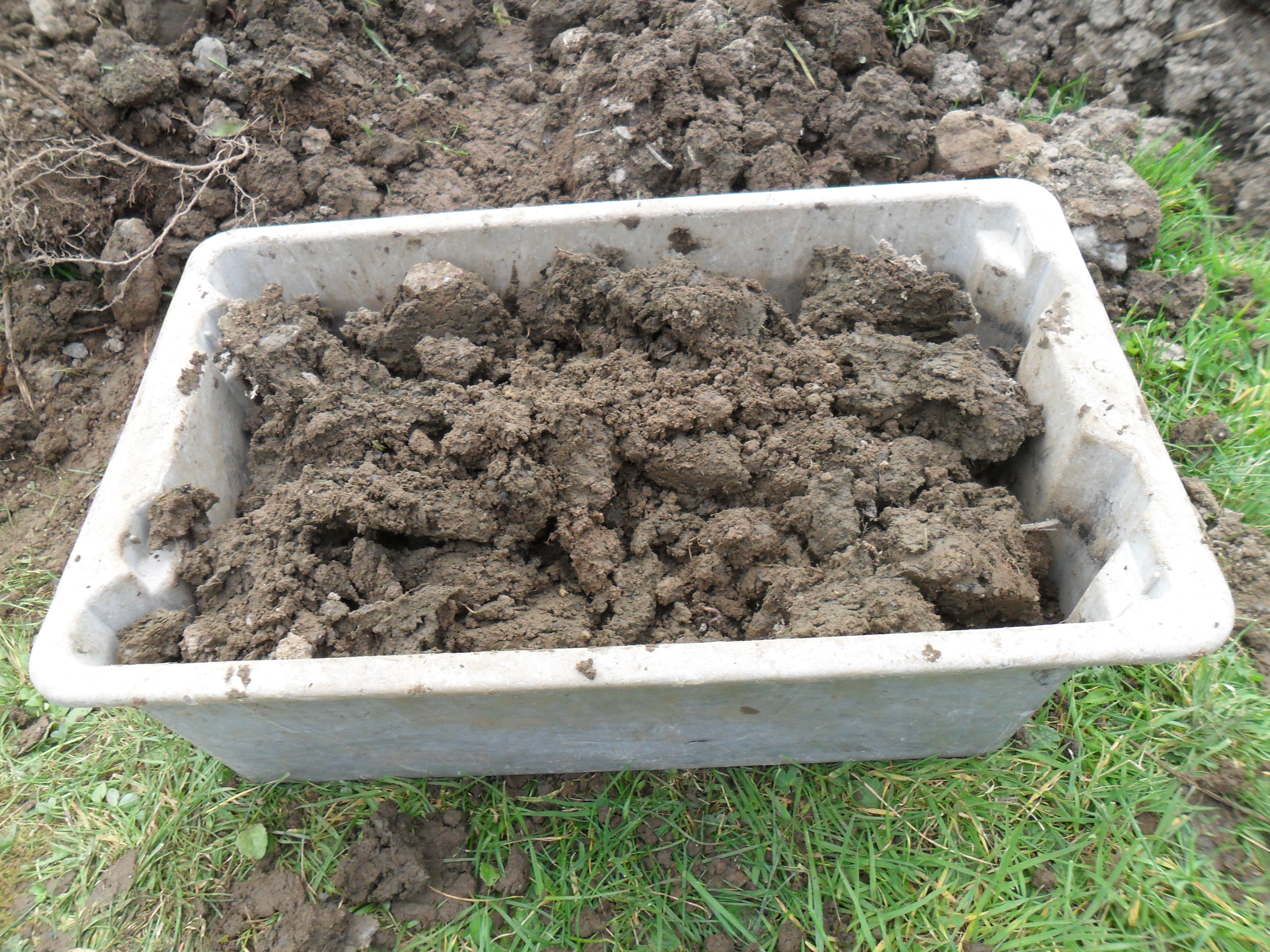
Making a flower bed, one bucket of topsoil at a time.

Ever look at a garden project and just think “no way”?  Or maybe the project is there, patiently waiting for your attention, yet the thought of tackling it is a bit overwhelming?  Well I’ve had those thoughts!  Lots of them.  That might be because I have grande plans for our garden!  But nothing is going to happen if I don’t get started on it.  It all happens with small steps.

Dreams are a good start. I have dreams about what I would love to see for my garden some time in the future. I also collect pictures in gardening books and magazines.  I recently (as in last night) came across a picture that I saved from years ago.  My 12 year old daughter actually laughed at me, since the garden is seriously amazing,  and she thinks I might be a tiny bit crazy!  There are three pages of pictures of this garden.  It really  is beautiful!   I love it as much today as the day I first saw it.  The design fits nicely with  what I have been planning for our garden.  Now to just get my husband on board!  One tree, shrub, and flower at a time!

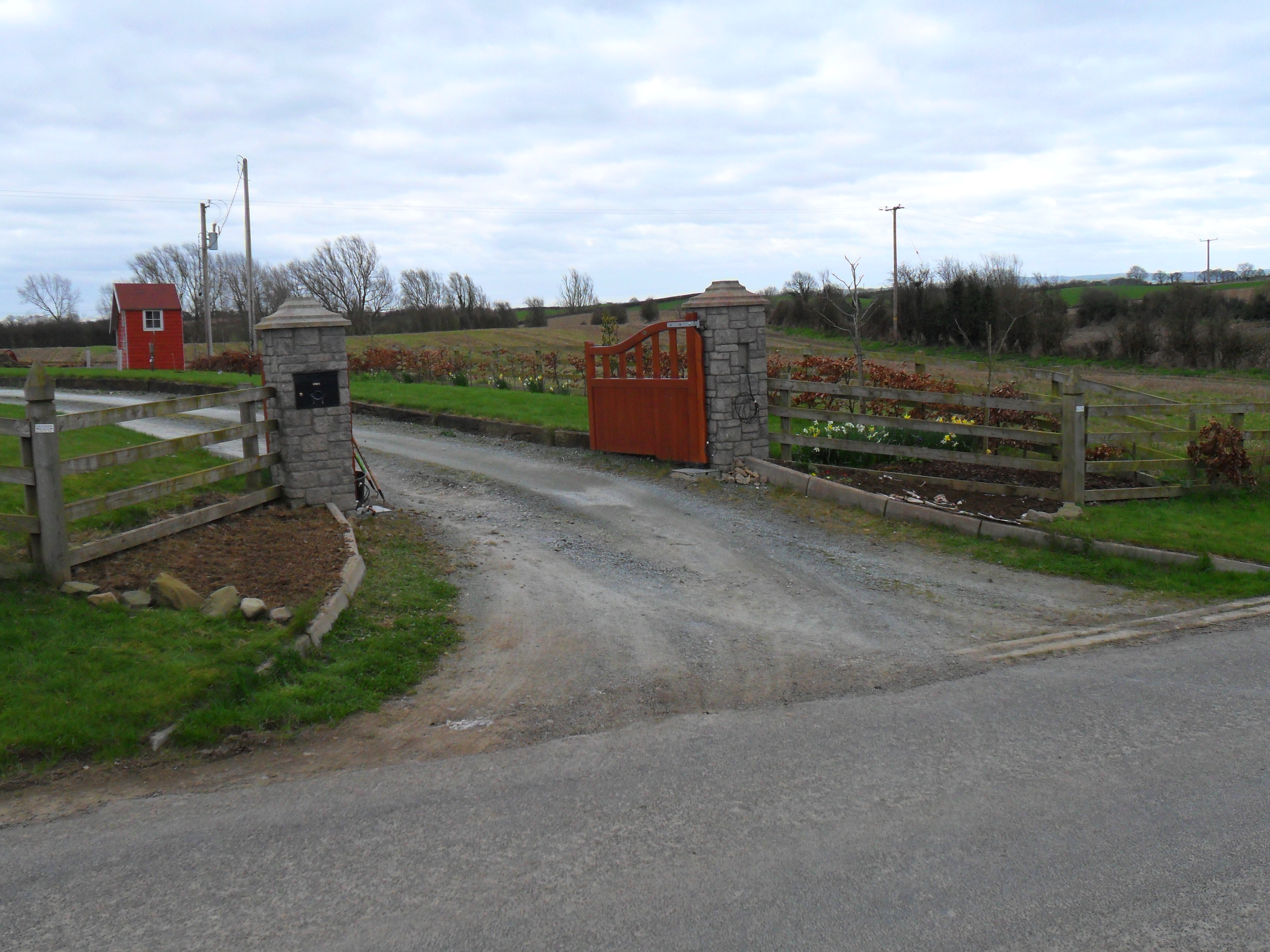
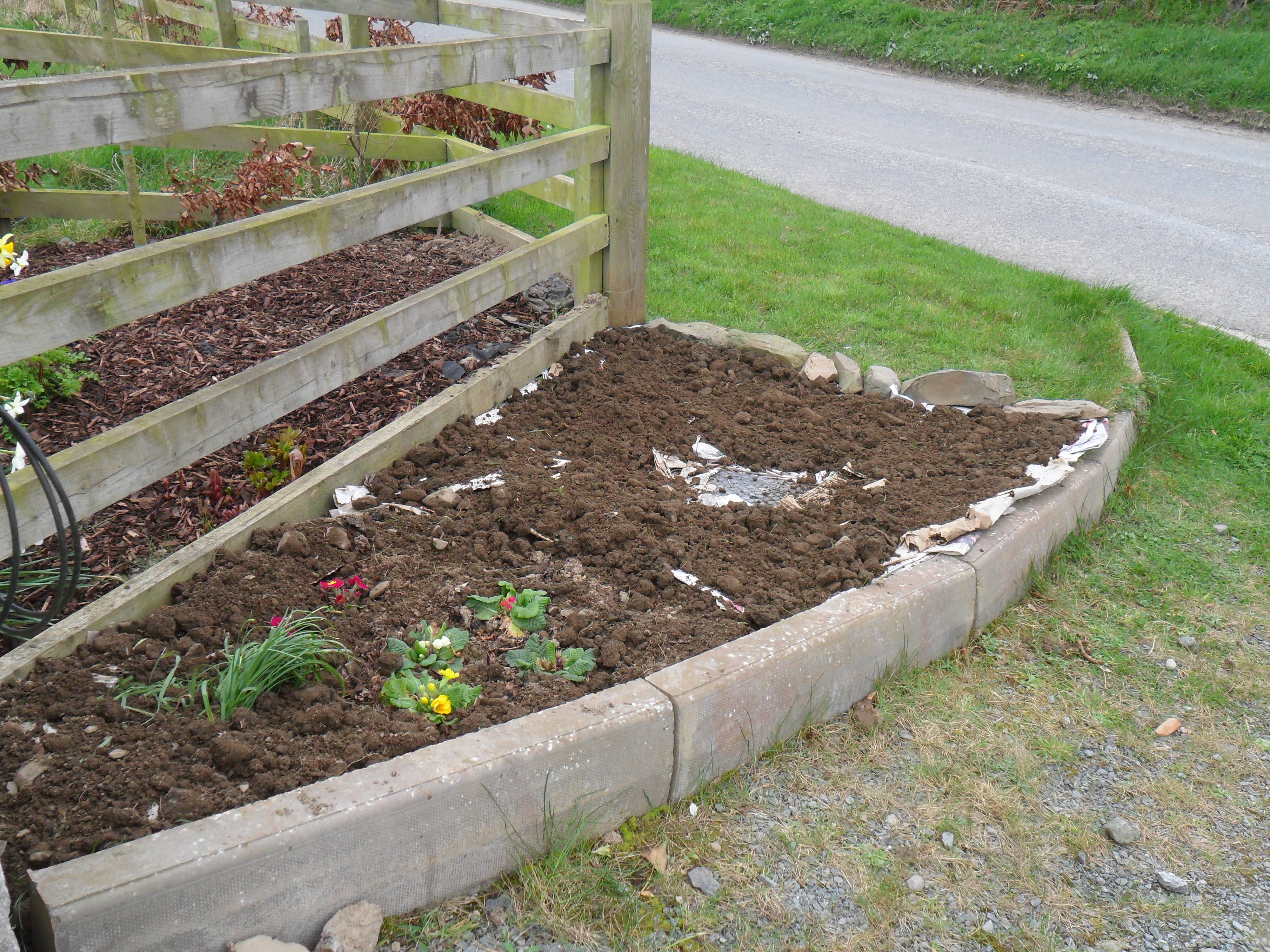
The pictures below are before and after views from the front of the house when we first moved in (you can see some of our moving boxes!)  and the two work-in-progress gardens that are, well,  still a work-in-progress.   What you can see is (a big mess!) weathered cardboard, seaweed, and turned over grass from where the boxwood was planted.   In September we placed the cardboard and newspapers where we wanted to kill the grass.   Yesterday  I laid down more thick layers of newspapers  before putting down the soil, just as a precaution, to keep grass away.   That garden already has a small Japanese Maple tree and a hydrangea (I don’t know the variety, unfortunately) and some Allium which I planted in October, so I haven’t seen them in their glory yet.  You can also see some tulips coming in to bloom.   This week I was also working at the front gates.  We planted a couple of Hostas there last year, but this year I’m hoping to give them some attention, and hopefully some more plants to keep them company.

I hope if you have a big garden project which you’ve been avoiding, that you’ll be motivated to dig in and get started with it!

Happy digging,

Dana

Here is the bucket I used to move the topsoil Patrick delivered to us.  I should have taken a picture of our desperate wheelbarrow – we are in need of a new one!  But for me, it was easier to work in small batches (both mentally, and physically!).

This is the front of the house garden in progress.  The potted boxwood plant was just placed there to keep newspapers down.  It is patiently waiting to be planted.  Not all of the grass was covered with cardboard originally, which you can see peeping out.  I managed to cover about 1/3 of the garden with topsoil.

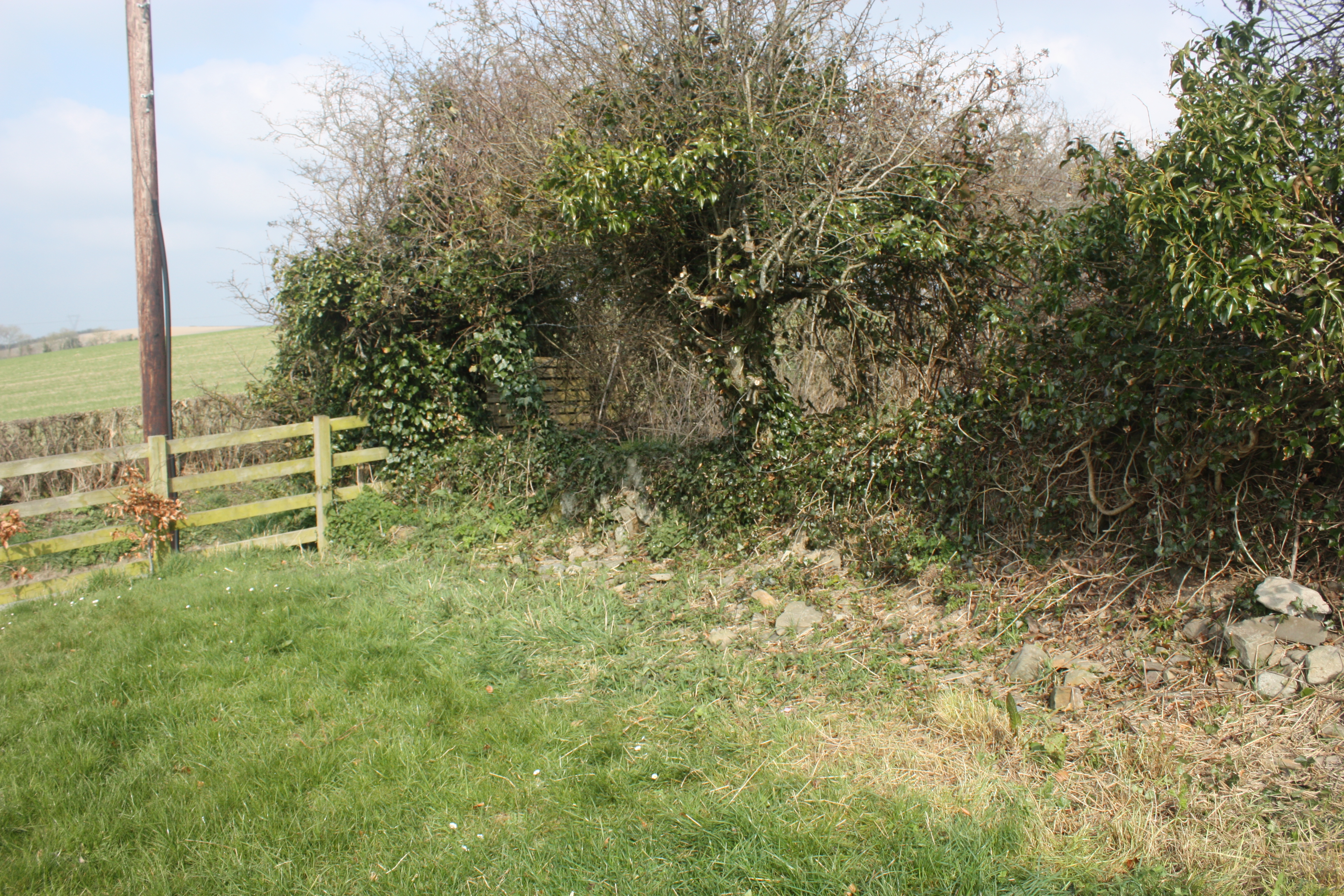
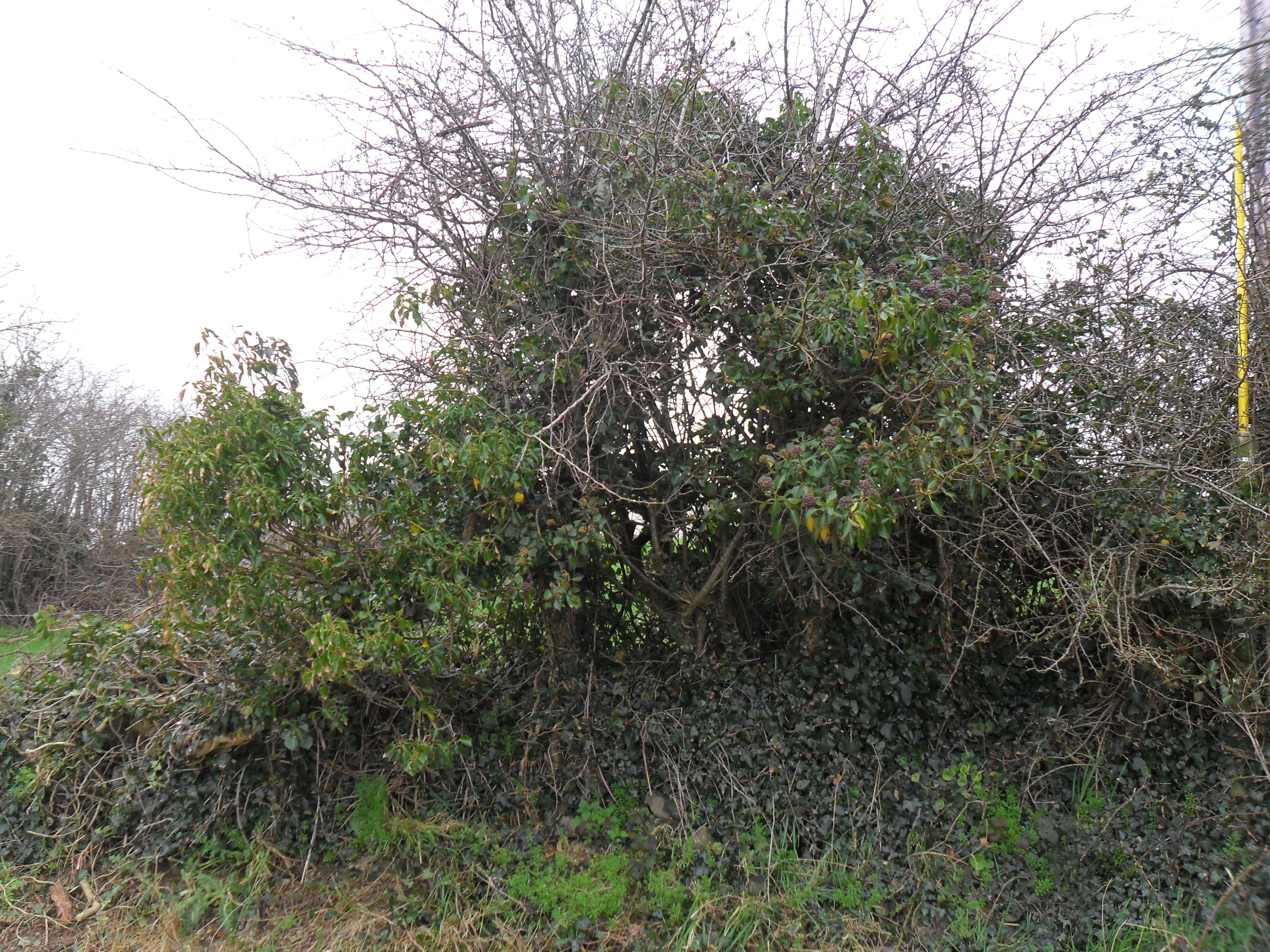
Pretty hydrangea.  The picture above shows more of the covered rock wall, through the Hawthorn, ivy & brambles!

Two Hostas live on the left. They aren’t visible just yet.

The water main cover is in this garden.

Ivy, ivy everywhere! Finding a lovely little rock “ditch wall”… under the ivy.

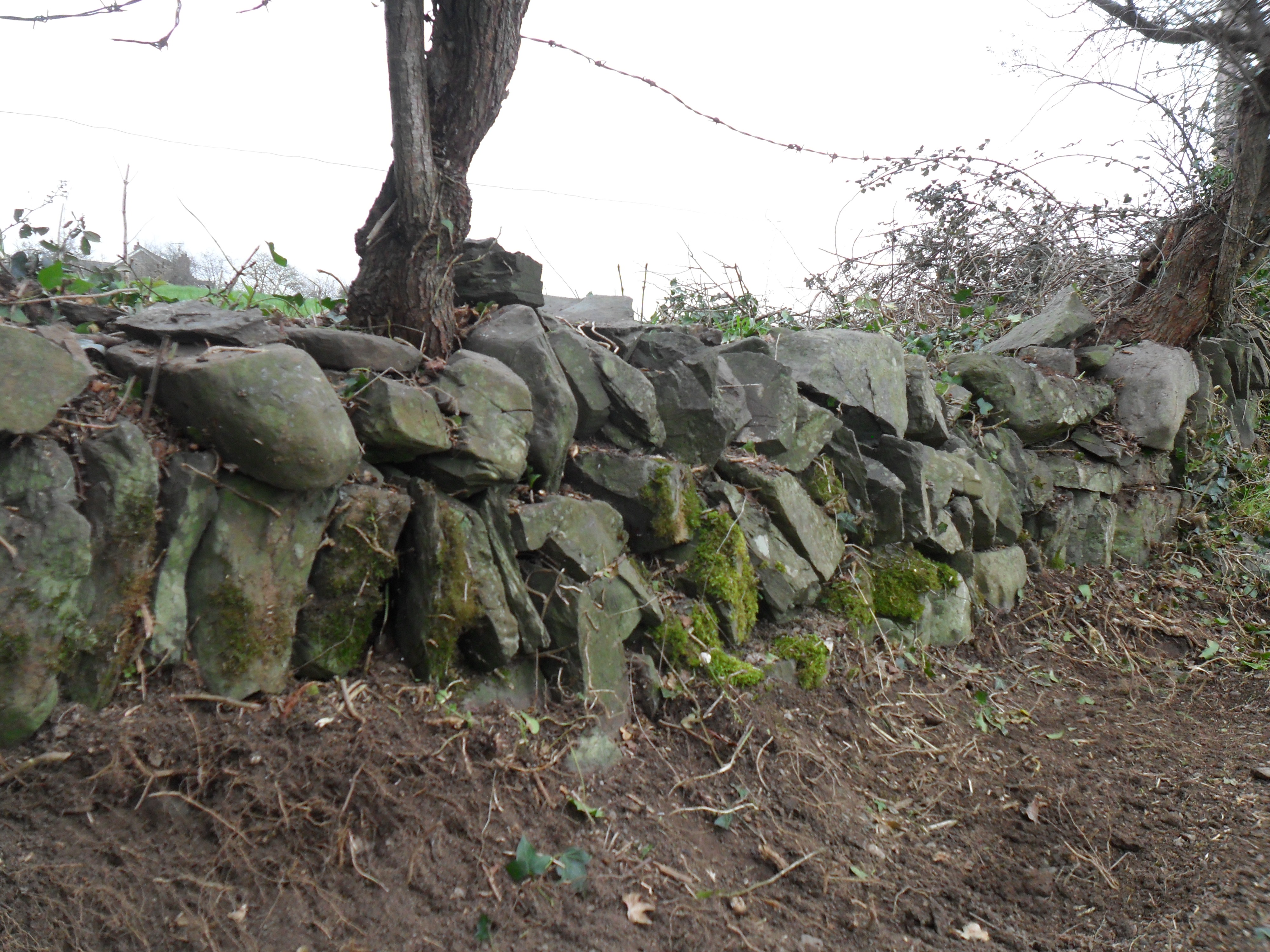
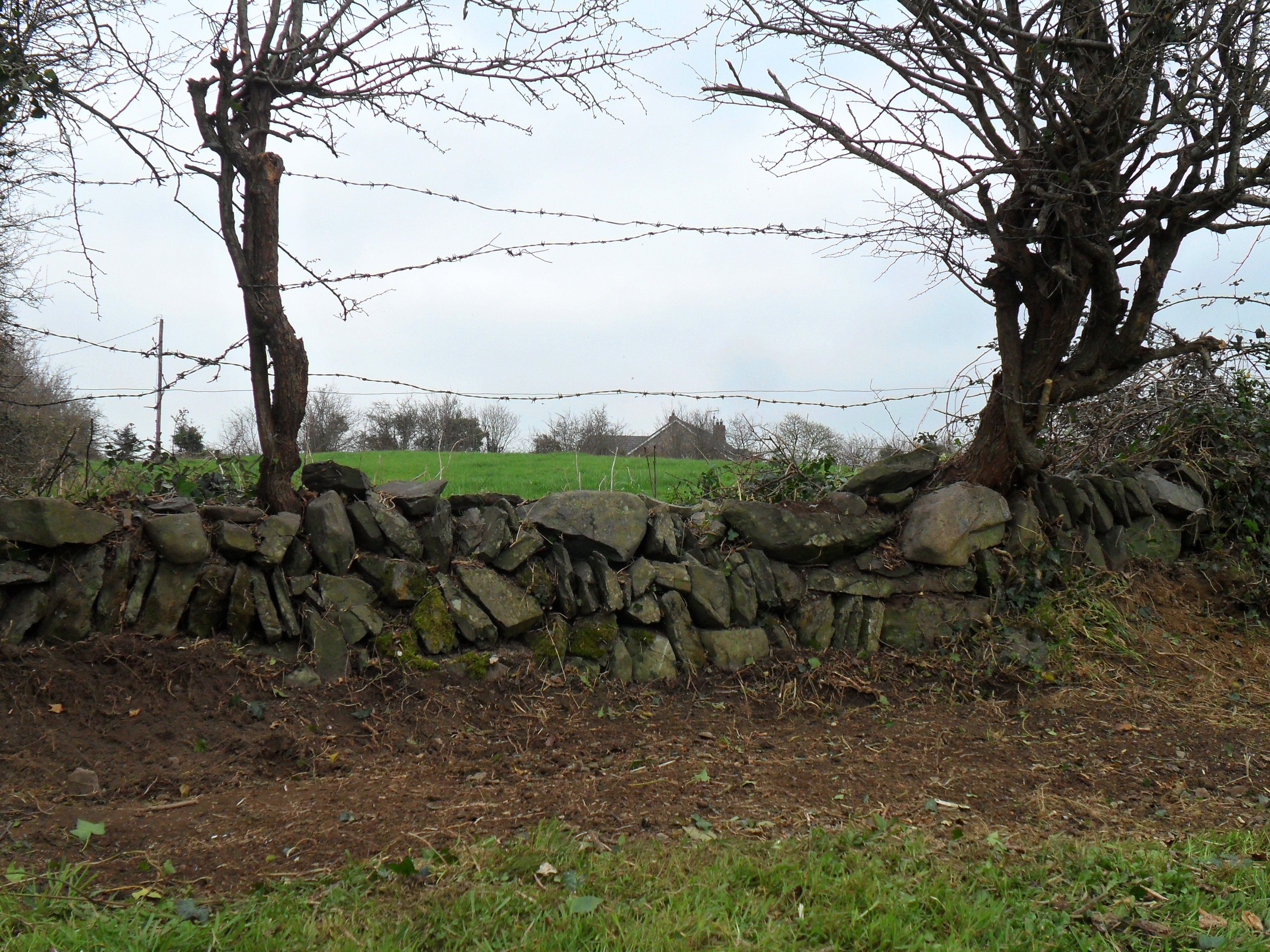
I love rock walls.   It was great to discover that the house we bought had a small rock wall along one property line.  My neighbor James, that wonderful guy who gave me fantastic manure,  told me it is called a ditch wall.  Not a very nice name, really.  To be honest, it didn’t look like much either.

The ditch wall is part of our traditional Hawthorn tree hedging, which is very common in Ireland.  The trees are planted all along the wall.  The row of Hawthorn trees are planted close together  which forms a thick barrier that prevents animals from getting through. I’d say the many thorny branches help keep them away, as well.  I live in an area that is still mainly fields. It is not uncommon for us to see cows on the other side of these trees.   The Hawthorn is covered in 5 petaled white flowers from May through June. In Ireland there is a strong connection with these traditional Hawthorns and fairies.   I read that it was once believed that putting a cutting of Hawthorn in your milking parlor  would give you more milk and it would be creamier.  Legend also claims that bad fortune from the fairies would befall anyone who took down or damaged a Hawthorn tree.  There are some very strong beliefs in fairies!

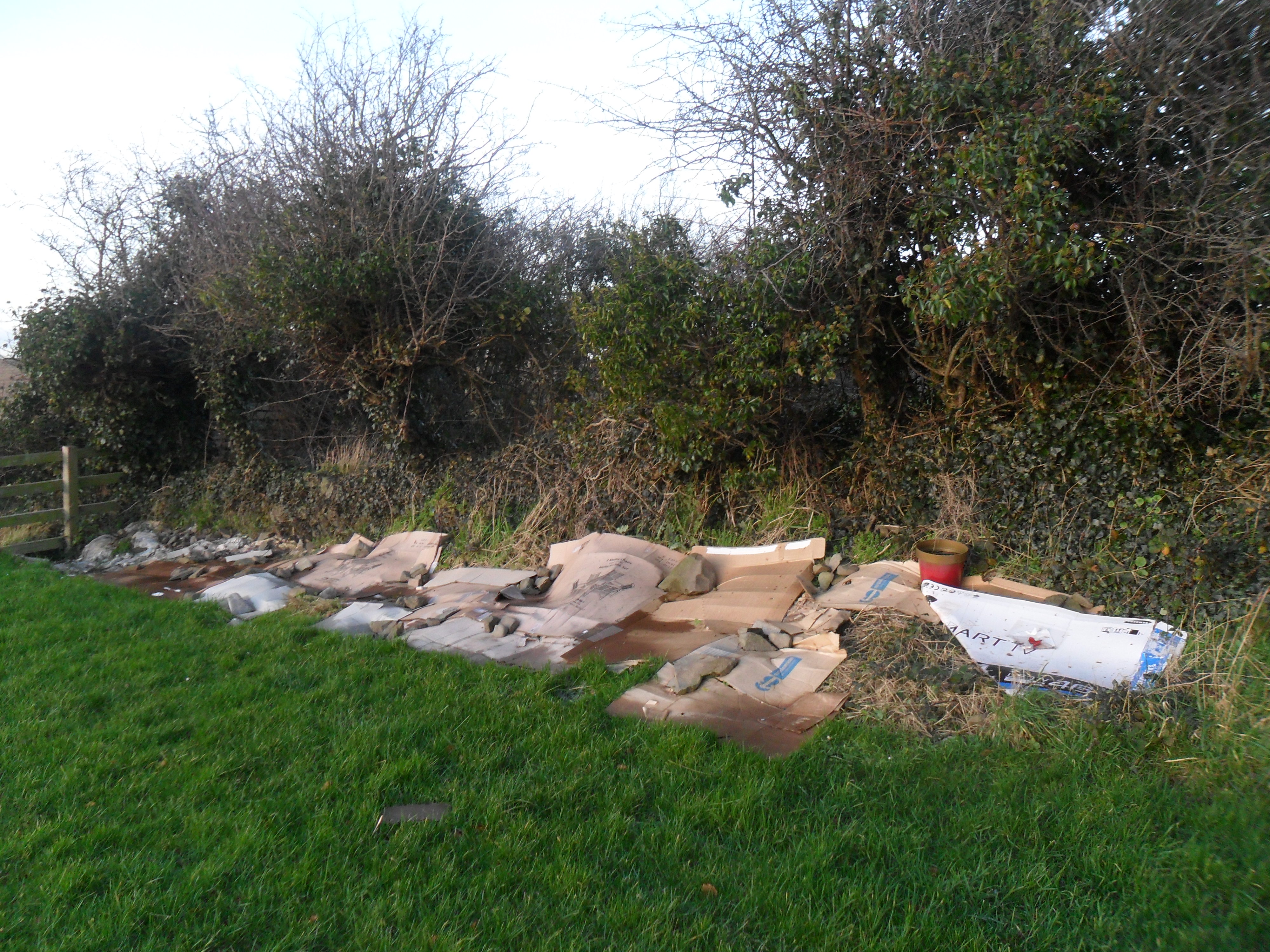
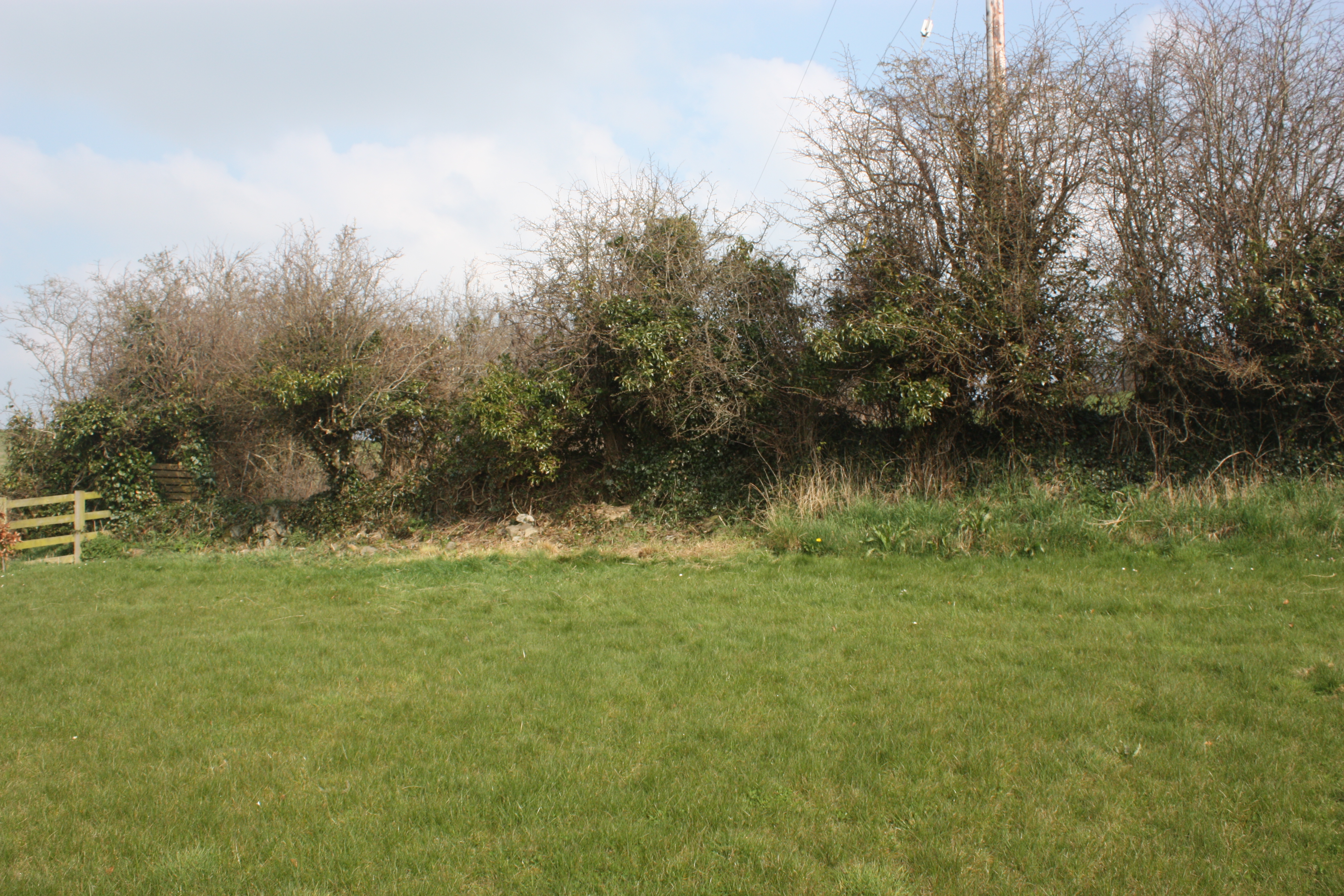
The first year here, I spent a lot of time cutting away brambles.  Piles and piles of brambles.  We could, sort of, make out the wall after I cleared the brambles. Our row of Hawthorns, and the ditch wall, are completely covered in ivy and whatever brambles that weren’t cut down last year.  This year, I’ve taken on the challenge of attacking the ivy.  This is quite an undertaking! Ivy can take on a life of it’s own and completely attack trees and the surrounding area.  I’m taking it one step at a time.  I have the eye on the prize: I want to grow wild flowers along the stone wall; the small, stone, ditch wall, that I think is just beautiful!

Here are some before and after pictures so far (actually, the order of photos is more like after and then before!).

Happy home-made gardening, one step at a time!

Dana

Here are pictures of what I’ve done so far and what I still have to do!

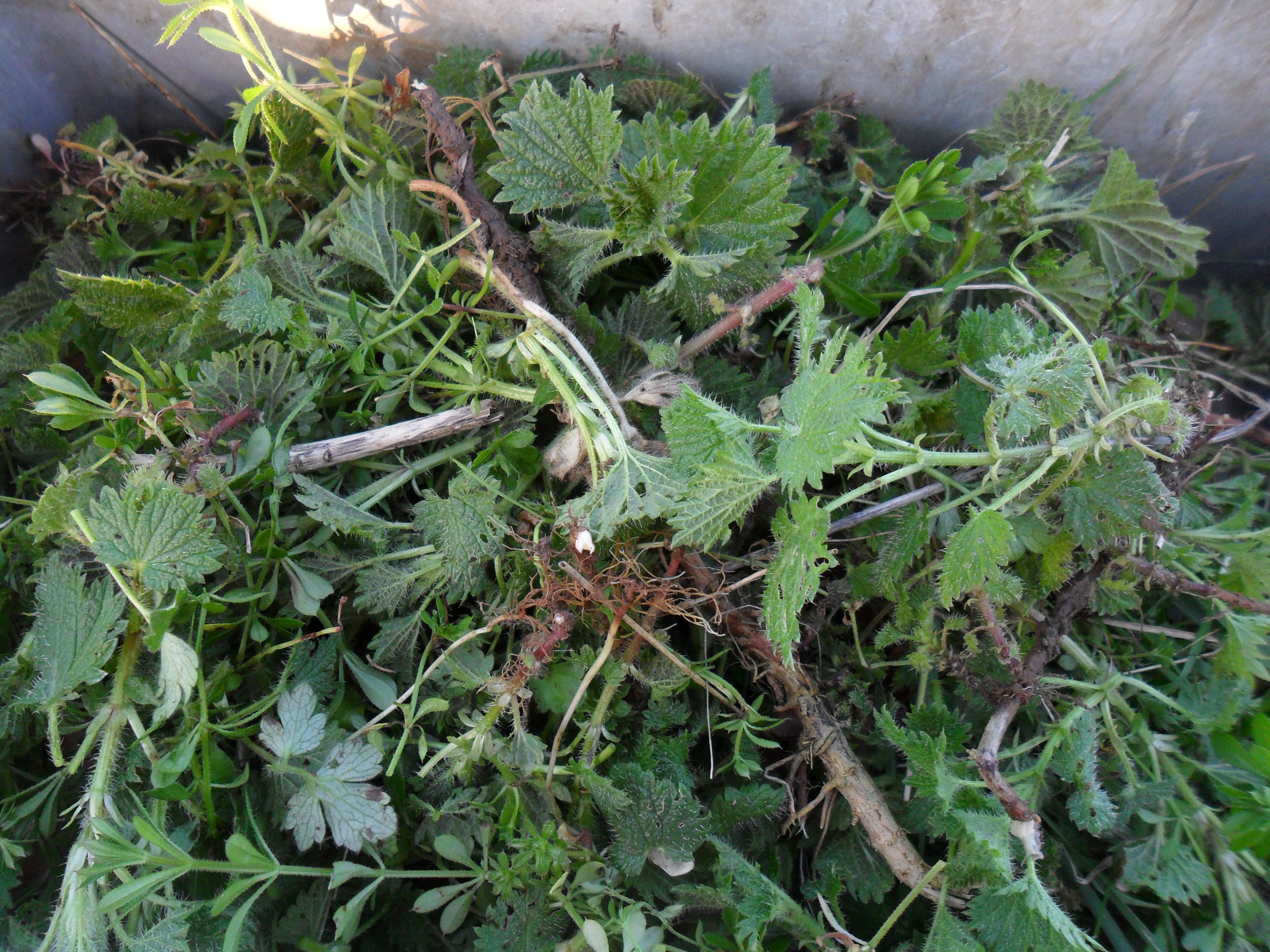
Using Nettles for liquid feed (fertilizer).

I have been doing quite a bit of weeding the past week. I have to say that I am very happy that I’ve managed to avoid the many nettles along my fence-line where I’ve been working.  I’m happy because they call it a “sting” when you touch them – but it pretty much hurts the entire day afterwards! I was on high alert this year to avoid being stung, after being tortured last year.  Now that I’ve avoided them, and weeded all around them, it’s time to go and pull those nettles out, carefully, to use them.

Nettles are a pain to touch, but they are also wonderful to have as an ingredient for making homemade liquid feed for your garden.  Frugal gardening at it’s best!  Free liquid fertilizer! It’s easy enough to do, too.  Fill a barrel/container half way with nettles, cover with water, and leave for a couple of weeks to ferment.  Dilute to “weak tea consistency”  (maybe they use that description because they drink so much tea in Ireland?).  This should be about one part nettle to ten parts water.  Spray on leaves of plants to use as a natural pesticide.  You should spray on dull, non-sunny days so as not to scorch plants.  Use as a plant feed every couple of weeks.

I’m going to reference Pamela Whitaker from Groundswell again.  I spoke of her in a previous post. She gives wonderful Organic Gardening workshops in Carlingford, County Louth,  to kids as well as adults and is overflowing with useful information.  From her workshop I learned that Nettles supply nitrogen, magnesium, sulphur and iron.  Sounds good!

I did learn a few things through trying this last year.  Be aware that this liquid feed gets stinky! Make sure you have it off to the side.  I had to move mine mid-summer last year to keep the smell at bay!  I’ve read of putting the nettles in a sack of some sort to avoid the mess it makes in the water, but this doesn’t bother me and I want to keep it as simple as possible.

I enjoy my homemade garden. I hope you do, too!
Dana

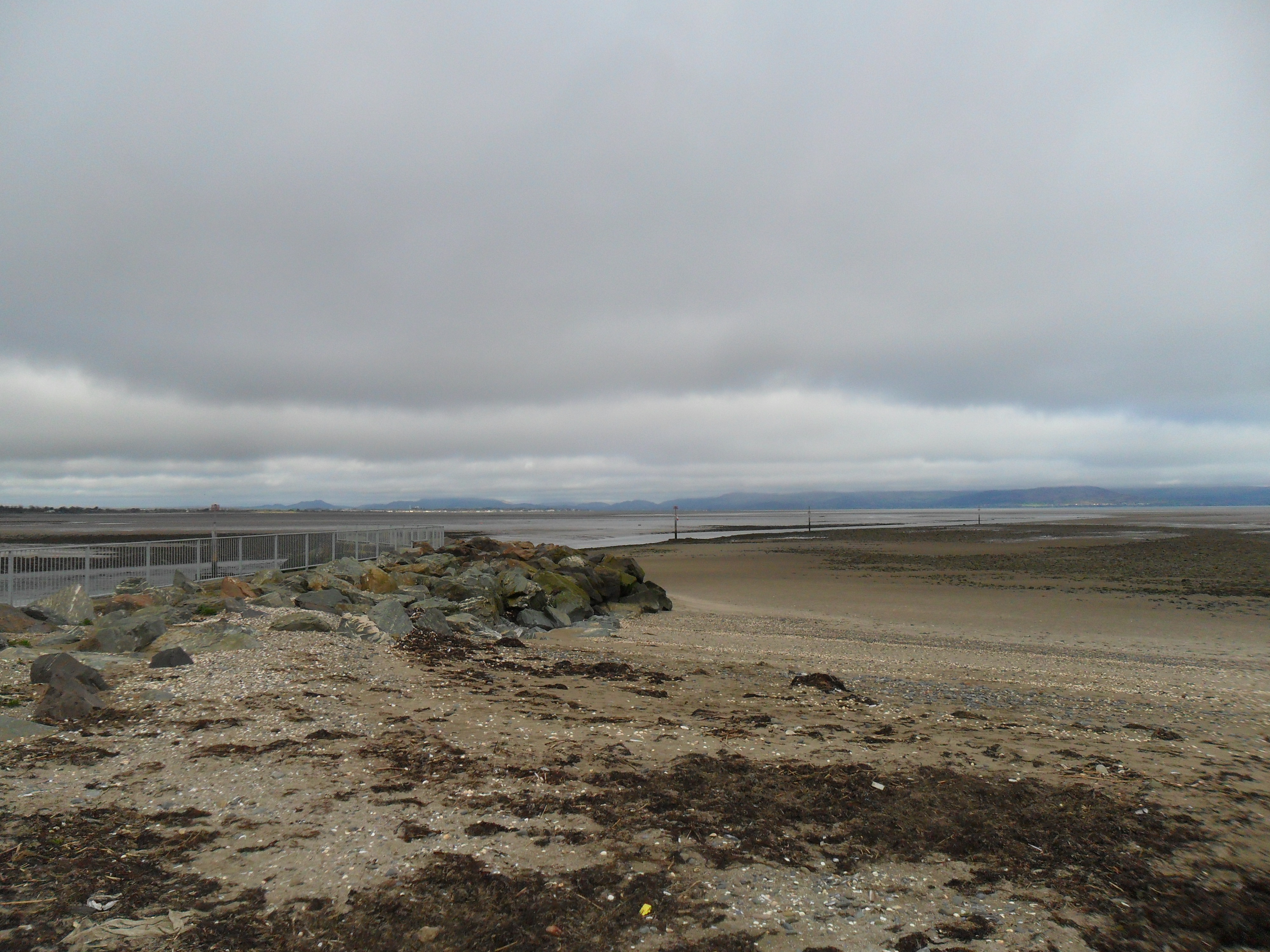
Getting seaweed for the garden, and enjoying the views.

I love that we are just a 15 minute drive to the Irish sea.  It’s great to go and have the kids run on the beach. I tend to look for pretty rocks, while they usually find some shells to bring home.  They love writing in the sand, too.  It’s just fun.  It’s always a treat when we make the time to do this.  Now that I’m obsessed with my garden, there is a new “fun” thing to do at the beach: collect seaweed!

Over the past couple of  years, I’ve attended a few Organic Gardening courses through Groundswell, in Carlingford, County Louth. Pamela Whitaker ran the courses.  She is just a wonderful woman who is overflowing with information on Organic Gardening!  She first introduced me to using seaweed in the garden.  It makes sense to use what you have around you (as long as it’s a clean beach!).  Seaweed can be used as a mulch, or can be added to your compost.  It is a plant growth stimulant, and contains a range of trace nutrients such as plant hormones and carbohydrates.  You should only used washed up seaweed that is no longer attached to rocks.  Also, depending on where you live and how much rain you get, it is recommended to rinse the seaweed before using.

I took these pictures yesterday.  I was lucky that the tide was out – way out! I was able to gather up a few bags of seaweed in no time.   I’ll be adding some to my compost pile, and the rest will be used as mulch.

The bottom picture shows some yellow gorse growing in the hill above the sea. It gives great color to sweeping landscapes!   I found this information about gorse:  U. europaeus is a very spiny and bushy shrub with blue-green branchlets and leaves reduced to small scales or thorns. It can grow to more than two metres tall. It is found throughout Ireland, especially in the east on lime-free soils in rough pastures, heaths and rocky places, but not in woodlands.

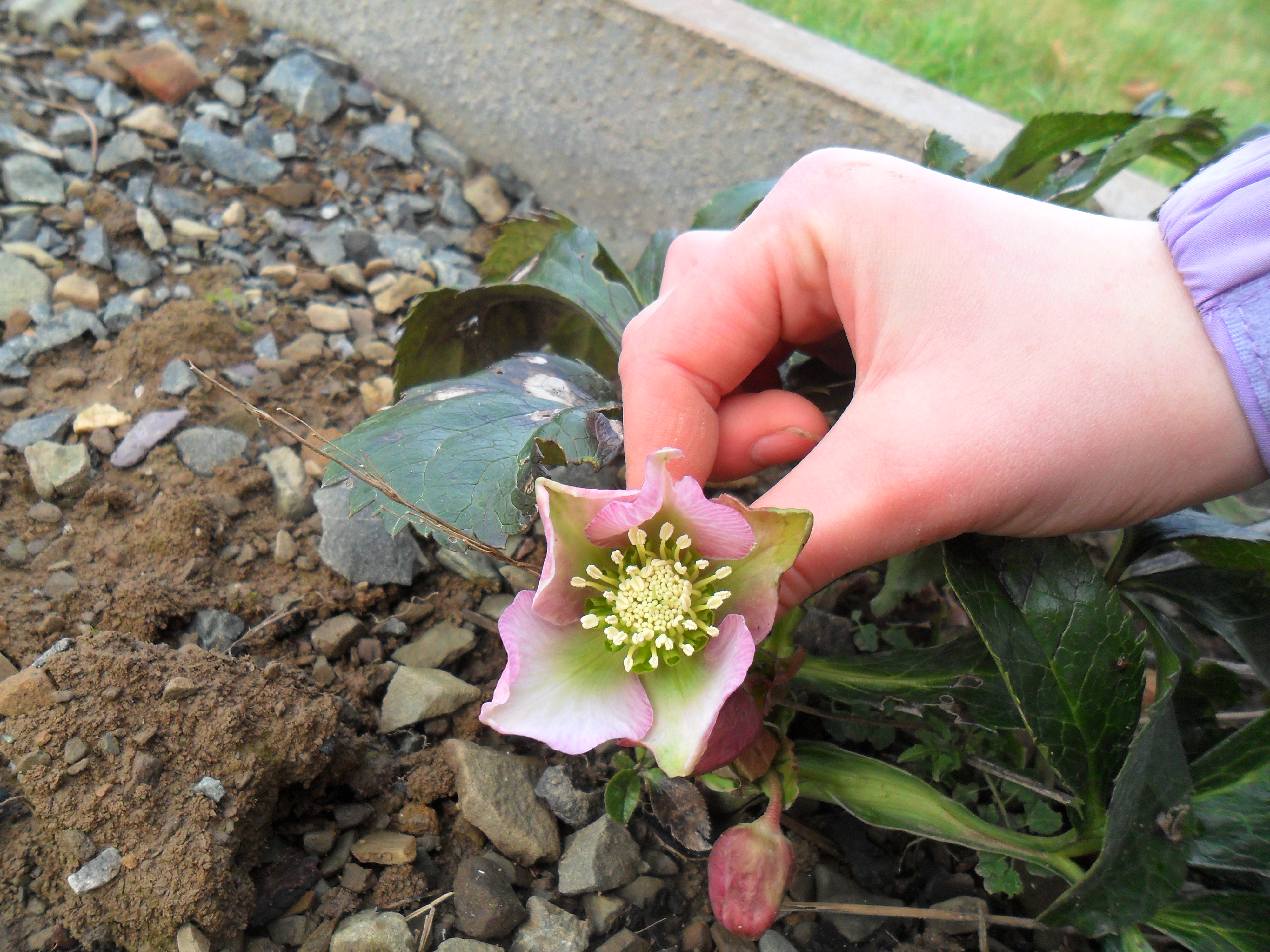
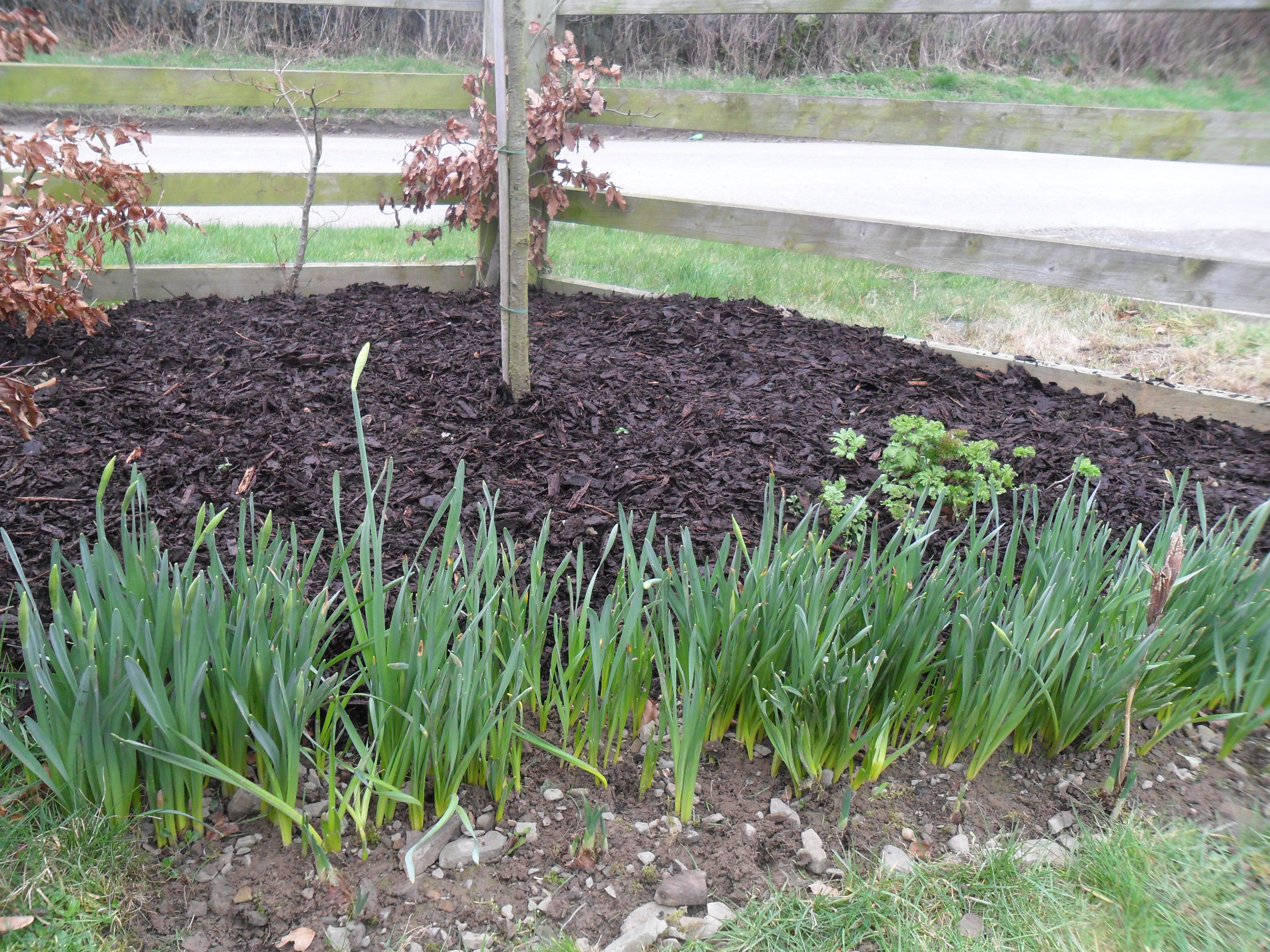
Hellebores in the garden, and planters of daffodils showing signs of spring.

I am  lucky enough to have a very good friend who loves gardening as much as, if not more than me.  I love visiting her and seeing what her garden is doing throughout the year.  Better still, she shared a bunch of plants with me last year.  I think she felt badly for my naked garden!  She gave me the hellebore in the picture above. It bloomed in early February, when everything else was looking very much dead, or at least in sleep/winter/mode.  I’m taking notes from her, to plan my garden so it will have something colorful throughout the entire year; either through flowers, or bushes, or trees.

From my kitchen, I can see these planters of daffodils.  Just a few containers with greens coming up is all it takes to brighten my day!

This past weekend I worked on clearing out this little garden (weeds grow so easily, and really make themselves at home just about anywhere!).  We put down some mulch to hopefully keep the weeds in check.  In front I have a row of daffodils almost ready to bloom.  In front of the daffodils I have Dutch Iris, given to me by another garden loving friend!  These will bloom after the daffodils have died.   The daffodil greens have to be left until they are completely and totally dead (that’s right, really really dead!), as this helps with the bulb life in subsequent years.  So it is nice to have something to (hopefully) detract from the dying greens.

Valentine’s Day – love your family and your compost!


Valentine’s Day can be a fun day to do something special with/for the kids.  I like to make cookies, and sent some in to school this morning with my girls.  We even have some left over for us to have at home which is a nice bonus.  Other than that, it’s not a big deal in our house.  I was never one to give my kids candy for Valentine’s Day.  They just don’t need it.  I usually had small gifts for them as a surprise (to make up for the no candy!) and I always gave them a  handmade card with words of what makes them special to me.  It’s too soon to tell if they’ll appreciate that, or only remember the fact they didn’t get chocolate!

So moving on from cookies … I’m going to jump to compost!  I love that we are composting.  It’s really not hard, and the result is fantastic feed for your soil!  I have a small container in the kitchen that I fill with raw vegetable scraps.  My 7 year old’s job is to empty that into a container we have right outside our back door.  When that fills it goes into the compost unit.  We’re pretty frugal when we can be.  You can buy fancy plastic containers for composting, or you can make a compost “unit”.   We found a helpful video on YouTube, and used wooden pallets to make a box like structure. When I say “we” I really mean my husband. I have to sing praises of him because he has done a lot of gardening work for me!  He built our compost unit.  We’ve modified the original one by taking off the bottom pallet.  This helps the flow of worms from the ground up.  I’ve also roughly started a second pile – to let the original one breakdown (I call it cooking).  With the new unit,  we are going to dig into the ground a foot deep and add the compost to that.  Again, this is to facilitate the movement of worms, and speed the breaking down process.

What do I compost?  The toilet rolls, our cardboard egg cartons, egg shells, tea bags, coffee grounds, all raw vegetables, grass cuttings, leaves.  I don’t compost cooked food, or meat or fish, or cat litter (gross!).  It’s important to bread down what you are composting.  The egg shells need to be crushed completely, egg cartons & toilet rolls need to be ripped into tiny pieces.  Vegetables need to be cut up.

Items can be categorized by being “green” “intermediate” or “brown”.  Here’s some examples:

GREENS – quick to rot

  • grass cuttings
  • poultry manure (without bedding)
  • young weeds & plants, nettles any age

INTERMEDIATE

  • fruit & vegetable scraps
  • rhubarb leaves (poisonous)
  • teabags, tea-leaves, coffee grounds
  • remains of veg plants
  • straw animal manures
  • cut flowers (cut smaller)
  • soft hedge clippings
  • bedding from herbivorous pets – rabbits, hamsters, etc.
  • perennial weeds (large quantities should be in their own pile)

BROWNS – slow to rot

  • old straw
  • tough plant and veg stems (broccoli)
  • old bedding plants
  • Autumn leaves
  • Woody prunings, evergreen hedge clippings (large quantities should be in their own pile)
  • cardboard tubes, egg cartons
  • crumpled paper and newspaper

Technically, the layering of your compost should be brown material, green material, light sprinkling of lime, then repeat.  There should be approximately 15 cm depth per green/brown layer.

Having said that… I heap mine on!  We keep an eye on whether it gets slimy.  That means it needs more browns.  We occasionally put lime on.  My husband rotates it with a pitchfork (he calls it a grape).  We keep it covered with plastic (and then wood on top of that to keep it from blowing away).    You just know by looking when it’s perfect for spreading – should be a nice dark brown soil/near soil texture.   Oh, and there should be LOTS of worms!

Compost – it’s an easy way to recycle what you have to make something great!  I hope you’ll try it, too.

Discovering what I was supposed to do … and Lavender Sachets, too.

It’s one of those things that I rarely do; sit down and concentrate on one thing.  I have three kids, a husband, and a cat.   I am being pulled in different directions 24/7.  So it was a nice change to have a quiet evening to myself where I could read through my gardening journal uninterrupted.  Yep, I was able to read about all of the great things I could have done in my garden this past fall… Ah well, this is a learning process.

I might not have been in the garden, but I was using plant material from my garden.  I was lucky enough to have English Lavender (Hidcote) already flourishing in our yard when we moved here.  Six plants of it. Six huge, gorgeous deep purple, super fragrant plants.  Prompted by my one sister-in-law, I decided to try drying them.  I cut as much as I could in July, and hung them upside down in dark places where ever I could manage in my house.  I liked having it in my closet as it smelled great!  By winter, the plants were plenty dry and ready to have the lavender pulled off of the stems.  Tedious, and way too boring an activity for the kids, it was just me left to do this task.  Boy did I smell fragrant doing this!  I filled a large air-tight container (a few times).  What to do with an abundance of lavender?  Make Sachets!  For all of the aunties, sisters-in-law, teachers, and to my neighbor who gave me the horse manure.  My husband has his sachet hanging in his car. My daughter has hers next to her pillow. I recently gave one to new parents as an accessory for their diaper (nappy) bag.  Everyone gets Lavender Sachets! 🙂
Pruning the apple & pear trees.

I took an organic gardening course before we bought our house.  I had big plans even back then!  I put all of my notes and the handouts  in a folder with the hopes that one day I’d get to use them.   I guess the expression “good things come to those who wait” keeps me going!  We were given two apple trees as a house warming present (what an awesome gift!) and we added a pear tree ourselves.  So it was time to do the year 2 pruning according to my notes.  Per my class:

From November through February Select 4 primary branches with good spacing and balance.  Cut back by half.  Remove any unwanted branches.  At end of season (Oct), strong secondary branches will have formed.

There, that’s done!  You can see the nice apples we had last season!